Ruby Tuesday Marketing Mix

Ready-Made Marketing Analysis, Ready to Use
Ruby Tuesday's marketing mix is a fascinating study in balancing casual dining appeal with evolving consumer tastes. From their diverse menu offerings and value-driven pricing to their widespread accessibility and targeted promotions, each element plays a crucial role in their brand's performance.
Go beyond the basics—get access to an in-depth, ready-made Marketing Mix Analysis covering Ruby Tuesday's Product, Price, Place, and Promotion strategies. Ideal for business professionals, students, and consultants looking for strategic insights into the casual dining sector.
Product

Diverse American Cuisine
Ruby Tuesday's product strategy centers on a diverse American cuisine, featuring staples like burgers, steaks, salads, and pasta. This broad menu caters to a wide range of customer preferences within a casual dining environment.
In January 2025, Ruby Tuesday refreshed its menu, notably introducing enhanced smashed burgers. This update also included new entrees and desserts, demonstrating a commitment to keeping the dining experience appealing and current for its patrons.
Signature Garden Bar
The Signature Garden Bar is a cornerstone of Ruby Tuesday's product strategy, offering a highly customizable salad experience. This allows guests to create their own meals from a diverse selection of fresh ingredients, appealing to a broad customer base.
This customizable offering functions as both a complete meal option and an enhancement to other dishes, attracting health-conscious individuals and those preferring lighter fare. Its flexibility ensures broad appeal across different dining preferences.
The Garden Bar continues to be a significant draw for Ruby Tuesday's core demographic, which includes women and families. Its consistent presence reinforces the brand's commitment to fresh, customizable dining experiences.

Quality and Freshness Focus
Ruby Tuesday places a strong emphasis on uncompromising freshness and quality throughout its entire menu. This dedication is evident in everything from their appetizers to their main courses, ensuring a consistently satisfying dining experience for every guest.
The restaurant is known for its perfectly seasoned steaks, crave-worthy burgers, and a diverse selection of seafood entrees, all prepared with a commitment to high-quality ingredients. This focus on premium sourcing is key to delivering delicious and memorable meals.
For instance, in 2024, Ruby Tuesday continued to highlight its sourcing of fresh, never-frozen beef for its burgers, a key differentiator in the casual dining market. This commitment to quality ingredients is a cornerstone of their brand promise, aiming to build customer loyalty through consistently good food.

Takeout and Delivery Options
Ruby Tuesday has significantly expanded its product offering beyond the traditional dine-in experience by embracing takeout and delivery options. This strategic move caters to the growing consumer demand for convenience and at-home dining, a trend that accelerated notably in recent years. The company's official website serves as a central hub for customers to easily place orders for pickup or delivery across the nation.
This adaptation reflects a broader industry shift. In 2023, the US off-premises dining market, which includes takeout and delivery, continued its strong growth trajectory, accounting for a substantial portion of restaurant sales. For instance, data from Datassentials indicated that off-premises dining represented over 60% of total restaurant occasions by the end of 2023.
- Convenient Access: Online ordering via the Ruby Tuesday website allows customers to enjoy meals at home.
- Nationwide Reach: Delivery and pickup services are available across the United States.
- Industry Trend Alignment: This strategy directly addresses the increasing consumer preference for off-premises dining solutions.
- Digital Engagement: The website facilitates a seamless ordering process, enhancing customer accessibility.
Seasonal and Special Menu Items
Ruby Tuesday leverages seasonal and special menu items to keep its offerings fresh and exciting, a key component of its product strategy. This approach directly addresses the need to cater to evolving consumer tastes and drive repeat business. For instance, promotions like 'The Great Steaktacular' introduced new cuts such as Cajun Rib Eye, while limited-time specials like 'Big BBQ Beef Ribs' and the 'Fried Pickle Smashed Burger' generated buzz and encouraged trial.
These dynamic menu additions are crucial for maintaining customer engagement and differentiating Ruby Tuesday in a competitive casual dining market. By consistently refreshing the product line with timely and appealing options, the company aims to boost same-store sales and attract new patrons. In the first quarter of fiscal year 2024, Ruby Tuesday reported a 3.5% increase in comparable restaurant sales, partly attributed to successful limited-time offers and seasonal promotions.
- Menu Innovation: Introduction of seasonal and limited-time offers like Cajun Rib Eye and Big BBQ Beef Ribs.
- Customer Engagement: Special items encourage repeat visits and create menu excitement.
- Sales Impact: These promotions contribute to positive comparable restaurant sales growth, with Q1 FY2024 showing a 3.5% increase.
Evolving Menu & Convenience Drive Sales Growth
Ruby Tuesday's product strategy emphasizes a diverse American menu, including burgers, steaks, and salads, with a strong focus on freshness and quality. The Signature Garden Bar offers a customizable salad experience, appealing to health-conscious diners and families. Recent menu updates in January 2025, featuring enhanced smashed burgers and new entrees, demonstrate a commitment to keeping offerings relevant.
The brand also prioritizes convenient access through expanded takeout and delivery options, aligning with the significant growth in the US off-premises dining market, which represented over 60% of total restaurant occasions by the end of 2023. Seasonal and limited-time offers, such as the Cajun Rib Eye and Big BBQ Beef Ribs, are crucial for customer engagement and have contributed to positive sales, with a 3.5% increase in comparable restaurant sales reported for Q1 FY2024.
| Product Element | Description | Key Features/Initiatives | Target Audience Appeal | Recent Performance/Data |
|---|---|---|---|---|
| Menu Diversity | American cuisine staples | Burgers, steaks, salads, pasta | Broad customer preferences | Menu refresh in Jan 2025 |
| Signature Garden Bar | Customizable salad bar | Fresh ingredients, build-your-own meals | Health-conscious, families | Consistent draw for core demographic |
| Quality Focus | Premium ingredients | Never-frozen beef, fresh seafood | Customers seeking quality | Highlighting fresh beef sourcing in 2024 |
| Off-Premises Dining | Takeout and delivery | Online ordering via website | Convenience-seeking consumers | Over 60% of occasions in US off-premises dining (2023) |
| Limited-Time Offers | Seasonal and special items | Cajun Rib Eye, BBQ Beef Ribs | Customer engagement, repeat visits | 3.5% comparable sales growth (Q1 FY2024) |
What is included in the product
 Detailed Word Document
This analysis provides a comprehensive breakdown of Ruby Tuesday's marketing strategies, examining its Product offerings, Pricing tactics, Place (distribution) decisions, and Promotion efforts.
It offers a deep dive into how Ruby Tuesday positions itself in the casual dining market, using real-world brand practices for a grounded understanding.

 Customizable Excel Spreadsheet
Streamlines the complex Ruby Tuesday 4Ps analysis into actionable insights, alleviating the pain of information overload for busy executives.
Provides a clear, concise overview of Ruby Tuesday's marketing strategy, simplifying the challenge of understanding their competitive positioning.
Place

Casual Dining Restaurant Locations
Ruby Tuesday's primary product is its physical casual dining restaurant locations, designed to offer a welcoming and relaxed environment for diners. These establishments are key to the brand's customer experience, providing a space for families and individuals to gather and enjoy meals.
The company strategically selects these locations to ensure accessibility for its target customer base, aiming for visibility and convenience. Despite past challenges leading to some closures, the remaining Ruby Tuesday restaurants continue to be vital community hubs for dining.
As of early 2024, Ruby Tuesday operates a significantly reduced number of locations compared to its peak, with reports indicating around 200 restaurants remaining across the United States, a stark contrast to the over 800 it once had.
Domestic and International Presence
Ruby Tuesday operates a dual model of franchised and company-owned restaurants, extending its reach both domestically and across international borders. While the company has streamlined its U.S. presence, it continues to serve customers in various markets, aiming for a uniform brand experience.
As of late 2024, Ruby Tuesday's domestic footprint has been significantly adjusted, with a focus on optimizing its market presence. Internationally, the brand maintains a presence in select regions, though specific growth or contraction figures for 2024-2025 international operations are not publicly detailed, indicating a strategic approach to global expansion.

Online Ordering and Pickup
Ruby Tuesday enhances its Place strategy by offering convenient online ordering and pickup through its digital platforms. This allows customers to easily order their favorite meals for collection directly from their neighborhood Ruby Tuesday, streamlining the dining experience and meeting the growing demand for on-the-go options.
The company's website, which lists all restaurant locations, serves as the primary portal for this service, making it simple for patrons to find a nearby spot and place their orders. This digital integration is crucial for meeting modern consumer expectations for accessibility and speed.

Third-Party Delivery Partnerships
Ruby Tuesday leverages third-party delivery platforms to extend its market presence and cater to the growing demand for at-home dining. This strategy significantly broadens customer accessibility, allowing individuals to enjoy Ruby Tuesday's offerings without visiting a physical location. The convenience factor is paramount in today's competitive restaurant industry, directly impacting sales volume and customer retention.
These partnerships are vital for maximizing convenience and sales, especially as consumer habits continue to evolve. While the specific commission rates vary by platform, their role in reaching a wider audience and driving incremental revenue is undeniable. For instance, DoorDash, a major player in the food delivery market, reported a 27% increase in gross order value in Q1 2024 compared to the previous year, highlighting the sector's growth and the potential benefits for restaurant partners.
- Expanded Reach: Access to customers who prioritize convenience and home delivery.
- Sales Potential: Drives incremental revenue by tapping into a larger market.
- Market Trend: Aligns with the increasing consumer preference for delivered meals.
- Operational Integration: Streamlines the process of offering delivery without direct fleet management.
Strategic Footprint Management
Ruby Tuesday has actively managed its physical footprint, a critical aspect of its place strategy. This has involved strategic closures of underperforming restaurants to streamline operations and concentrate resources on more viable markets. For instance, reports in early 2024 highlighted several closures, with some attributed to lease expirations and others to the need to adapt to evolving consumer preferences and competitive landscapes.
The company's approach to footprint management is dynamic, reflecting a commitment to optimizing its market presence. By shedding less profitable locations, Ruby Tuesday aims to improve overall financial health and operational efficiency. This ongoing evaluation of its store portfolio is essential for maintaining competitiveness and ensuring a robust presence in key demographic areas.
- 2024 Closures: Reports indicated a number of restaurant closures throughout 2024, impacting various states and signaling a strategic recalibration of its physical presence.
- Profitability Focus: The closures are part of a broader strategy to enhance profitability by exiting markets or individual locations that no longer align with the company's financial objectives.
- Market Adaptation: Ruby Tuesday's footprint adjustments in 2024 and early 2025 demonstrate an effort to adapt to changing market conditions and consumer behavior, ensuring its remaining locations are well-positioned for success.
Place Strategy: Optimized Footprint, Expanded Digital Access
Ruby Tuesday's "Place" strategy centers on its physical restaurant locations and how customers access them. While the company has significantly reduced its footprint, with approximately 200 locations remaining as of early 2024, it continues to optimize its presence. The brand also extends its reach through online ordering for pickup and partnerships with third-party delivery services, adapting to modern consumer convenience demands.
| Aspect | Description | Data Point/Trend |
|---|---|---|
| Physical Locations | Company-owned and franchised restaurants | Approximately 200 locations as of early 2024; down from over 800 peak. |
| Digital Access | Online ordering for pickup | Available via the company website. |
| Delivery Services | Partnerships with third-party platforms | Expands market reach and caters to at-home dining trends. |
| Footprint Management | Strategic closures and optimization | Ongoing process in 2024 to enhance profitability and market presence. |
Full Version Awaits
Ruby Tuesday 4P's Marketing Mix Analysis
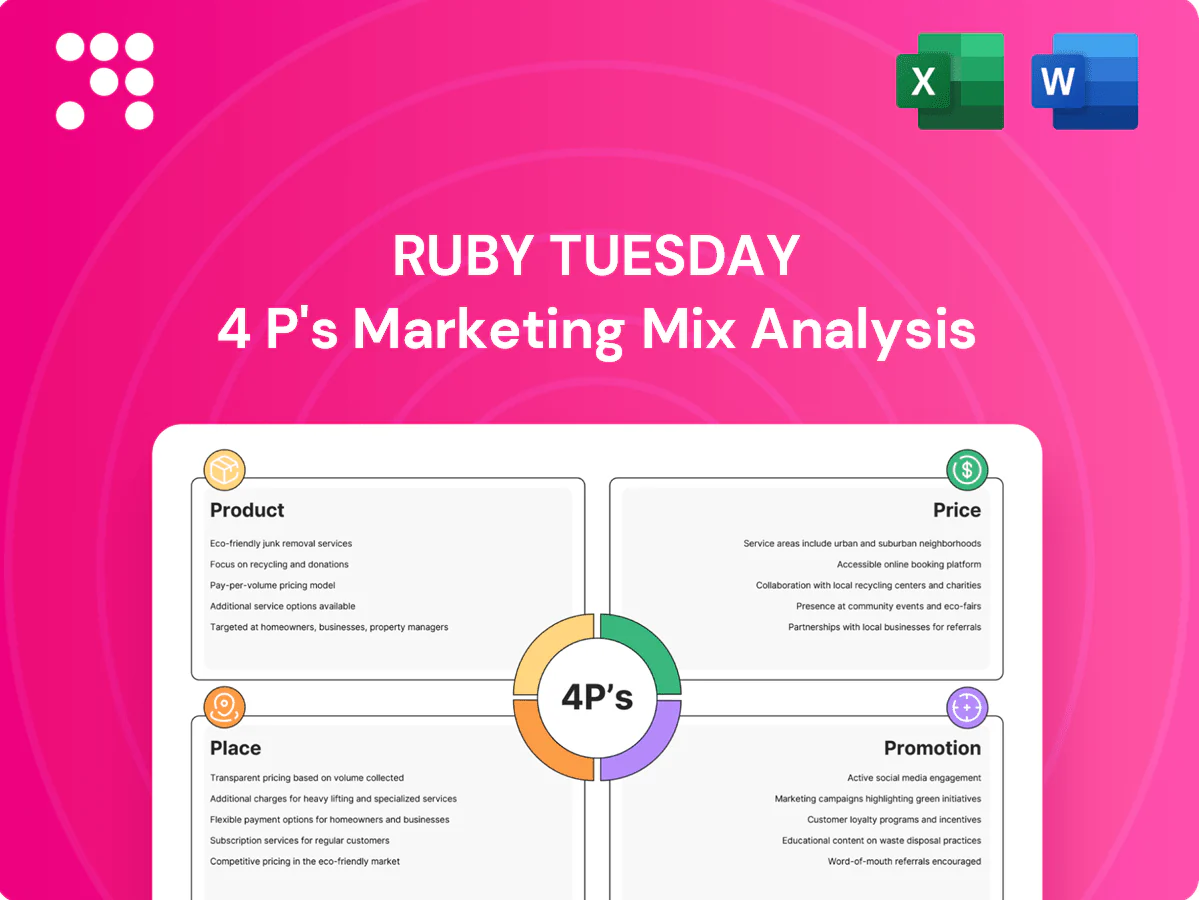
The preview shown here is the actual document you’ll receive instantly after purchase—no surprises. This comprehensive Ruby Tuesday 4P's Marketing Mix Analysis covers Product, Price, Place, and Promotion in detail. You're viewing the exact version of the analysis you'll receive, fully complete and ready to use.

Description
Ready-Made Marketing Analysis, Ready to Use
Ruby Tuesday's marketing mix is a fascinating study in balancing casual dining appeal with evolving consumer tastes. From their diverse menu offerings and value-driven pricing to their widespread accessibility and targeted promotions, each element plays a crucial role in their brand's performance.
Go beyond the basics—get access to an in-depth, ready-made Marketing Mix Analysis covering Ruby Tuesday's Product, Price, Place, and Promotion strategies. Ideal for business professionals, students, and consultants looking for strategic insights into the casual dining sector.
Product
Diverse American Cuisine
Ruby Tuesday's product strategy centers on a diverse American cuisine, featuring staples like burgers, steaks, salads, and pasta. This broad menu caters to a wide range of customer preferences within a casual dining environment.
In January 2025, Ruby Tuesday refreshed its menu, notably introducing enhanced smashed burgers. This update also included new entrees and desserts, demonstrating a commitment to keeping the dining experience appealing and current for its patrons.
Signature Garden Bar
The Signature Garden Bar is a cornerstone of Ruby Tuesday's product strategy, offering a highly customizable salad experience. This allows guests to create their own meals from a diverse selection of fresh ingredients, appealing to a broad customer base.
This customizable offering functions as both a complete meal option and an enhancement to other dishes, attracting health-conscious individuals and those preferring lighter fare. Its flexibility ensures broad appeal across different dining preferences.
The Garden Bar continues to be a significant draw for Ruby Tuesday's core demographic, which includes women and families. Its consistent presence reinforces the brand's commitment to fresh, customizable dining experiences.
Quality and Freshness Focus
Ruby Tuesday places a strong emphasis on uncompromising freshness and quality throughout its entire menu. This dedication is evident in everything from their appetizers to their main courses, ensuring a consistently satisfying dining experience for every guest.
The restaurant is known for its perfectly seasoned steaks, crave-worthy burgers, and a diverse selection of seafood entrees, all prepared with a commitment to high-quality ingredients. This focus on premium sourcing is key to delivering delicious and memorable meals.
For instance, in 2024, Ruby Tuesday continued to highlight its sourcing of fresh, never-frozen beef for its burgers, a key differentiator in the casual dining market. This commitment to quality ingredients is a cornerstone of their brand promise, aiming to build customer loyalty through consistently good food.
Takeout and Delivery Options
Ruby Tuesday has significantly expanded its product offering beyond the traditional dine-in experience by embracing takeout and delivery options. This strategic move caters to the growing consumer demand for convenience and at-home dining, a trend that accelerated notably in recent years. The company's official website serves as a central hub for customers to easily place orders for pickup or delivery across the nation.
This adaptation reflects a broader industry shift. In 2023, the US off-premises dining market, which includes takeout and delivery, continued its strong growth trajectory, accounting for a substantial portion of restaurant sales. For instance, data from Datassentials indicated that off-premises dining represented over 60% of total restaurant occasions by the end of 2023.
- Convenient Access: Online ordering via the Ruby Tuesday website allows customers to enjoy meals at home.
- Nationwide Reach: Delivery and pickup services are available across the United States.
- Industry Trend Alignment: This strategy directly addresses the increasing consumer preference for off-premises dining solutions.
- Digital Engagement: The website facilitates a seamless ordering process, enhancing customer accessibility.
Seasonal and Special Menu Items
Ruby Tuesday leverages seasonal and special menu items to keep its offerings fresh and exciting, a key component of its product strategy. This approach directly addresses the need to cater to evolving consumer tastes and drive repeat business. For instance, promotions like 'The Great Steaktacular' introduced new cuts such as Cajun Rib Eye, while limited-time specials like 'Big BBQ Beef Ribs' and the 'Fried Pickle Smashed Burger' generated buzz and encouraged trial.
These dynamic menu additions are crucial for maintaining customer engagement and differentiating Ruby Tuesday in a competitive casual dining market. By consistently refreshing the product line with timely and appealing options, the company aims to boost same-store sales and attract new patrons. In the first quarter of fiscal year 2024, Ruby Tuesday reported a 3.5% increase in comparable restaurant sales, partly attributed to successful limited-time offers and seasonal promotions.
- Menu Innovation: Introduction of seasonal and limited-time offers like Cajun Rib Eye and Big BBQ Beef Ribs.
- Customer Engagement: Special items encourage repeat visits and create menu excitement.
- Sales Impact: These promotions contribute to positive comparable restaurant sales growth, with Q1 FY2024 showing a 3.5% increase.
Evolving Menu & Convenience Drive Sales Growth
Ruby Tuesday's product strategy emphasizes a diverse American menu, including burgers, steaks, and salads, with a strong focus on freshness and quality. The Signature Garden Bar offers a customizable salad experience, appealing to health-conscious diners and families. Recent menu updates in January 2025, featuring enhanced smashed burgers and new entrees, demonstrate a commitment to keeping offerings relevant.
The brand also prioritizes convenient access through expanded takeout and delivery options, aligning with the significant growth in the US off-premises dining market, which represented over 60% of total restaurant occasions by the end of 2023. Seasonal and limited-time offers, such as the Cajun Rib Eye and Big BBQ Beef Ribs, are crucial for customer engagement and have contributed to positive sales, with a 3.5% increase in comparable restaurant sales reported for Q1 FY2024.
| Product Element | Description | Key Features/Initiatives | Target Audience Appeal | Recent Performance/Data |
|---|---|---|---|---|
| Menu Diversity | American cuisine staples | Burgers, steaks, salads, pasta | Broad customer preferences | Menu refresh in Jan 2025 |
| Signature Garden Bar | Customizable salad bar | Fresh ingredients, build-your-own meals | Health-conscious, families | Consistent draw for core demographic |
| Quality Focus | Premium ingredients | Never-frozen beef, fresh seafood | Customers seeking quality | Highlighting fresh beef sourcing in 2024 |
| Off-Premises Dining | Takeout and delivery | Online ordering via website | Convenience-seeking consumers | Over 60% of occasions in US off-premises dining (2023) |
| Limited-Time Offers | Seasonal and special items | Cajun Rib Eye, BBQ Beef Ribs | Customer engagement, repeat visits | 3.5% comparable sales growth (Q1 FY2024) |
What is included in the product
Detailed Word Document
This analysis provides a comprehensive breakdown of Ruby Tuesday's marketing strategies, examining its Product offerings, Pricing tactics, Place (distribution) decisions, and Promotion efforts.
It offers a deep dive into how Ruby Tuesday positions itself in the casual dining market, using real-world brand practices for a grounded understanding.
Customizable Excel Spreadsheet
Streamlines the complex Ruby Tuesday 4Ps analysis into actionable insights, alleviating the pain of information overload for busy executives.
Provides a clear, concise overview of Ruby Tuesday's marketing strategy, simplifying the challenge of understanding their competitive positioning.
Place
Casual Dining Restaurant Locations
Ruby Tuesday's primary product is its physical casual dining restaurant locations, designed to offer a welcoming and relaxed environment for diners. These establishments are key to the brand's customer experience, providing a space for families and individuals to gather and enjoy meals.
The company strategically selects these locations to ensure accessibility for its target customer base, aiming for visibility and convenience. Despite past challenges leading to some closures, the remaining Ruby Tuesday restaurants continue to be vital community hubs for dining.
As of early 2024, Ruby Tuesday operates a significantly reduced number of locations compared to its peak, with reports indicating around 200 restaurants remaining across the United States, a stark contrast to the over 800 it once had.
Domestic and International Presence
Ruby Tuesday operates a dual model of franchised and company-owned restaurants, extending its reach both domestically and across international borders. While the company has streamlined its U.S. presence, it continues to serve customers in various markets, aiming for a uniform brand experience.
As of late 2024, Ruby Tuesday's domestic footprint has been significantly adjusted, with a focus on optimizing its market presence. Internationally, the brand maintains a presence in select regions, though specific growth or contraction figures for 2024-2025 international operations are not publicly detailed, indicating a strategic approach to global expansion.
Online Ordering and Pickup
Ruby Tuesday enhances its Place strategy by offering convenient online ordering and pickup through its digital platforms. This allows customers to easily order their favorite meals for collection directly from their neighborhood Ruby Tuesday, streamlining the dining experience and meeting the growing demand for on-the-go options.
The company's website, which lists all restaurant locations, serves as the primary portal for this service, making it simple for patrons to find a nearby spot and place their orders. This digital integration is crucial for meeting modern consumer expectations for accessibility and speed.
Third-Party Delivery Partnerships
Ruby Tuesday leverages third-party delivery platforms to extend its market presence and cater to the growing demand for at-home dining. This strategy significantly broadens customer accessibility, allowing individuals to enjoy Ruby Tuesday's offerings without visiting a physical location. The convenience factor is paramount in today's competitive restaurant industry, directly impacting sales volume and customer retention.
These partnerships are vital for maximizing convenience and sales, especially as consumer habits continue to evolve. While the specific commission rates vary by platform, their role in reaching a wider audience and driving incremental revenue is undeniable. For instance, DoorDash, a major player in the food delivery market, reported a 27% increase in gross order value in Q1 2024 compared to the previous year, highlighting the sector's growth and the potential benefits for restaurant partners.
- Expanded Reach: Access to customers who prioritize convenience and home delivery.
- Sales Potential: Drives incremental revenue by tapping into a larger market.
- Market Trend: Aligns with the increasing consumer preference for delivered meals.
- Operational Integration: Streamlines the process of offering delivery without direct fleet management.
Strategic Footprint Management
Ruby Tuesday has actively managed its physical footprint, a critical aspect of its place strategy. This has involved strategic closures of underperforming restaurants to streamline operations and concentrate resources on more viable markets. For instance, reports in early 2024 highlighted several closures, with some attributed to lease expirations and others to the need to adapt to evolving consumer preferences and competitive landscapes.
The company's approach to footprint management is dynamic, reflecting a commitment to optimizing its market presence. By shedding less profitable locations, Ruby Tuesday aims to improve overall financial health and operational efficiency. This ongoing evaluation of its store portfolio is essential for maintaining competitiveness and ensuring a robust presence in key demographic areas.
- 2024 Closures: Reports indicated a number of restaurant closures throughout 2024, impacting various states and signaling a strategic recalibration of its physical presence.
- Profitability Focus: The closures are part of a broader strategy to enhance profitability by exiting markets or individual locations that no longer align with the company's financial objectives.
- Market Adaptation: Ruby Tuesday's footprint adjustments in 2024 and early 2025 demonstrate an effort to adapt to changing market conditions and consumer behavior, ensuring its remaining locations are well-positioned for success.
Place Strategy: Optimized Footprint, Expanded Digital Access
Ruby Tuesday's "Place" strategy centers on its physical restaurant locations and how customers access them. While the company has significantly reduced its footprint, with approximately 200 locations remaining as of early 2024, it continues to optimize its presence. The brand also extends its reach through online ordering for pickup and partnerships with third-party delivery services, adapting to modern consumer convenience demands.
| Aspect | Description | Data Point/Trend |
|---|---|---|
| Physical Locations | Company-owned and franchised restaurants | Approximately 200 locations as of early 2024; down from over 800 peak. |
| Digital Access | Online ordering for pickup | Available via the company website. |
| Delivery Services | Partnerships with third-party platforms | Expands market reach and caters to at-home dining trends. |
| Footprint Management | Strategic closures and optimization | Ongoing process in 2024 to enhance profitability and market presence. |
Full Version Awaits
Ruby Tuesday 4P's Marketing Mix Analysis
The preview shown here is the actual document you’ll receive instantly after purchase—no surprises. This comprehensive Ruby Tuesday 4P's Marketing Mix Analysis covers Product, Price, Place, and Promotion in detail. You're viewing the exact version of the analysis you'll receive, fully complete and ready to use.