Ryanair Holdings Business Model Canvas

Low-cost carrier Business Model Canvas - profit levers, cost structure, growth playbook
Unlock the full strategic blueprint behind Ryanair Holdings with our Business Model Canvas — a concise, company-specific map of value propositions, cost structure, and growth levers. Perfect for investors, consultants, and founders, this downloadable Word/Excel file reveals how Ryanair scales profitably. Purchase the full canvas to benchmark, plan, and execute with confidence.
Partnerships

Aircraft manufacturer and lessors
Primary partnerships with Boeing and major lessors secure Ryanair Holdings a standardized fleet of over 500 Boeing 737s as of 2024, enabling scale advantages. Bulk orders, coordinated delivery schedules and volume pricing underpin its cost-leadership model. Manufacturer technical support and MAX upgrade programs improve reliability and fuel efficiency while joint financing and lease arrangements mitigate residual-value risk.
Airports and ground handling providers
Agreements with secondary/regional airports secure significantly lower landing/operating charges (commonly 30–40% below major hubs) and enable Ryanair’s target 25-minute turnarounds, cutting on-ground time. Priority slot access and efficient handling lift aircraft utilization and frequency while co-marketing with airports boosts local demand and route sustainability. Ground handlers commit to strict on-time metrics aligned with Ryanair’s operational model.

Fuel suppliers and hedging counterparties
Fuel suppliers and hedging counterparties mitigate jet fuel price volatility for Ryanair, underpinning structured hedging programs that stabilize unit costs and support fare planning. In FY2024 Ryanair carried about 168.5 million passengers, so fuel cost stability is critical to margins. Supply reliability across bases ensures operational continuity, while relationships with major refiners and leading banks enable active risk management and liquidity for hedges.

MRO and parts vendors
MRO and OEM part suppliers keep Ryanair’s 600+ Boeing 737 fleet airworthy at low cost by using power-by-the-hour and component pooling to cut inventory and downtime; standardized tooling and training reduce unit maintenance cost, while predictive maintenance partnerships have reduced AOG events and improved utilization by up to 5% in recent implementations.
Ancillary service partners
Alliances with car rental, hotels, insurance and payment providers drive Ryanair's ancillary ecosystem, supporting an ancillary revenue stream of about €5.8bn in FY2024 and diversifying income beyond fares. Affiliate and commission structures monetize site traffic, while seamless integration into the booking flow boosts conversion and average yield. Co-promotions with partners add customer value without raising base fares, preserving Ryanair's low-cost appeal.
- Partners: car rental, hotels, insurance, payments
- FY2024 ancillary revenue: €5.8bn
- Monetization: affiliate & commission models
- Impact: higher conversion via integrated booking flow
Low-cost carrier with 600+ 737s, 25-min turns, €5.8bn
Ryanair's key partners—Boeing/lessors, regional airports, fuel hedgers, MROs and travel ancillaries—secure a standardized 600+ Boeing 737 fleet, low airport charges (30–40% below major hubs), stable fuel costs and scaled low unit maintenance. These alliances enable high utilization, 25-minute turnarounds, +~5% utilization from predictive maintenance and ancillary revenue of €5.8bn (FY2024).
| Metric | Value (FY2024) |
|---|---|
| Passengers | 168.5m |
| Ancillary revenue | €5.8bn |
| Fleet | 600+ 737s |
| Airport cost delta | 30–40% lower |
| Predictive maintenance impact | ~+5% utilization |
What is included in the product
 Detailed Word Document
A concise Business Model Canvas for Ryanair Holdings outlining lean, low-cost point-to-point air travel: cost leadership via fleet commonality, high aircraft utilization, direct digital sales and rapid turnarounds; value propositions focus on ultra-low fares and reliable schedules while monetizing ancillaries, with customer segments spanning price-sensitive leisure and short-haul business travelers across Europe.

 Customizable Excel Spreadsheet
High-level view of Ryanair’s low-cost, high-utilization model as an editable canvas that relieves pain by clarifying cost drivers, route economics, and ancillary revenue levers for faster strategic decisions.
Activities

Schedule and network optimization
Designing point-to-point, short-haul routes to maximize aircraft utilization is core: Ryanair carried about 170 million passengers in FY2024 while targeting roughly 12 hours average daily aircraft utilization and rapid rotations to sustain high daily cycles. Seasonal and daypart adjustments track demand curves, and route launches/exits follow strict ROI discipline with break-even horizons typically within 12–24 months.
Dynamic pricing and revenue management
Advanced yield management balances load factors and unit revenue, leveraging Ryanair's scale after carrying ~179 million passengers in FY2024; continuous fare adjustments reflect demand, competition and remaining seats. Ancillary bundling and cross-sell algorithms lifted ancillary revenue to about €3.6bn in FY2024, boosting per-passenger spend. Data-driven A/B testing refines offers and price points.

Turnaround and operational efficiency
Ryanair targets sub-30-minute turnarounds, aiming for a 25-minute standard to maximize aircraft utilization. Lean ground processes and simplified procedures minimize complexity and ground time. Strictly uniform cabin layouts speed boarding and cleaning cycles. Punctuality and aircraft availability are monitored in real time across a network of over 2,400 daily flights (2024).

Fleet planning and maintenance
Ryanair's fleet planning centers on a standardized Boeing 737 fleet, which in 2024 comprised over 500 aircraft, simplifying pilot training, spares and line maintenance and lowering unit costs.
Phased deliveries and retirements align capacity with seasonal demand; preventive and predictive maintenance programs cut AOG events and improve dispatch reliability.
Long‑term engine and airframe support contracts manage cost volatility and sustain on‑time performance.
- standardized Boeing 737 fleet
- over 500 aircraft (2024)
- phased deliveries/retirements
- preventive/predictive maintenance
- engine & airframe support contracts
Digital sales and self-service enablement
Digital sales and self-service enablement cut GDS and agent fees as Ryanair drives over 90% of bookings through direct channels; in 2024 ancillaries represented about 22% of group revenue, boosted by mobile-first booking, check-in and add-on flows. Automated systems process changes, refunds and notifications at scale, reducing handling costs and SLA times, while continuous UX optimization raises conversion and ancillary take-up.
- Direct sales >90% share (2024)
- Ancillaries ≈22% of revenue (2024)
- Mobile-first UX drives adoption
- Automation scales service and reduces costs
Low‑cost carrier: 179m pax, €3.6bn ancillaries, 25‑min turns
Ryanair runs point-to-point short‑haul ops (≈179m pax FY2024) targeting ~12h daily aircraft utilization and 25‑minute turns to maximize cycles. Fleet standardization (>500 Boeing 737 in 2024) plus phased deliveries and predictive maintenance cut costs and AOG risk. Digital direct sales (>90% bookings) and ancillaries (~€3.6bn, ~22% revenue in 2024) drive unit revenue.
| Metric | 2024 |
|---|---|
| Passengers | ≈179m |
| Ancillary rev | €3.6bn (22%) |
| Fleet | >500 B737 |
| Turnaround | 25 min target |
| Direct bookings | >90% |
| Utilization | ~12 hrs/day |
What You See Is What You Get
Business Model Canvas
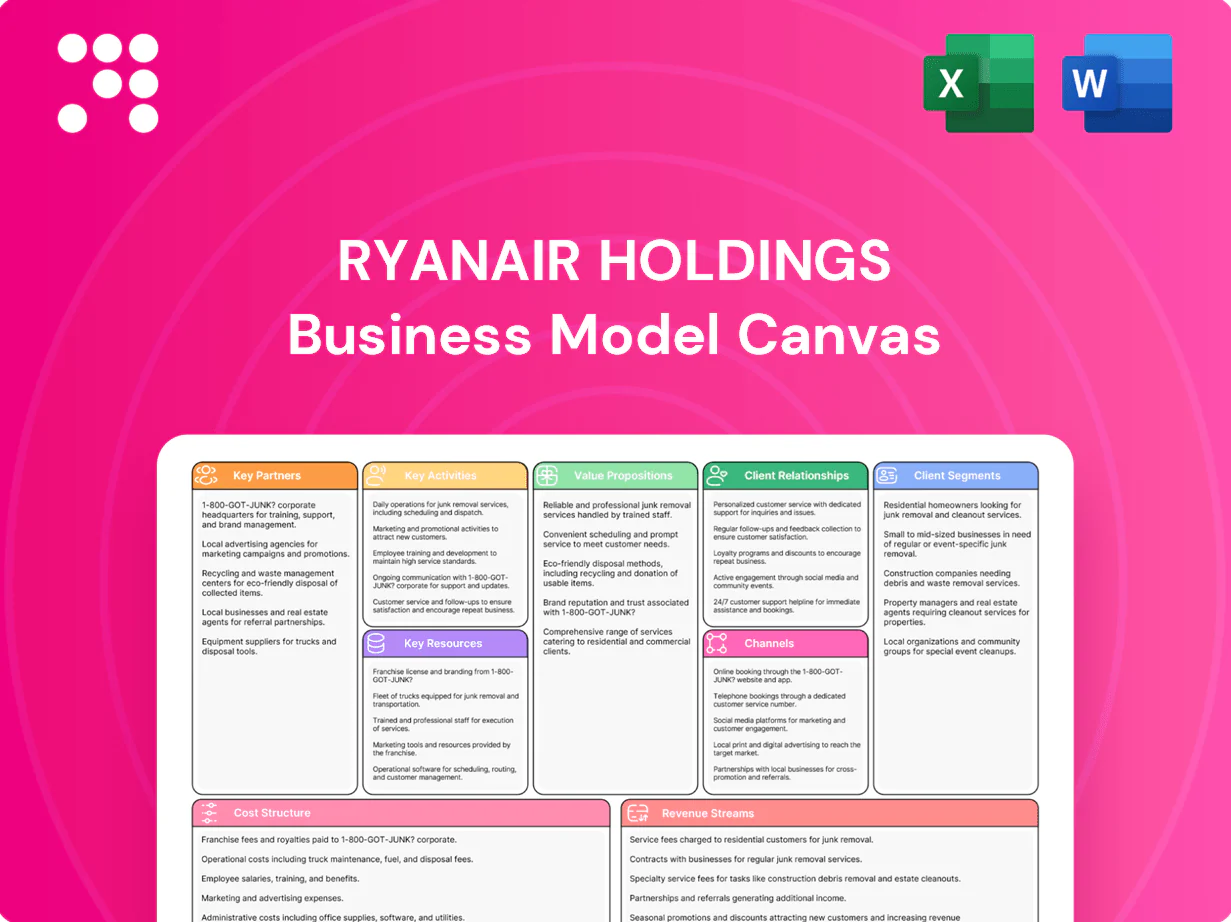
The Ryanair Holdings Business Model Canvas shown here is the actual deliverable, not a mockup, and reflects the same structure, content, and level of detail you’ll receive after purchase. When you complete your order, you’ll get this exact file—ready to edit, present, and use for strategic or financial analysis. No placeholders, no surprises.

Description
Low-cost carrier Business Model Canvas - profit levers, cost structure, growth playbook
Unlock the full strategic blueprint behind Ryanair Holdings with our Business Model Canvas — a concise, company-specific map of value propositions, cost structure, and growth levers. Perfect for investors, consultants, and founders, this downloadable Word/Excel file reveals how Ryanair scales profitably. Purchase the full canvas to benchmark, plan, and execute with confidence.
Partnerships
Aircraft manufacturer and lessors
Primary partnerships with Boeing and major lessors secure Ryanair Holdings a standardized fleet of over 500 Boeing 737s as of 2024, enabling scale advantages. Bulk orders, coordinated delivery schedules and volume pricing underpin its cost-leadership model. Manufacturer technical support and MAX upgrade programs improve reliability and fuel efficiency while joint financing and lease arrangements mitigate residual-value risk.
Airports and ground handling providers
Agreements with secondary/regional airports secure significantly lower landing/operating charges (commonly 30–40% below major hubs) and enable Ryanair’s target 25-minute turnarounds, cutting on-ground time. Priority slot access and efficient handling lift aircraft utilization and frequency while co-marketing with airports boosts local demand and route sustainability. Ground handlers commit to strict on-time metrics aligned with Ryanair’s operational model.
Fuel suppliers and hedging counterparties
Fuel suppliers and hedging counterparties mitigate jet fuel price volatility for Ryanair, underpinning structured hedging programs that stabilize unit costs and support fare planning. In FY2024 Ryanair carried about 168.5 million passengers, so fuel cost stability is critical to margins. Supply reliability across bases ensures operational continuity, while relationships with major refiners and leading banks enable active risk management and liquidity for hedges.
MRO and parts vendors
MRO and OEM part suppliers keep Ryanair’s 600+ Boeing 737 fleet airworthy at low cost by using power-by-the-hour and component pooling to cut inventory and downtime; standardized tooling and training reduce unit maintenance cost, while predictive maintenance partnerships have reduced AOG events and improved utilization by up to 5% in recent implementations.
Ancillary service partners
Alliances with car rental, hotels, insurance and payment providers drive Ryanair's ancillary ecosystem, supporting an ancillary revenue stream of about €5.8bn in FY2024 and diversifying income beyond fares. Affiliate and commission structures monetize site traffic, while seamless integration into the booking flow boosts conversion and average yield. Co-promotions with partners add customer value without raising base fares, preserving Ryanair's low-cost appeal.
- Partners: car rental, hotels, insurance, payments
- FY2024 ancillary revenue: €5.8bn
- Monetization: affiliate & commission models
- Impact: higher conversion via integrated booking flow
Low-cost carrier with 600+ 737s, 25-min turns, €5.8bn
Ryanair's key partners—Boeing/lessors, regional airports, fuel hedgers, MROs and travel ancillaries—secure a standardized 600+ Boeing 737 fleet, low airport charges (30–40% below major hubs), stable fuel costs and scaled low unit maintenance. These alliances enable high utilization, 25-minute turnarounds, +~5% utilization from predictive maintenance and ancillary revenue of €5.8bn (FY2024).
| Metric | Value (FY2024) |
|---|---|
| Passengers | 168.5m |
| Ancillary revenue | €5.8bn |
| Fleet | 600+ 737s |
| Airport cost delta | 30–40% lower |
| Predictive maintenance impact | ~+5% utilization |
What is included in the product
Detailed Word Document
A concise Business Model Canvas for Ryanair Holdings outlining lean, low-cost point-to-point air travel: cost leadership via fleet commonality, high aircraft utilization, direct digital sales and rapid turnarounds; value propositions focus on ultra-low fares and reliable schedules while monetizing ancillaries, with customer segments spanning price-sensitive leisure and short-haul business travelers across Europe.
Customizable Excel Spreadsheet
High-level view of Ryanair’s low-cost, high-utilization model as an editable canvas that relieves pain by clarifying cost drivers, route economics, and ancillary revenue levers for faster strategic decisions.
Activities
Schedule and network optimization
Designing point-to-point, short-haul routes to maximize aircraft utilization is core: Ryanair carried about 170 million passengers in FY2024 while targeting roughly 12 hours average daily aircraft utilization and rapid rotations to sustain high daily cycles. Seasonal and daypart adjustments track demand curves, and route launches/exits follow strict ROI discipline with break-even horizons typically within 12–24 months.
Dynamic pricing and revenue management
Advanced yield management balances load factors and unit revenue, leveraging Ryanair's scale after carrying ~179 million passengers in FY2024; continuous fare adjustments reflect demand, competition and remaining seats. Ancillary bundling and cross-sell algorithms lifted ancillary revenue to about €3.6bn in FY2024, boosting per-passenger spend. Data-driven A/B testing refines offers and price points.
Turnaround and operational efficiency
Ryanair targets sub-30-minute turnarounds, aiming for a 25-minute standard to maximize aircraft utilization. Lean ground processes and simplified procedures minimize complexity and ground time. Strictly uniform cabin layouts speed boarding and cleaning cycles. Punctuality and aircraft availability are monitored in real time across a network of over 2,400 daily flights (2024).
Fleet planning and maintenance
Ryanair's fleet planning centers on a standardized Boeing 737 fleet, which in 2024 comprised over 500 aircraft, simplifying pilot training, spares and line maintenance and lowering unit costs.
Phased deliveries and retirements align capacity with seasonal demand; preventive and predictive maintenance programs cut AOG events and improve dispatch reliability.
Long‑term engine and airframe support contracts manage cost volatility and sustain on‑time performance.
- standardized Boeing 737 fleet
- over 500 aircraft (2024)
- phased deliveries/retirements
- preventive/predictive maintenance
- engine & airframe support contracts
Digital sales and self-service enablement
Digital sales and self-service enablement cut GDS and agent fees as Ryanair drives over 90% of bookings through direct channels; in 2024 ancillaries represented about 22% of group revenue, boosted by mobile-first booking, check-in and add-on flows. Automated systems process changes, refunds and notifications at scale, reducing handling costs and SLA times, while continuous UX optimization raises conversion and ancillary take-up.
- Direct sales >90% share (2024)
- Ancillaries ≈22% of revenue (2024)
- Mobile-first UX drives adoption
- Automation scales service and reduces costs
Low‑cost carrier: 179m pax, €3.6bn ancillaries, 25‑min turns
Ryanair runs point-to-point short‑haul ops (≈179m pax FY2024) targeting ~12h daily aircraft utilization and 25‑minute turns to maximize cycles. Fleet standardization (>500 Boeing 737 in 2024) plus phased deliveries and predictive maintenance cut costs and AOG risk. Digital direct sales (>90% bookings) and ancillaries (~€3.6bn, ~22% revenue in 2024) drive unit revenue.
| Metric | 2024 |
|---|---|
| Passengers | ≈179m |
| Ancillary rev | €3.6bn (22%) |
| Fleet | >500 B737 |
| Turnaround | 25 min target |
| Direct bookings | >90% |
| Utilization | ~12 hrs/day |
What You See Is What You Get
Business Model Canvas
The Ryanair Holdings Business Model Canvas shown here is the actual deliverable, not a mockup, and reflects the same structure, content, and level of detail you’ll receive after purchase. When you complete your order, you’ll get this exact file—ready to edit, present, and use for strategic or financial analysis. No placeholders, no surprises.