Steel Authority of India Business Model Canvas

Strategic Business Model Canvas for a leading Indian steelmaker
Unlock the full strategic blueprint behind Steel Authority of India’s business model. This concise Business Model Canvas maps value propositions, key partners, revenue streams and cost drivers to show how SAIL competes and scales. Ideal for investors, consultants and managers—download the complete editable Canvas in Word and Excel to benchmark and execute strategy.
Partnerships

Mining and raw material suppliers
SAIL secures iron ore, coking coal, limestone and ferroalloys via captive mines and external suppliers to support its 14.8 Mt crude steel output in FY2023-24, reducing market exposure. Long-term linkages and forward contracts stabilize input costs and mitigate supply shocks. Strategic sourcing balances domestic ore with imported high-grade coking coal (majority-import reliant) for consistent metallurgical quality. Supplier development programs enforce specs and on-time delivery metrics.
Railways and logistics providers
Partnerships with Indian Railways (which moved 1,228 million tonnes of freight in 2022–23), major port operators (handling ~1,300 million tonnes in 2023–24) and private fleet providers enable bulk movement of raw materials and finished steel for SAIL; priority rakes and optimized routes cut turnaround time materially, lowering freight per ton and improving reliability during peak demand and monsoon seasons.

Government and public sector entities
Engagement with ministries, PSUs and state utilities aligns SAIL with national projects and demand; India’s National Infrastructure Pipeline (~111 lakh crore for 2020–25) underpins long-term offtake. Access to public tenders secures steady revenue streams, while compliance partnerships speed clearances and standards. Joint initiatives, including the 2023 PLI for specialty steel (INR 6,322 crore), boost domestic capacity and self-reliance.

Technology and equipment partners
Alliances with global OEMs and research institutes have accelerated process upgrades at SAIL, improving product quality and enabling technology transfer for advanced grades; investments in blast furnace, continuous casting and rolling mill modernisations have driven yield and scrap-to-steel recovery gains. Predictive maintenance tools cut unplanned downtime by 30–50% and lower energy intensity, improving throughput and margins.
- Alliances: OEMs + institutes — faster tech transfer
- Upgrades: blast furnace, casting, rolling — higher yields
- Advanced grades: accelerated development via partnerships
- Predictive maintenance: 30–50% downtime reduction, lower energy intensity
Distributors and downstream fabricators
Channel partners expand SAILs geographic reach to MSME customers across India, tapping a market where India produced 128.6 million tonnes of crude steel in 2023 (worldsteel).
Service centres and downstream fabricators add value through cutting, bending and finishing while partnership terms align inventory, credit and service levels; feedback loops inform product development and demand planning.
- MSME reach via distributors
- Value-add: cutting, bending, finishing
- Aligned terms: inventory, credit, service
- Feedback loops for product & demand planning
Captive mines secure 14.8 Mt; logistics ensure scale
SAIL secures captive mines + suppliers to support 14.8 Mt crude steel (FY2023‑24), using long‑term linkages and import coking coal to stabilise costs. Logistics ties with Indian Railways and ports ensure bulk movement; tech alliances and predictive maintenance cut downtime 30–50%. Channel partners and service centres expand reach to MSMEs within India’s 128.6 Mt steel market (2023).
| Item | Metric |
|---|---|
| Crude steel (SAIL) | 14.8 Mt (FY2023‑24) |
| India steel prod | 128.6 Mt (2023) |
| Rail freight | 1,228 Mt (2022‑23) |
| PLI specialty steel | INR 6,322 Cr (2023) |
What is included in the product
 Detailed Word Document
A comprehensive Business Model Canvas for Steel Authority of India (SAIL) detailing customer segments, channels, value propositions, key activities, resources, partners, cost structure and revenue streams across 9 blocks, reflecting real-world operations and strategic plans; ideal for presentations and investor discussions, it includes competitive advantages and linked SWOT insights to support decision-making and validation.

 Customizable Excel Spreadsheet
High-level, editable Business Model Canvas for Steel Authority of India that condenses complex operations and stakeholder linkages into a one-page snapshot, relieving the pain of scattered strategy documents and saving hours on formatting and alignment for boardrooms or team collaboration.
Activities

Integrated steelmaking operations
Integrated end-to-end operations span captive mining through sinter/hot metal production, steelmaking (BF-BOF/EAF) and rolling, supporting SAIL’s installed crude steel capacity of about 21.4 MTPA (2024).
Continuous casting and precision finishing lines maintain dimensional accuracy and surface quality for flat and long products, reducing rework and scrap.
Operational excellence programs target higher throughput and yield while embedding safety, reliability and energy-optimization measures across plants.
Quality assurance and R&D
Testing, certifications and strict process control sustain grade consistency across SAILs 7 integrated and 1 special steel plant, with ISO 9001 and ISO 14001 certifications across units.
R&D at RDCIS, recognised by DSIR, develops high-strength, weathering and specialty steels tailored for automotive, rail and infrastructure requirements.
Metallurgical innovation is validated through structured customer trials in field conditions to de-risk rollouts and ensure performance.

Sales, contracting, and tendering
Participates in government tenders and large project contracts, leveraging Maharatna status to bid on strategic orders as India’s steel demand approached ~120 Mt in 2024; SAIL’s crude steel output exceeded 12 Mt in FY2023-24. Negotiates long-term offtake agreements with OEMs and EPCs to secure volume and revenue visibility. Uses auctions and market-linked pricing for price discovery, while account planning aligns production schedules with demand forecasts and contracted supplies.

Supply chain and logistics management
SAIL coordinates inbound raw materials and outbound finished goods to support 13.17 million tonnes crude steel production in 2024, optimizing rake allocation, warehousing and stockyard operations to cut dwell times and costs. Digital tracking across rakes and yards improves visibility and trims lead times while risk-management buffers address port and rail disruptions.
- Inbound/outbound coordination
- Rake allocation & stockyard ops
- Digital tracking for visibility
- Risk buffers for ports/rail
Sustainability and asset maintenance
Sustainability and asset maintenance at Steel Authority of India focus on energy efficiency, waste-heat recovery and emissions control to cut the steel sector’s ~7–9% share of global CO2 emissions; India produced ~120 million tonnes of crude steel in 2023 (World Steel Association). Slag utilization and by-product management reduce landfill and improve circularity, while preventive and predictive maintenance extend asset life and lower unplanned downtime; compliance reporting meets environmental and safety norms.
- Energy efficiency: WHR, process optimization
- Slag/by-product: reuse to cut landfill
- Maintenance: preventive + predictive
- Compliance: environmental & safety reporting
Integrated steel ops: captive mining-to-rolling, 21.4 MTPA capacity, 13.17 Mt crude (2024)
Integrated operations cover captive mining to rolling supporting ~21.4 MTPA installed capacity and 13.17 Mt crude steel production in 2024.
Focus on BF-BOF/EAF steelmaking, continuous casting, precision finishing, WHR and preventive/predictive maintenance to raise yield and cut downtime.
R&D (RDCIS, DSIR-recognised), certifications, customer trials and Maharatna status enable strategic tenders and long-term offtake agreements.
| Metric | Value (2024) |
|---|---|
| Installed capacity | 21.4 MTPA |
| Crude output | 13.17 Mt |
| Integrated plants | 7 + 1 special |
| India crude steel | ~120 Mt |
| R&D | RDCIS (DSIR) |
Full Version Awaits
Business Model Canvas
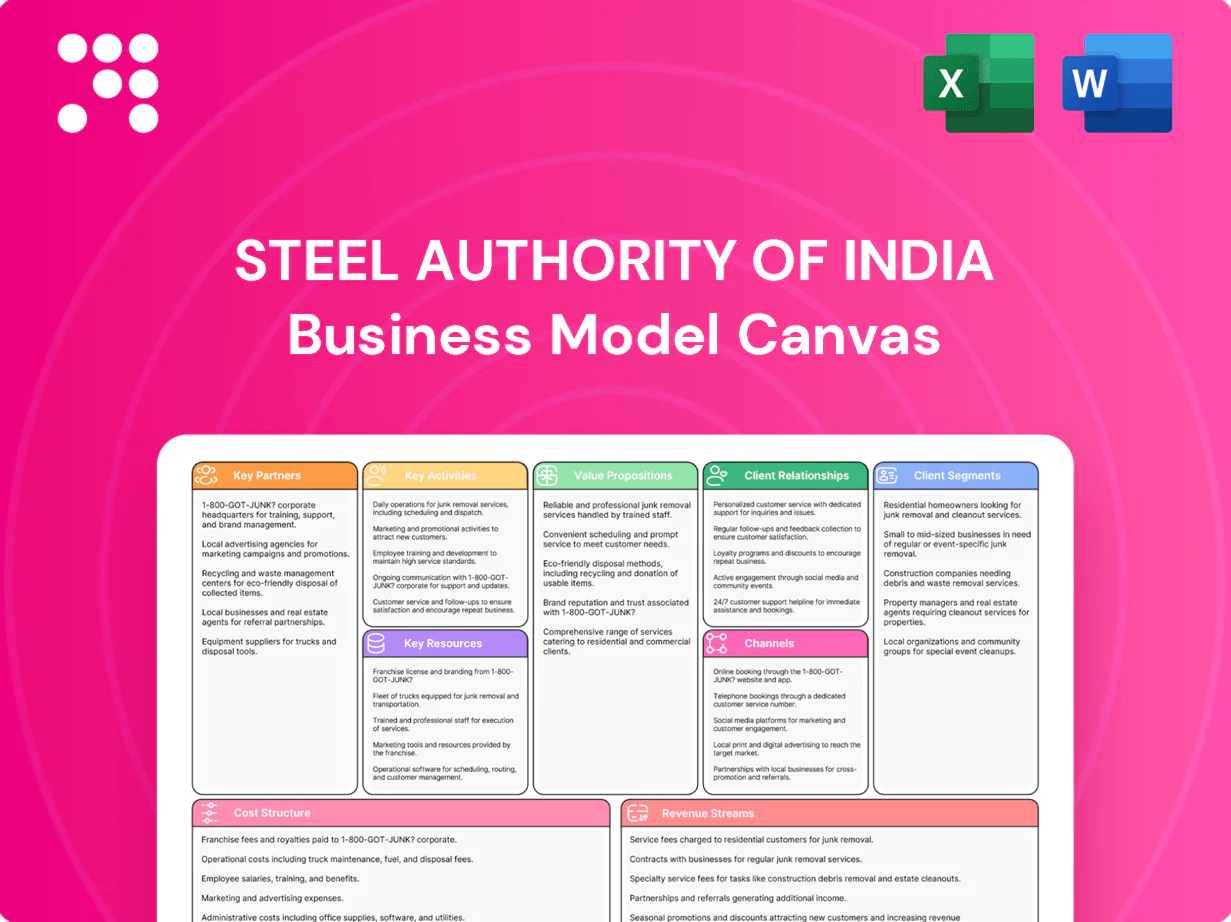
The document you're previewing is the actual Steel Authority of India Business Model Canvas you’ll receive—no mockup or sample. Purchase grants instant access to this same complete, editable file, formatted exactly as shown and ready for download, editing, and presentation.

Description
Strategic Business Model Canvas for a leading Indian steelmaker
Unlock the full strategic blueprint behind Steel Authority of India’s business model. This concise Business Model Canvas maps value propositions, key partners, revenue streams and cost drivers to show how SAIL competes and scales. Ideal for investors, consultants and managers—download the complete editable Canvas in Word and Excel to benchmark and execute strategy.
Partnerships
Mining and raw material suppliers
SAIL secures iron ore, coking coal, limestone and ferroalloys via captive mines and external suppliers to support its 14.8 Mt crude steel output in FY2023-24, reducing market exposure. Long-term linkages and forward contracts stabilize input costs and mitigate supply shocks. Strategic sourcing balances domestic ore with imported high-grade coking coal (majority-import reliant) for consistent metallurgical quality. Supplier development programs enforce specs and on-time delivery metrics.
Railways and logistics providers
Partnerships with Indian Railways (which moved 1,228 million tonnes of freight in 2022–23), major port operators (handling ~1,300 million tonnes in 2023–24) and private fleet providers enable bulk movement of raw materials and finished steel for SAIL; priority rakes and optimized routes cut turnaround time materially, lowering freight per ton and improving reliability during peak demand and monsoon seasons.
Government and public sector entities
Engagement with ministries, PSUs and state utilities aligns SAIL with national projects and demand; India’s National Infrastructure Pipeline (~111 lakh crore for 2020–25) underpins long-term offtake. Access to public tenders secures steady revenue streams, while compliance partnerships speed clearances and standards. Joint initiatives, including the 2023 PLI for specialty steel (INR 6,322 crore), boost domestic capacity and self-reliance.
Technology and equipment partners
Alliances with global OEMs and research institutes have accelerated process upgrades at SAIL, improving product quality and enabling technology transfer for advanced grades; investments in blast furnace, continuous casting and rolling mill modernisations have driven yield and scrap-to-steel recovery gains. Predictive maintenance tools cut unplanned downtime by 30–50% and lower energy intensity, improving throughput and margins.
- Alliances: OEMs + institutes — faster tech transfer
- Upgrades: blast furnace, casting, rolling — higher yields
- Advanced grades: accelerated development via partnerships
- Predictive maintenance: 30–50% downtime reduction, lower energy intensity
Distributors and downstream fabricators
Channel partners expand SAILs geographic reach to MSME customers across India, tapping a market where India produced 128.6 million tonnes of crude steel in 2023 (worldsteel).
Service centres and downstream fabricators add value through cutting, bending and finishing while partnership terms align inventory, credit and service levels; feedback loops inform product development and demand planning.
- MSME reach via distributors
- Value-add: cutting, bending, finishing
- Aligned terms: inventory, credit, service
- Feedback loops for product & demand planning
Captive mines secure 14.8 Mt; logistics ensure scale
SAIL secures captive mines + suppliers to support 14.8 Mt crude steel (FY2023‑24), using long‑term linkages and import coking coal to stabilise costs. Logistics ties with Indian Railways and ports ensure bulk movement; tech alliances and predictive maintenance cut downtime 30–50%. Channel partners and service centres expand reach to MSMEs within India’s 128.6 Mt steel market (2023).
| Item | Metric |
|---|---|
| Crude steel (SAIL) | 14.8 Mt (FY2023‑24) |
| India steel prod | 128.6 Mt (2023) |
| Rail freight | 1,228 Mt (2022‑23) |
| PLI specialty steel | INR 6,322 Cr (2023) |
What is included in the product
Detailed Word Document
A comprehensive Business Model Canvas for Steel Authority of India (SAIL) detailing customer segments, channels, value propositions, key activities, resources, partners, cost structure and revenue streams across 9 blocks, reflecting real-world operations and strategic plans; ideal for presentations and investor discussions, it includes competitive advantages and linked SWOT insights to support decision-making and validation.
Customizable Excel Spreadsheet
High-level, editable Business Model Canvas for Steel Authority of India that condenses complex operations and stakeholder linkages into a one-page snapshot, relieving the pain of scattered strategy documents and saving hours on formatting and alignment for boardrooms or team collaboration.
Activities
Integrated steelmaking operations
Integrated end-to-end operations span captive mining through sinter/hot metal production, steelmaking (BF-BOF/EAF) and rolling, supporting SAIL’s installed crude steel capacity of about 21.4 MTPA (2024).
Continuous casting and precision finishing lines maintain dimensional accuracy and surface quality for flat and long products, reducing rework and scrap.
Operational excellence programs target higher throughput and yield while embedding safety, reliability and energy-optimization measures across plants.
Quality assurance and R&D
Testing, certifications and strict process control sustain grade consistency across SAILs 7 integrated and 1 special steel plant, with ISO 9001 and ISO 14001 certifications across units.
R&D at RDCIS, recognised by DSIR, develops high-strength, weathering and specialty steels tailored for automotive, rail and infrastructure requirements.
Metallurgical innovation is validated through structured customer trials in field conditions to de-risk rollouts and ensure performance.
Sales, contracting, and tendering
Participates in government tenders and large project contracts, leveraging Maharatna status to bid on strategic orders as India’s steel demand approached ~120 Mt in 2024; SAIL’s crude steel output exceeded 12 Mt in FY2023-24. Negotiates long-term offtake agreements with OEMs and EPCs to secure volume and revenue visibility. Uses auctions and market-linked pricing for price discovery, while account planning aligns production schedules with demand forecasts and contracted supplies.
Supply chain and logistics management
SAIL coordinates inbound raw materials and outbound finished goods to support 13.17 million tonnes crude steel production in 2024, optimizing rake allocation, warehousing and stockyard operations to cut dwell times and costs. Digital tracking across rakes and yards improves visibility and trims lead times while risk-management buffers address port and rail disruptions.
- Inbound/outbound coordination
- Rake allocation & stockyard ops
- Digital tracking for visibility
- Risk buffers for ports/rail
Sustainability and asset maintenance
Sustainability and asset maintenance at Steel Authority of India focus on energy efficiency, waste-heat recovery and emissions control to cut the steel sector’s ~7–9% share of global CO2 emissions; India produced ~120 million tonnes of crude steel in 2023 (World Steel Association). Slag utilization and by-product management reduce landfill and improve circularity, while preventive and predictive maintenance extend asset life and lower unplanned downtime; compliance reporting meets environmental and safety norms.
- Energy efficiency: WHR, process optimization
- Slag/by-product: reuse to cut landfill
- Maintenance: preventive + predictive
- Compliance: environmental & safety reporting
Integrated steel ops: captive mining-to-rolling, 21.4 MTPA capacity, 13.17 Mt crude (2024)
Integrated operations cover captive mining to rolling supporting ~21.4 MTPA installed capacity and 13.17 Mt crude steel production in 2024.
Focus on BF-BOF/EAF steelmaking, continuous casting, precision finishing, WHR and preventive/predictive maintenance to raise yield and cut downtime.
R&D (RDCIS, DSIR-recognised), certifications, customer trials and Maharatna status enable strategic tenders and long-term offtake agreements.
| Metric | Value (2024) |
|---|---|
| Installed capacity | 21.4 MTPA |
| Crude output | 13.17 Mt |
| Integrated plants | 7 + 1 special |
| India crude steel | ~120 Mt |
| R&D | RDCIS (DSIR) |
Full Version Awaits
Business Model Canvas
The document you're previewing is the actual Steel Authority of India Business Model Canvas you’ll receive—no mockup or sample. Purchase grants instant access to this same complete, editable file, formatted exactly as shown and ready for download, editing, and presentation.