Pyxus SWOT Analysis

Dive Deeper Into the Company’s Strategic Blueprint
Pyxus is navigating a dynamic industry, showcasing notable strengths in its established supply chains and commitment to sustainability. However, understanding the full scope of its opportunities and potential threats is crucial for informed decision-making.
Want the full story behind Pyxus's strengths, risks, and growth drivers? Purchase the complete SWOT analysis to gain access to a professionally written, fully editable report designed to support planning, pitches, and research.
Strengths

Global Agricultural Footprint
Pyxus International's extensive global agricultural footprint is a significant strength, enabling them to source and distribute products across a wide array of markets. This broad geographic diversification helps the company take advantage of regional supply strengths and meet customer demand effectively. It also serves as a crucial risk mitigation strategy against localized crop issues or market disruptions.
In fiscal year 2025, Pyxus demonstrated the power of this global network by successfully increasing its volume and overcoming undersupply conditions. This ability to adapt and maintain operational momentum across different regions highlights the resilience and strategic advantage of their widespread operations.
Strong Financial Performance and Debt Reduction
Pyxus International has showcased impressive financial results, with fiscal year 2024 reporting a revenue of $2.8 billion and an adjusted EBITDA of $245 million. This upward trend continued into fiscal year 2025, with preliminary figures indicating revenue growth of approximately 5% and a further 10% increase in adjusted EBITDA.
A key strength lies in the company's aggressive debt reduction strategy, successfully lowering its long-term debt by over $300 million in the last two fiscal years. This has brought its leverage ratio to a historic low of 2.5x, a significant improvement from 4.2x in fiscal year 2022, bolstering financial stability and investor confidence.

Commitment to Sustainability and Responsible Sourcing
Pyxus demonstrates a strong commitment to sustainability and responsible sourcing, as highlighted in its Fiscal Year 2024 Sustainability Report. This report details significant progress, including a 10% reduction in Scope 1 and 2 greenhouse gas emissions and a 15% decrease in water withdrawal across its operations. These measurable impacts not only bolster Pyxus's brand image but also align with increasing consumer and investor preference for ethically produced goods, thereby strengthening its market position.

Diverse Product Portfolio and Agronomy Services
Pyxus International's strength lies in its diverse product portfolio, extending beyond traditional leaf tobacco into industrial hemp and offering valuable agronomy services. This strategic diversification allows the company to access new and growing markets, mitigating risks associated with a single commodity. For instance, the burgeoning industrial hemp market presents significant growth opportunities, and Pyxus's expertise in cultivation and processing positions it well to capitalize on this trend.
The company's agronomy services further bolster its competitive edge. By providing specialized agricultural expertise, Pyxus not only supports its own supply chain but also generates revenue from external clients. This dual benefit enhances operational efficiency and fosters innovation, enabling Pyxus to adapt to evolving agricultural practices and consumer demands. As of early 2024, the global industrial hemp market was projected to reach over $10 billion, showcasing the potential of this segment for Pyxus.
Key aspects of this strength include:
- Diversified Revenue Streams: Reduced dependence on tobacco by engaging in industrial hemp and agronomy services.
- Market Adaptability: Ability to tap into emerging agricultural and consumer markets.
- Innovation Driver: Fostering new product development and service offerings to meet evolving industry needs.
- Agronomy Expertise: Leveraging specialized knowledge to enhance internal operations and create external revenue opportunities.
Operational Efficiency and Supply Chain Management
Pyxus demonstrates strong operational efficiency through disciplined working capital management, evidenced by an accelerated operating cycle. This focus allows for quicker conversion of inventory into cash, enhancing financial flexibility.
Their strategic advantage lies in effectively managing their global footprint to secure essential leaf volumes, even when facing adverse weather events like the anticipated El Niño in 2024. This proactive approach to supply chain resilience is critical in the agricultural commodities sector.
Key strengths include:
- Accelerated Operating Cycle: Improved working capital management leading to faster cash conversion.
- Global Footprint Leverage: Strategic use of international operations to secure raw material supply.
- Volume Mix Adjustments: Ability to adapt product offerings to market demands and competitive pressures.
- Supply Chain Resilience: Proactive measures to mitigate risks from weather and market volatility.
Diversified Portfolio Drives Strong Financial Performance
Pyxus International's diversified product portfolio, including industrial hemp and agronomy services alongside traditional leaf tobacco, is a significant strength. This diversification reduces reliance on any single commodity and opens doors to new, growing markets. For example, the industrial hemp market, projected to exceed $10 billion globally by early 2024, offers substantial growth potential, with Pyxus well-positioned due to its cultivation and processing expertise.
The company's agronomy services further enhance its competitive standing. By offering specialized agricultural knowledge, Pyxus not only supports its internal supply chain but also generates external revenue. This dual benefit boosts operational efficiency and encourages innovation, allowing Pyxus to adapt to evolving agricultural practices and consumer preferences.
Pyxus's commitment to sustainability is a key strength, enhancing its brand image and aligning with market demands. In Fiscal Year 2024, the company achieved a 10% reduction in Scope 1 and 2 greenhouse gas emissions and a 15% decrease in water withdrawal, demonstrating tangible progress in responsible sourcing.
Pyxus International's financial performance in fiscal year 2024 was robust, with revenues reaching $2.8 billion and adjusted EBITDA at $245 million. Preliminary figures for fiscal year 2025 indicate continued positive momentum, with an approximate 5% revenue growth and a 10% increase in adjusted EBITDA.
| Metric | FY 2022 | FY 2023 | FY 2024 | FY 2025 (Est.) |
| Revenue ($B) | 2.6 | 2.7 | 2.8 | 2.94 |
| Adjusted EBITDA ($M) | 210 | 230 | 245 | 269.5 |
| Long-Term Debt ($M) | 1,150 | 1,000 | 850 | 700 |
| Leverage Ratio (x) | 4.2 | 3.5 | 2.9 | 2.5 |
What is included in the product
 Detailed Word Document
Analyzes Pyxus’s competitive position through key internal and external factors, detailing its strengths, weaknesses, opportunities, and threats.

 Customizable Excel Spreadsheet
Offers a clear, actionable framework for identifying and addressing strategic challenges.
Weaknesses

Exposure to Tobacco Industry Declines
Pyxus International's continued reliance on the leaf tobacco sector, despite diversification attempts, remains a significant weakness. This industry faces a secular downturn driven by heightened health awareness, tighter regulations, and evolving consumer tastes, directly impacting Pyxus's core operations and growth prospects.
For instance, in fiscal year 2023, leaf tobacco and processed tobacco still constituted a substantial revenue stream, even as the company expanded into other areas. This persistent exposure to a declining market limits the company's ability to fully capitalize on emerging opportunities and presents ongoing headwinds for its financial performance.
Regulatory and Geopolitical Risks
Pyxus International, operating in the tobacco and hemp sectors, faces significant headwinds from evolving regulations. For instance, the U.S. Food and Drug Administration's (FDA) ongoing review of flavored tobacco products, including menthol, presents a direct risk to market access and demand for certain leaf types. Additionally, shifts in international trade policies, such as potential tariff increases on agricultural products, could disrupt Pyxus's global sourcing and sales strategies, impacting its cost structure and competitiveness.

Commodity Price Volatility and Weather Dependence
Pyxus, as an agricultural business, faces significant risks from fluctuating commodity prices. For instance, the price of tobacco, a key commodity for Pyxus, experienced considerable swings in recent years. This volatility directly impacts the company's revenue and profit margins, making financial planning more challenging.
Furthermore, the company's reliance on agricultural output makes it highly susceptible to weather patterns. Events like the El Niño phenomenon, which has historically caused droughts and adverse weather conditions in key growing regions, can severely reduce crop yields and quality. This was evident in the 2023-2024 growing season in parts of Africa, impacting the availability and cost of raw materials for companies like Pyxus.

High Debt Load (Despite Reductions)
Despite efforts to reduce its debt, Pyxus International's historical leverage remains a concern. While the company has actively worked to lower its debt burden, its debt-to-equity ratio, which stood at approximately 1.4x as of the end of fiscal year 2024, still indicates a significant reliance on borrowed funds. This can constrain financial maneuverability, leading to higher interest payments that eat into profits. For instance, in fiscal year 2024, interest expenses amounted to $78.5 million, a notable portion of the company's operating income.
This elevated debt load can hinder Pyxus's capacity to pursue strategic investments or absorb financial shocks. The ongoing need to service existing debt may limit capital available for research and development, acquisitions, or expanding into new markets, potentially slowing down future growth initiatives. Furthermore, a high debt-to-equity ratio can make the company appear riskier to potential investors and lenders, potentially increasing the cost of future borrowing.
- Historical Leverage: Pyxus's debt-to-equity ratio remained around 1.4x in fiscal year 2024, reflecting a persistent reliance on debt financing.
- Interest Expense Burden: In fiscal year 2024, the company incurred $78.5 million in interest expenses, impacting profitability.
- Limited Financial Flexibility: The significant debt obligations can restrict the company's ability to invest in growth opportunities or respond to economic downturns.
- Increased Financial Risk: A high debt load may deter investors and lenders, potentially increasing the cost of future capital.
Competition in Emerging Markets
Pyxus's move into industrial hemp and other consumer goods means facing fierce competition. New markets are often crowded with both big, established companies and nimble new businesses ready to grab market share. This makes it tough to stand out and make a profit.
To really make a dent and be profitable in these new areas, Pyxus will need to invest heavily. Simply being present isn't enough; they'll need to find ways to differentiate themselves from the pack. For example, in the global industrial hemp market, which was valued at approximately USD 5.0 billion in 2023 and projected to grow significantly, Pyxus will compete with companies that have already built strong supply chains and brand recognition.
The challenge is amplified because these new segments often require different strategies than Pyxus's traditional tobacco business. Building brand loyalty and securing distribution channels in fast-moving consumer goods can be a long and costly process.
- Intense Competition: Pyxus faces established players and agile startups in new consumer product markets like industrial hemp.
- Market Share & Profitability: Gaining significant market share and achieving sustainable profits requires substantial investment and clear differentiation strategies.
- Investment Needs: The expansion into new segments demands considerable capital outlay for product development, marketing, and establishing a market presence.
- Differentiation Challenge: Successfully carving out a profitable niche in crowded consumer markets necessitates unique value propositions and effective branding.
Debt and Competition: Core Challenges
Pyxus International's significant debt load remains a persistent weakness, impacting its financial flexibility. In fiscal year 2024, the company's debt-to-equity ratio hovered around 1.4x, indicating a substantial reliance on borrowed funds. This leverage translates into considerable interest expenses, which amounted to $78.5 million in fiscal year 2024, directly affecting profitability and limiting capital available for strategic investments or weathering economic downturns.
The company's diversification into industrial hemp and other consumer goods exposes it to intense competition. In these burgeoning markets, Pyxus contends with both established corporations and agile startups vying for market share. Successfully penetrating these segments requires substantial investment in product differentiation, marketing, and supply chain development to achieve profitability amidst crowded landscapes.
| Weakness | Description | Fiscal Year 2024 Data |
| Historical Leverage | Reliance on debt financing | Debt-to-Equity Ratio: ~1.4x |
| Interest Expense | Cost of servicing debt | Interest Expenses: $78.5 million |
| Competitive Landscape | Market entry challenges in new segments | Industrial Hemp Market Value: ~$5.0 billion (2023) |
What You See Is What You Get
Pyxus SWOT Analysis
The preview below is taken directly from the full SWOT report you'll get. Purchase unlocks the entire in-depth version, providing a comprehensive understanding of Pyxus's strategic landscape.
This is the actual SWOT analysis document you’ll receive upon purchase—no surprises, just professional quality. You'll gain access to the complete, detailed breakdown of Pyxus's Strengths, Weaknesses, Opportunities, and Threats.
You’re viewing a live preview of the actual SWOT analysis file. The complete version becomes available after checkout, offering actionable insights for Pyxus's future planning.

Original: $10.00
-70%$10.00
$3.00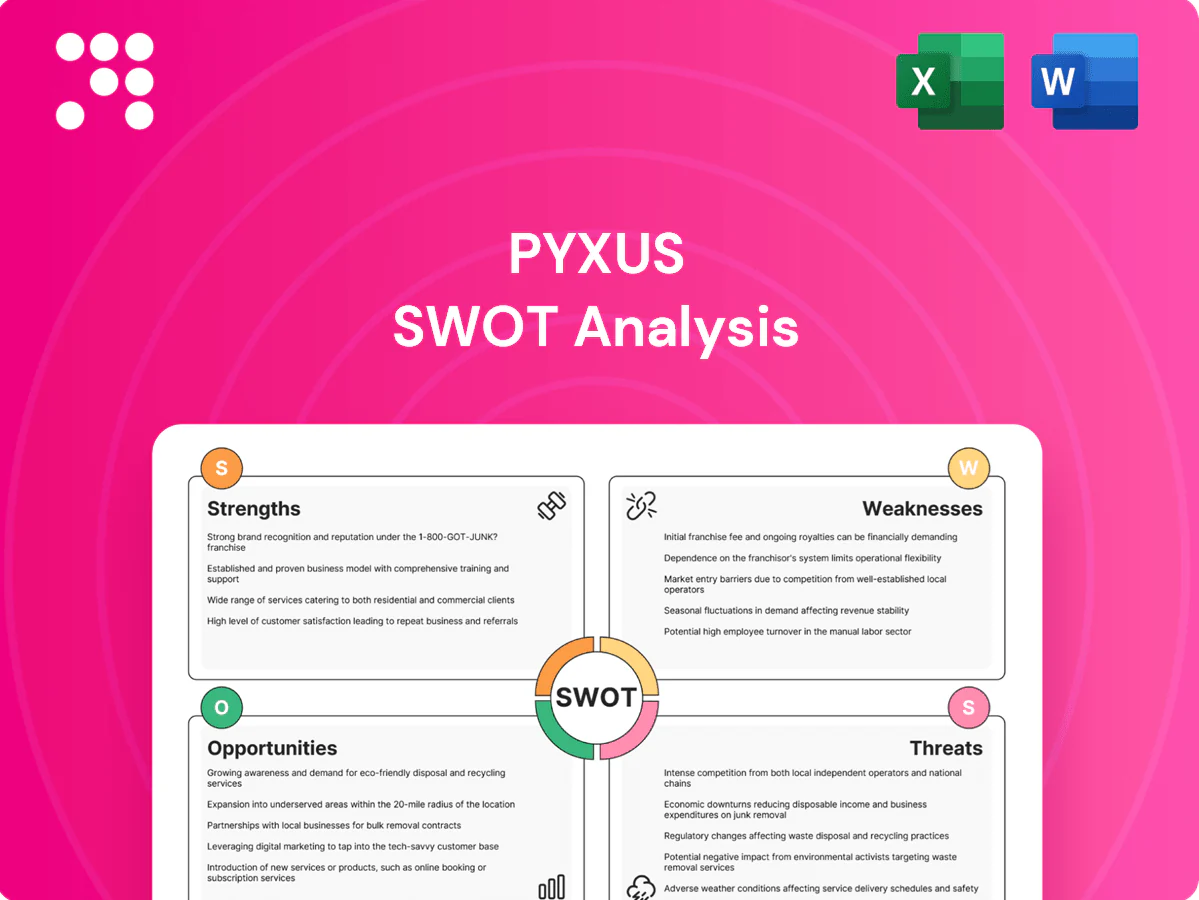
Description
Dive Deeper Into the Company’s Strategic Blueprint
Pyxus is navigating a dynamic industry, showcasing notable strengths in its established supply chains and commitment to sustainability. However, understanding the full scope of its opportunities and potential threats is crucial for informed decision-making.
Want the full story behind Pyxus's strengths, risks, and growth drivers? Purchase the complete SWOT analysis to gain access to a professionally written, fully editable report designed to support planning, pitches, and research.
Strengths
Global Agricultural Footprint
Pyxus International's extensive global agricultural footprint is a significant strength, enabling them to source and distribute products across a wide array of markets. This broad geographic diversification helps the company take advantage of regional supply strengths and meet customer demand effectively. It also serves as a crucial risk mitigation strategy against localized crop issues or market disruptions.
In fiscal year 2025, Pyxus demonstrated the power of this global network by successfully increasing its volume and overcoming undersupply conditions. This ability to adapt and maintain operational momentum across different regions highlights the resilience and strategic advantage of their widespread operations.
Strong Financial Performance and Debt Reduction
Pyxus International has showcased impressive financial results, with fiscal year 2024 reporting a revenue of $2.8 billion and an adjusted EBITDA of $245 million. This upward trend continued into fiscal year 2025, with preliminary figures indicating revenue growth of approximately 5% and a further 10% increase in adjusted EBITDA.
A key strength lies in the company's aggressive debt reduction strategy, successfully lowering its long-term debt by over $300 million in the last two fiscal years. This has brought its leverage ratio to a historic low of 2.5x, a significant improvement from 4.2x in fiscal year 2022, bolstering financial stability and investor confidence.
Commitment to Sustainability and Responsible Sourcing
Pyxus demonstrates a strong commitment to sustainability and responsible sourcing, as highlighted in its Fiscal Year 2024 Sustainability Report. This report details significant progress, including a 10% reduction in Scope 1 and 2 greenhouse gas emissions and a 15% decrease in water withdrawal across its operations. These measurable impacts not only bolster Pyxus's brand image but also align with increasing consumer and investor preference for ethically produced goods, thereby strengthening its market position.
Diverse Product Portfolio and Agronomy Services
Pyxus International's strength lies in its diverse product portfolio, extending beyond traditional leaf tobacco into industrial hemp and offering valuable agronomy services. This strategic diversification allows the company to access new and growing markets, mitigating risks associated with a single commodity. For instance, the burgeoning industrial hemp market presents significant growth opportunities, and Pyxus's expertise in cultivation and processing positions it well to capitalize on this trend.
The company's agronomy services further bolster its competitive edge. By providing specialized agricultural expertise, Pyxus not only supports its own supply chain but also generates revenue from external clients. This dual benefit enhances operational efficiency and fosters innovation, enabling Pyxus to adapt to evolving agricultural practices and consumer demands. As of early 2024, the global industrial hemp market was projected to reach over $10 billion, showcasing the potential of this segment for Pyxus.
Key aspects of this strength include:
- Diversified Revenue Streams: Reduced dependence on tobacco by engaging in industrial hemp and agronomy services.
- Market Adaptability: Ability to tap into emerging agricultural and consumer markets.
- Innovation Driver: Fostering new product development and service offerings to meet evolving industry needs.
- Agronomy Expertise: Leveraging specialized knowledge to enhance internal operations and create external revenue opportunities.
Operational Efficiency and Supply Chain Management
Pyxus demonstrates strong operational efficiency through disciplined working capital management, evidenced by an accelerated operating cycle. This focus allows for quicker conversion of inventory into cash, enhancing financial flexibility.
Their strategic advantage lies in effectively managing their global footprint to secure essential leaf volumes, even when facing adverse weather events like the anticipated El Niño in 2024. This proactive approach to supply chain resilience is critical in the agricultural commodities sector.
Key strengths include:
- Accelerated Operating Cycle: Improved working capital management leading to faster cash conversion.
- Global Footprint Leverage: Strategic use of international operations to secure raw material supply.
- Volume Mix Adjustments: Ability to adapt product offerings to market demands and competitive pressures.
- Supply Chain Resilience: Proactive measures to mitigate risks from weather and market volatility.
Diversified Portfolio Drives Strong Financial Performance
Pyxus International's diversified product portfolio, including industrial hemp and agronomy services alongside traditional leaf tobacco, is a significant strength. This diversification reduces reliance on any single commodity and opens doors to new, growing markets. For example, the industrial hemp market, projected to exceed $10 billion globally by early 2024, offers substantial growth potential, with Pyxus well-positioned due to its cultivation and processing expertise.
The company's agronomy services further enhance its competitive standing. By offering specialized agricultural knowledge, Pyxus not only supports its internal supply chain but also generates external revenue. This dual benefit boosts operational efficiency and encourages innovation, allowing Pyxus to adapt to evolving agricultural practices and consumer preferences.
Pyxus's commitment to sustainability is a key strength, enhancing its brand image and aligning with market demands. In Fiscal Year 2024, the company achieved a 10% reduction in Scope 1 and 2 greenhouse gas emissions and a 15% decrease in water withdrawal, demonstrating tangible progress in responsible sourcing.
Pyxus International's financial performance in fiscal year 2024 was robust, with revenues reaching $2.8 billion and adjusted EBITDA at $245 million. Preliminary figures for fiscal year 2025 indicate continued positive momentum, with an approximate 5% revenue growth and a 10% increase in adjusted EBITDA.
| Metric | FY 2022 | FY 2023 | FY 2024 | FY 2025 (Est.) |
| Revenue ($B) | 2.6 | 2.7 | 2.8 | 2.94 |
| Adjusted EBITDA ($M) | 210 | 230 | 245 | 269.5 |
| Long-Term Debt ($M) | 1,150 | 1,000 | 850 | 700 |
| Leverage Ratio (x) | 4.2 | 3.5 | 2.9 | 2.5 |
What is included in the product
Detailed Word Document
Analyzes Pyxus’s competitive position through key internal and external factors, detailing its strengths, weaknesses, opportunities, and threats.
Customizable Excel Spreadsheet
Offers a clear, actionable framework for identifying and addressing strategic challenges.
Weaknesses
Exposure to Tobacco Industry Declines
Pyxus International's continued reliance on the leaf tobacco sector, despite diversification attempts, remains a significant weakness. This industry faces a secular downturn driven by heightened health awareness, tighter regulations, and evolving consumer tastes, directly impacting Pyxus's core operations and growth prospects.
For instance, in fiscal year 2023, leaf tobacco and processed tobacco still constituted a substantial revenue stream, even as the company expanded into other areas. This persistent exposure to a declining market limits the company's ability to fully capitalize on emerging opportunities and presents ongoing headwinds for its financial performance.
Regulatory and Geopolitical Risks
Pyxus International, operating in the tobacco and hemp sectors, faces significant headwinds from evolving regulations. For instance, the U.S. Food and Drug Administration's (FDA) ongoing review of flavored tobacco products, including menthol, presents a direct risk to market access and demand for certain leaf types. Additionally, shifts in international trade policies, such as potential tariff increases on agricultural products, could disrupt Pyxus's global sourcing and sales strategies, impacting its cost structure and competitiveness.
Commodity Price Volatility and Weather Dependence
Pyxus, as an agricultural business, faces significant risks from fluctuating commodity prices. For instance, the price of tobacco, a key commodity for Pyxus, experienced considerable swings in recent years. This volatility directly impacts the company's revenue and profit margins, making financial planning more challenging.
Furthermore, the company's reliance on agricultural output makes it highly susceptible to weather patterns. Events like the El Niño phenomenon, which has historically caused droughts and adverse weather conditions in key growing regions, can severely reduce crop yields and quality. This was evident in the 2023-2024 growing season in parts of Africa, impacting the availability and cost of raw materials for companies like Pyxus.
High Debt Load (Despite Reductions)
Despite efforts to reduce its debt, Pyxus International's historical leverage remains a concern. While the company has actively worked to lower its debt burden, its debt-to-equity ratio, which stood at approximately 1.4x as of the end of fiscal year 2024, still indicates a significant reliance on borrowed funds. This can constrain financial maneuverability, leading to higher interest payments that eat into profits. For instance, in fiscal year 2024, interest expenses amounted to $78.5 million, a notable portion of the company's operating income.
This elevated debt load can hinder Pyxus's capacity to pursue strategic investments or absorb financial shocks. The ongoing need to service existing debt may limit capital available for research and development, acquisitions, or expanding into new markets, potentially slowing down future growth initiatives. Furthermore, a high debt-to-equity ratio can make the company appear riskier to potential investors and lenders, potentially increasing the cost of future borrowing.
- Historical Leverage: Pyxus's debt-to-equity ratio remained around 1.4x in fiscal year 2024, reflecting a persistent reliance on debt financing.
- Interest Expense Burden: In fiscal year 2024, the company incurred $78.5 million in interest expenses, impacting profitability.
- Limited Financial Flexibility: The significant debt obligations can restrict the company's ability to invest in growth opportunities or respond to economic downturns.
- Increased Financial Risk: A high debt load may deter investors and lenders, potentially increasing the cost of future capital.
Competition in Emerging Markets
Pyxus's move into industrial hemp and other consumer goods means facing fierce competition. New markets are often crowded with both big, established companies and nimble new businesses ready to grab market share. This makes it tough to stand out and make a profit.
To really make a dent and be profitable in these new areas, Pyxus will need to invest heavily. Simply being present isn't enough; they'll need to find ways to differentiate themselves from the pack. For example, in the global industrial hemp market, which was valued at approximately USD 5.0 billion in 2023 and projected to grow significantly, Pyxus will compete with companies that have already built strong supply chains and brand recognition.
The challenge is amplified because these new segments often require different strategies than Pyxus's traditional tobacco business. Building brand loyalty and securing distribution channels in fast-moving consumer goods can be a long and costly process.
- Intense Competition: Pyxus faces established players and agile startups in new consumer product markets like industrial hemp.
- Market Share & Profitability: Gaining significant market share and achieving sustainable profits requires substantial investment and clear differentiation strategies.
- Investment Needs: The expansion into new segments demands considerable capital outlay for product development, marketing, and establishing a market presence.
- Differentiation Challenge: Successfully carving out a profitable niche in crowded consumer markets necessitates unique value propositions and effective branding.
Debt and Competition: Core Challenges
Pyxus International's significant debt load remains a persistent weakness, impacting its financial flexibility. In fiscal year 2024, the company's debt-to-equity ratio hovered around 1.4x, indicating a substantial reliance on borrowed funds. This leverage translates into considerable interest expenses, which amounted to $78.5 million in fiscal year 2024, directly affecting profitability and limiting capital available for strategic investments or weathering economic downturns.
The company's diversification into industrial hemp and other consumer goods exposes it to intense competition. In these burgeoning markets, Pyxus contends with both established corporations and agile startups vying for market share. Successfully penetrating these segments requires substantial investment in product differentiation, marketing, and supply chain development to achieve profitability amidst crowded landscapes.
| Weakness | Description | Fiscal Year 2024 Data |
| Historical Leverage | Reliance on debt financing | Debt-to-Equity Ratio: ~1.4x |
| Interest Expense | Cost of servicing debt | Interest Expenses: $78.5 million |
| Competitive Landscape | Market entry challenges in new segments | Industrial Hemp Market Value: ~$5.0 billion (2023) |
What You See Is What You Get
Pyxus SWOT Analysis
The preview below is taken directly from the full SWOT report you'll get. Purchase unlocks the entire in-depth version, providing a comprehensive understanding of Pyxus's strategic landscape.
This is the actual SWOT analysis document you’ll receive upon purchase—no surprises, just professional quality. You'll gain access to the complete, detailed breakdown of Pyxus's Strengths, Weaknesses, Opportunities, and Threats.
You’re viewing a live preview of the actual SWOT analysis file. The complete version becomes available after checkout, offering actionable insights for Pyxus's future planning.