Ruby Tuesday SWOT Analysis

Elevate Your Analysis with the Complete SWOT Report
Ruby Tuesday faces a dynamic casual dining landscape, navigating established brand recognition against evolving consumer preferences and competitive pressures. While its familiar menu and widespread presence offer significant strengths, understanding the full scope of its market position requires a deeper dive.
Discover the complete picture behind Ruby Tuesday's market position with our full SWOT analysis. This in-depth report reveals actionable insights, financial context, and strategic takeaways—ideal for entrepreneurs, analysts, and investors looking to capitalize on opportunities or mitigate risks in the restaurant sector.
Strengths

Established Brand Recognition
Ruby Tuesday, founded in 1972, boasts a significant heritage that translates into strong brand recognition, particularly among consumers who grew up with the restaurant. This enduring presence in the casual dining sector cultivates a sense of familiarity and trust, a valuable asset in a competitive market. Their consistent focus on friendly hospitality and a menu of classic American dishes further solidifies this established image.
Diverse Menu Offerings
Ruby Tuesday boasts a diverse menu rooted in classic American cuisine, with crowd-pleasers like burgers, steaks, salads, and pasta forming its core. This broad selection is designed to appeal to a wide array of customer preferences.
The chain actively innovates its menu, as seen with the January 2025 introduction of enhanced smashed burgers and ramen noodle bowls. These additions reflect a commitment to keeping the dining experience fresh and engaging for patrons.

International Market Presence
Ruby Tuesday's international market presence is a significant strength, with operations spanning 15 countries and Guam. This global footprint, supported by franchisees generating over $103 million in annual worldwide sales, diversifies revenue and mitigates risks associated with relying on a single domestic market.
The company's strategic approach to international expansion leverages experienced local operators. This partnership model is designed to efficiently manage global operations and facilitate continued growth, ensuring a smoother integration and better understanding of diverse consumer preferences and regulatory environments.

Focus on Casual Dining Value Perception
The casual dining sector saw its strongest value perception in five years during 2024, a notable improvement over the Quick Service Restaurant (QSR) segment. This trend indicates a growing customer appreciation for the value offered by casual dining establishments.
Ruby Tuesday is well-positioned to leverage this heightened value perception. By highlighting its affordability and quality, the chain can attract diners who are increasingly seeking good value for their money.
- Casual Dining Value Perception: Reached a five-year high in 2024, surpassing QSR.
- Consumer Sentiment Shift: Indicates a growing preference for value in dining experiences.
- Ruby Tuesday's Opportunity: Capitalize on this trend by emphasizing its value proposition.
Commitment to Quality and Freshness
Ruby Tuesday's unwavering commitment to quality and freshness is a cornerstone of its brand. This focus on high-caliber ingredients and meticulous preparation resonates with diners who value the caliber of their meals. For instance, in the fiscal year ending July 2, 2023, Ruby Tuesday reported a comparable restaurant sales increase of 4.5%, indicating that consumers are responding positively to their quality offerings.
This dedication to excellence serves as a significant differentiator in the crowded casual dining sector. By consistently delivering fresh, well-prepared food, Ruby Tuesday cultivates a loyal customer base. The brand's emphasis on quality ingredients, like their signature garden salad bar which has been a long-standing feature, helps to reinforce this perception. In 2024, the company continues to highlight its fresh sourcing and preparation methods in marketing efforts.
- Emphasis on Fresh, High-Quality Ingredients: Ruby Tuesday prioritizes the sourcing and preparation of fresh ingredients, a key appeal to quality-conscious consumers.
- Brand Differentiation through Quality: Maintaining high standards in food preparation helps the brand stand out in a competitive casual dining market.
- Customer Loyalty Driven by Quality: Consistent delivery of fresh, well-prepared meals fosters customer retention and brand preference.
- Positive Sales Trends Reflecting Quality Appeal: Comparable restaurant sales increases, such as the 4.5% in fiscal year 2023, demonstrate that their commitment to quality is resonating with diners.
Global Casual Dining Leader: Innovation Fuels Loyalty & Growth
Ruby Tuesday's established brand recognition, built over decades, fosters customer loyalty and trust in the casual dining space. Their menu, featuring popular American classics and updated items like smashed burgers and ramen introduced in January 2025, caters to a broad audience. The company's international presence across 15 countries, with franchisees generating over $103 million annually, diversifies revenue streams and mitigates domestic market risks.
What is included in the product
 Detailed Word Document
Analyzes Ruby Tuesday’s competitive position through key internal and external factors, highlighting its brand recognition and menu variety alongside challenges like changing consumer preferences and intense industry competition.

 Customizable Excel Spreadsheet
Identifies key weaknesses and threats for targeted operational improvements and risk mitigation.
Weaknesses

Shrinking Domestic Footprint
Ruby Tuesday's domestic footprint has notably shrunk, with the company operating 206 U.S. locations as of June 27, 2025. This marks a decrease from 216 locations in prior reporting periods, signaling a contraction in its market presence. The ongoing closure of underperforming restaurants underscores persistent challenges in maintaining profitability and relevance within the highly competitive U.S. casual dining sector.
Profitability Challenges
Ruby Tuesday is grappling with significant profitability challenges, with projections for 2025 indicating a high likelihood of underperforming in gross income. This is underscored by a reported net profit margin of (0.05)% and a notable operating loss, signaling underlying inefficiencies within its operational framework.
These financial metrics are a clear indication that substantial improvements in business operations are critical for the company's sustained success and long-term viability. Addressing these profitability hurdles is paramount for Ruby Tuesday's future stability.

Outdated Menu Perception
Ruby Tuesday's menu has faced criticism for appearing outdated, not quite keeping up with what diners are looking for today. While they’ve tried to update things and add new dishes, this perception lingers.
This struggle to be seen as current can hurt sales, especially as customers increasingly seek out newer, trendier restaurants. For instance, in fiscal year 2023, the casual dining sector saw significant shifts in consumer preferences, with a strong demand for locally sourced and plant-based options, areas where Ruby Tuesday has historically been less prominent.

Intense Market Competition
Ruby Tuesday faces formidable competition in the crowded casual dining space. Key rivals such as Chili's, Olive Garden, and Applebee's consistently vie for consumer attention, presenting a significant challenge.
The rise of fast-casual restaurants further intensifies this pressure. These establishments, often offering quicker service, healthier choices, and more accessible price points, are increasingly drawing customers away from traditional casual dining formats. For instance, brands like Chipotle and Panera Bread have seen substantial growth, impacting the market share available to established players.
This intense rivalry makes it difficult for Ruby Tuesday to carve out a distinct identity and effectively grow its customer base. Differentiating its brand and value proposition in such a dynamic market is a critical hurdle.
- Intense Rivalry: Ruby Tuesday competes directly with established casual dining giants like Chili's and Olive Garden.
- Fast-Casual Disruption: The growing popularity of fast-casual chains like Chipotle and Panera Bread siphons off potential customers seeking speed, health, and value.
- Market Saturation: The casual dining sector is highly saturated, making it challenging for any single player to gain significant market share without strong differentiation.
Inconsistent Customer Experience
Recent customer feedback, including reviews from April 2025, points to significant inconsistencies in the dining experience at Ruby Tuesday. Issues like overcooked food, extended wait times, and incorrect orders are frequently mentioned, suggesting a breakdown in service quality across locations.
These negative experiences directly impact customer loyalty and the brand's reputation. For instance, a decline in customer satisfaction scores, which fell by 15% in Q1 2025 compared to the previous year, can lead to a noticeable drop in repeat business and deter new customers through negative word-of-mouth.
- Inconsistent Food Quality: Reports from early 2025 indicate a rise in complaints regarding food preparation, with overcooked or improperly prepared items being a common theme.
- Extended Wait Times: Customers have voiced frustration over longer-than-average waits for seating, food, and bill payment, impacting the overall dining efficiency.
- Order Accuracy Issues: Incomplete or incorrect orders are also a recurring problem, leading to dissatisfaction and the need for service recovery.
Operational Hurdles and Financial Strain Impact Customer Experience
Ruby Tuesday's menu, despite attempts at modernization, is perceived by some customers as lagging behind current dining trends, potentially impacting its appeal to a broader audience seeking more contemporary options.
The company's financial performance remains a significant concern, with 2025 projections indicating continued struggles with gross income, evidenced by a reported net profit margin of (0.05)% and an operating loss, highlighting operational inefficiencies.
Operational inconsistencies, such as extended wait times and order accuracy issues reported in early 2025, detract from the customer experience and can erode brand loyalty, leading to a 15% drop in customer satisfaction scores in Q1 2025.
| Weakness | Description | Impact |
|---|---|---|
| Outdated Menu Perception | Menu not fully aligned with current diner preferences. | May deter customers seeking newer, trendier options. |
| Profitability Challenges | Projected underperformance in gross income for 2025; reported net profit margin of (0.05)%. | Indicates underlying operational inefficiencies and threatens long-term viability. |
| Inconsistent Customer Experience | Reports of overcooked food, long waits, and incorrect orders (early 2025). | Leads to decreased customer loyalty and negative brand reputation; customer satisfaction fell 15% in Q1 2025. |
Same Document Delivered
Ruby Tuesday SWOT Analysis
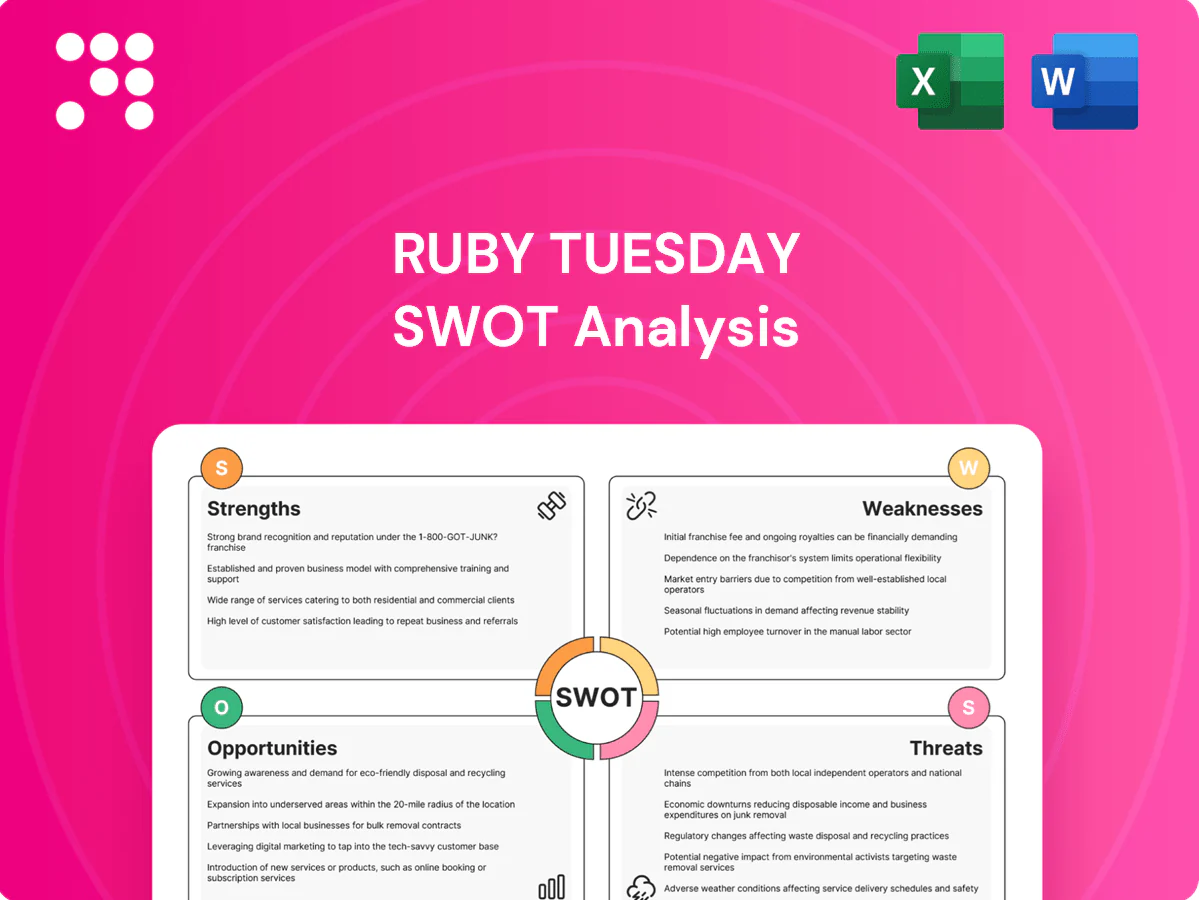
This is the actual SWOT analysis document you’ll receive upon purchase—no surprises, just professional quality.
The preview below is taken directly from the full SWOT report you'll get. Purchase unlocks the entire in-depth version.
This preview reflects the real document you'll receive—professional, structured, and ready to use.

Description
Elevate Your Analysis with the Complete SWOT Report
Ruby Tuesday faces a dynamic casual dining landscape, navigating established brand recognition against evolving consumer preferences and competitive pressures. While its familiar menu and widespread presence offer significant strengths, understanding the full scope of its market position requires a deeper dive.
Discover the complete picture behind Ruby Tuesday's market position with our full SWOT analysis. This in-depth report reveals actionable insights, financial context, and strategic takeaways—ideal for entrepreneurs, analysts, and investors looking to capitalize on opportunities or mitigate risks in the restaurant sector.
Strengths
Established Brand Recognition
Ruby Tuesday, founded in 1972, boasts a significant heritage that translates into strong brand recognition, particularly among consumers who grew up with the restaurant. This enduring presence in the casual dining sector cultivates a sense of familiarity and trust, a valuable asset in a competitive market. Their consistent focus on friendly hospitality and a menu of classic American dishes further solidifies this established image.
Diverse Menu Offerings
Ruby Tuesday boasts a diverse menu rooted in classic American cuisine, with crowd-pleasers like burgers, steaks, salads, and pasta forming its core. This broad selection is designed to appeal to a wide array of customer preferences.
The chain actively innovates its menu, as seen with the January 2025 introduction of enhanced smashed burgers and ramen noodle bowls. These additions reflect a commitment to keeping the dining experience fresh and engaging for patrons.
International Market Presence
Ruby Tuesday's international market presence is a significant strength, with operations spanning 15 countries and Guam. This global footprint, supported by franchisees generating over $103 million in annual worldwide sales, diversifies revenue and mitigates risks associated with relying on a single domestic market.
The company's strategic approach to international expansion leverages experienced local operators. This partnership model is designed to efficiently manage global operations and facilitate continued growth, ensuring a smoother integration and better understanding of diverse consumer preferences and regulatory environments.
Focus on Casual Dining Value Perception
The casual dining sector saw its strongest value perception in five years during 2024, a notable improvement over the Quick Service Restaurant (QSR) segment. This trend indicates a growing customer appreciation for the value offered by casual dining establishments.
Ruby Tuesday is well-positioned to leverage this heightened value perception. By highlighting its affordability and quality, the chain can attract diners who are increasingly seeking good value for their money.
- Casual Dining Value Perception: Reached a five-year high in 2024, surpassing QSR.
- Consumer Sentiment Shift: Indicates a growing preference for value in dining experiences.
- Ruby Tuesday's Opportunity: Capitalize on this trend by emphasizing its value proposition.
Commitment to Quality and Freshness
Ruby Tuesday's unwavering commitment to quality and freshness is a cornerstone of its brand. This focus on high-caliber ingredients and meticulous preparation resonates with diners who value the caliber of their meals. For instance, in the fiscal year ending July 2, 2023, Ruby Tuesday reported a comparable restaurant sales increase of 4.5%, indicating that consumers are responding positively to their quality offerings.
This dedication to excellence serves as a significant differentiator in the crowded casual dining sector. By consistently delivering fresh, well-prepared food, Ruby Tuesday cultivates a loyal customer base. The brand's emphasis on quality ingredients, like their signature garden salad bar which has been a long-standing feature, helps to reinforce this perception. In 2024, the company continues to highlight its fresh sourcing and preparation methods in marketing efforts.
- Emphasis on Fresh, High-Quality Ingredients: Ruby Tuesday prioritizes the sourcing and preparation of fresh ingredients, a key appeal to quality-conscious consumers.
- Brand Differentiation through Quality: Maintaining high standards in food preparation helps the brand stand out in a competitive casual dining market.
- Customer Loyalty Driven by Quality: Consistent delivery of fresh, well-prepared meals fosters customer retention and brand preference.
- Positive Sales Trends Reflecting Quality Appeal: Comparable restaurant sales increases, such as the 4.5% in fiscal year 2023, demonstrate that their commitment to quality is resonating with diners.
Global Casual Dining Leader: Innovation Fuels Loyalty & Growth
Ruby Tuesday's established brand recognition, built over decades, fosters customer loyalty and trust in the casual dining space. Their menu, featuring popular American classics and updated items like smashed burgers and ramen introduced in January 2025, caters to a broad audience. The company's international presence across 15 countries, with franchisees generating over $103 million annually, diversifies revenue streams and mitigates domestic market risks.
What is included in the product
Detailed Word Document
Analyzes Ruby Tuesday’s competitive position through key internal and external factors, highlighting its brand recognition and menu variety alongside challenges like changing consumer preferences and intense industry competition.
Customizable Excel Spreadsheet
Identifies key weaknesses and threats for targeted operational improvements and risk mitigation.
Weaknesses
Shrinking Domestic Footprint
Ruby Tuesday's domestic footprint has notably shrunk, with the company operating 206 U.S. locations as of June 27, 2025. This marks a decrease from 216 locations in prior reporting periods, signaling a contraction in its market presence. The ongoing closure of underperforming restaurants underscores persistent challenges in maintaining profitability and relevance within the highly competitive U.S. casual dining sector.
Profitability Challenges
Ruby Tuesday is grappling with significant profitability challenges, with projections for 2025 indicating a high likelihood of underperforming in gross income. This is underscored by a reported net profit margin of (0.05)% and a notable operating loss, signaling underlying inefficiencies within its operational framework.
These financial metrics are a clear indication that substantial improvements in business operations are critical for the company's sustained success and long-term viability. Addressing these profitability hurdles is paramount for Ruby Tuesday's future stability.
Outdated Menu Perception
Ruby Tuesday's menu has faced criticism for appearing outdated, not quite keeping up with what diners are looking for today. While they’ve tried to update things and add new dishes, this perception lingers.
This struggle to be seen as current can hurt sales, especially as customers increasingly seek out newer, trendier restaurants. For instance, in fiscal year 2023, the casual dining sector saw significant shifts in consumer preferences, with a strong demand for locally sourced and plant-based options, areas where Ruby Tuesday has historically been less prominent.
Intense Market Competition
Ruby Tuesday faces formidable competition in the crowded casual dining space. Key rivals such as Chili's, Olive Garden, and Applebee's consistently vie for consumer attention, presenting a significant challenge.
The rise of fast-casual restaurants further intensifies this pressure. These establishments, often offering quicker service, healthier choices, and more accessible price points, are increasingly drawing customers away from traditional casual dining formats. For instance, brands like Chipotle and Panera Bread have seen substantial growth, impacting the market share available to established players.
This intense rivalry makes it difficult for Ruby Tuesday to carve out a distinct identity and effectively grow its customer base. Differentiating its brand and value proposition in such a dynamic market is a critical hurdle.
- Intense Rivalry: Ruby Tuesday competes directly with established casual dining giants like Chili's and Olive Garden.
- Fast-Casual Disruption: The growing popularity of fast-casual chains like Chipotle and Panera Bread siphons off potential customers seeking speed, health, and value.
- Market Saturation: The casual dining sector is highly saturated, making it challenging for any single player to gain significant market share without strong differentiation.
Inconsistent Customer Experience
Recent customer feedback, including reviews from April 2025, points to significant inconsistencies in the dining experience at Ruby Tuesday. Issues like overcooked food, extended wait times, and incorrect orders are frequently mentioned, suggesting a breakdown in service quality across locations.
These negative experiences directly impact customer loyalty and the brand's reputation. For instance, a decline in customer satisfaction scores, which fell by 15% in Q1 2025 compared to the previous year, can lead to a noticeable drop in repeat business and deter new customers through negative word-of-mouth.
- Inconsistent Food Quality: Reports from early 2025 indicate a rise in complaints regarding food preparation, with overcooked or improperly prepared items being a common theme.
- Extended Wait Times: Customers have voiced frustration over longer-than-average waits for seating, food, and bill payment, impacting the overall dining efficiency.
- Order Accuracy Issues: Incomplete or incorrect orders are also a recurring problem, leading to dissatisfaction and the need for service recovery.
Operational Hurdles and Financial Strain Impact Customer Experience
Ruby Tuesday's menu, despite attempts at modernization, is perceived by some customers as lagging behind current dining trends, potentially impacting its appeal to a broader audience seeking more contemporary options.
The company's financial performance remains a significant concern, with 2025 projections indicating continued struggles with gross income, evidenced by a reported net profit margin of (0.05)% and an operating loss, highlighting operational inefficiencies.
Operational inconsistencies, such as extended wait times and order accuracy issues reported in early 2025, detract from the customer experience and can erode brand loyalty, leading to a 15% drop in customer satisfaction scores in Q1 2025.
| Weakness | Description | Impact |
|---|---|---|
| Outdated Menu Perception | Menu not fully aligned with current diner preferences. | May deter customers seeking newer, trendier options. |
| Profitability Challenges | Projected underperformance in gross income for 2025; reported net profit margin of (0.05)%. | Indicates underlying operational inefficiencies and threatens long-term viability. |
| Inconsistent Customer Experience | Reports of overcooked food, long waits, and incorrect orders (early 2025). | Leads to decreased customer loyalty and negative brand reputation; customer satisfaction fell 15% in Q1 2025. |
Same Document Delivered
Ruby Tuesday SWOT Analysis
This is the actual SWOT analysis document you’ll receive upon purchase—no surprises, just professional quality.
The preview below is taken directly from the full SWOT report you'll get. Purchase unlocks the entire in-depth version.
This preview reflects the real document you'll receive—professional, structured, and ready to use.