Qunar.Com, Inc. SWOT Analysis

Your Strategic Toolkit Starts Here
Qunar.com’s SWOT highlights a strong brand and travel-tech platform with solid user reach, offset by thin margins, regulatory sensitivity, and intense competition from OTA giants; emerging international opportunities and data-driven personalization are clear growth levers. What you’ve seen is just the beginning—gain the full investor-ready SWOT in Word and Excel to strategize, present, and act with confidence.
Strengths

Leading travel meta-search and booking platform in China
As Qunar, majority-owned by Trip.com Group since 2015, strong brand recognition and high organic traffic drive lower-cost user acquisition and repeated visits. Its meta-search breadth lets users compare airlines, hotels and agencies in real time, positioning Qunar as a first-stop travel discovery gateway. Scale advantages from group ownership enable deeper inventory and stronger partner negotiation leverage, serving millions of users across China.
Comprehensive product breadth across flights, hotels, and ground transport
Coverage spans flights, hotels, trains, buses, car rentals and packages—Qunar, acquired by Trip.com Group in 2015, serves millions of users with end-to-end trip fulfilment.
Cross-sell across categories boosts average order value and monetization per user, while broad inventory raises match rates and conversion.
One-stop convenience improves retention and repeat purchase behavior for leisure and business travelers.

Dual monetization via commissions and advertising
Dual monetization via commissions and advertising diversifies Qunar.Com’s revenue, reducing dependence on a single line item. Commissions capture high-intent booking transactions while advertising monetizes large consideration-stage audiences and content traffic. This mix smooths yields across seasonality and demand cycles. It also enables revenue from non-booking content, reviews and user-generated travel guides.

Rich user-generated content and reviews
Rich user-generated reviews and travel guides on Qunar bolster trust and cut decision friction, supporting Trip.com Group ownership since 2015 and feeding higher conversion rates for suppliers beyond price alone. User content boosts organic SEO and repeat visits, while unique reviews and local tips differentiate listings and raise booking likelihood. Network effects strengthen as more users contribute, creating a deeper data moat over time.
- Trust: user reviews reduce purchase friction
- SEO: content drives organic traffic and repeat visits
- Conversion: differentiates suppliers beyond price
- Network effect: more contributors deepen data moat
Data and algorithmic pricing/aggregation capabilities
Qunar leverages real-time aggregation and pricing intelligence to surface competitive deals rapidly, improving deal discovery and user stickiness. Advanced ranking and recommendation models empirically raise conversion rates and ad ROI while large-scale behavioral data strengthens fraud detection and content quality. Continuous online learning loops compound accuracy and defensibility over time.
- Real-time aggregation
- Improved ranking & recommendation
- Data-driven fraud detection
- Continuous learning for defensibility
Meta-search travel platform: real-time aggregation, ML ranking, higher conversion and dual revenue
Qunar, majority-owned by Trip.com Group since 2015, is a high-traffic meta-search and full-service travel platform serving millions of users across flights, hotels, trains and packages. Strengths include strong brand/SEO, rich user reviews and content, group-scale inventory/negotiation leverage, cross-sell that boosts AOV, and dual revenue from commissions and advertising. Real-time aggregation plus ML-driven ranking improves conversion and ad ROI.
| Metric | Fact |
|---|---|
| Ownership | Trip.com Group (since 2015) |
| Scale | Serves millions of users (platform-wide) |
| Coverage | Flights, hotels, trains, buses, cars, packages |
| Monetization | Commissions & advertising |
What is included in the product
 Detailed Word Document
Provides a concise SWOT analysis of Qunar.Com, Inc., highlighting internal strengths and weaknesses and external opportunities and threats shaping its competitive position in the online travel services market.

 Customizable Excel Spreadsheet
Provides a concise SWOT matrix to quickly pinpoint Qunar.com's vulnerabilities and strengths, enabling rapid prioritization of fixes for customer acquisition, platform reliability, and competitive positioning.
Weaknesses

Dependence on third-party suppliers and OTAs
Qunar’s heavy reliance on airlines, hotels and travel agencies exposes it to supply restrictions and conflicts that can reduce available inventory and price competitiveness. Inventory pullbacks or exclusivity deals by partners have in the past degraded user experience and conversion rates. Partner disputes can cascade into service disruptions and cancellations, while Qunar’s bargaining power is constrained versus dominant hotel chains and carrier alliances.
Intense price competition and thin take rates
Chinese online travel is highly promotional, compressing margins as platforms chase share; meta-search models typically earn lower take rates of about 1–3% versus 8–15% for direct OTA bookings. Price wars force higher subsidies and raise customer acquisition costs, eroding unit economics. Profitability is volatile across peak and off-peak seasons, amplifying the impact of thin take rates on cash flow.

Service quality and dispute resolution challenges
Fragmented supplier base at Qunar, acquired by Trip.com Group in 2015, increases risk of post-booking issues and complicates refunds, changes and overbooking resolution. Slow handling of these events erodes satisfaction and fuels negative social media attention, where isolated incidents can trend rapidly. Rising customer-support demands squeeze unit economics through higher per-booking support costs.

High exposure to China travel market cycles
Heavy concentration in the China travel market makes Qunar highly sensitive to local macro swings; 2023 domestic tourism revenue totaled RMB 5.8 trillion (Ministry of Culture and Tourism), so policy shifts or localized disruptions can sharply hit booking demand and revenue.
- Concentration: domestic exposure raises cyclicality
- Policy risk: local restrictions can cut demand
- Diversification: limited international mix amplifies volatility
- FX/outbound: currency and travel controls constrain growth
Trust risks from inaccurate listings or fake reviews
Trust risks from inaccurate listings or fake reviews undermine Qunar.com’s credibility: ensuring quality control across thousands of partners is complex, inaccurate availability or pricing leads to booking failures, and manipulated reviews can mislead users and trigger platform or regulator penalties, requiring continuous investment in verification and moderation.
- Complex partner QA
- Inaccurate pricing/availability
- Fake reviews risk
- Ongoing verification costs
Dependence on airlines, hotels and meta-search 1–3% take rates squeeze margins
Heavy reliance on airlines, hotels and agencies constrains inventory and bargaining power, risking cancellations and conversion drops. Meta-search take rates run about 1–3% versus 8–15% for direct OTA bookings, compressing margins and forcing promotional spend. Concentration in China ties performance to domestic tourism (RMB 5.8 trillion in 2023). Trust issues from inaccurate listings and fake reviews raise verification costs.
| Metric | Figure |
|---|---|
| Meta-search take rate | 1–3% |
| Direct OTA take rate | 8–15% |
| China domestic tourism (2023) | RMB 5.8 trillion |
| Acquisition by Trip.com Group | 2015 |
Same Document Delivered
Qunar.Com, Inc. SWOT Analysis
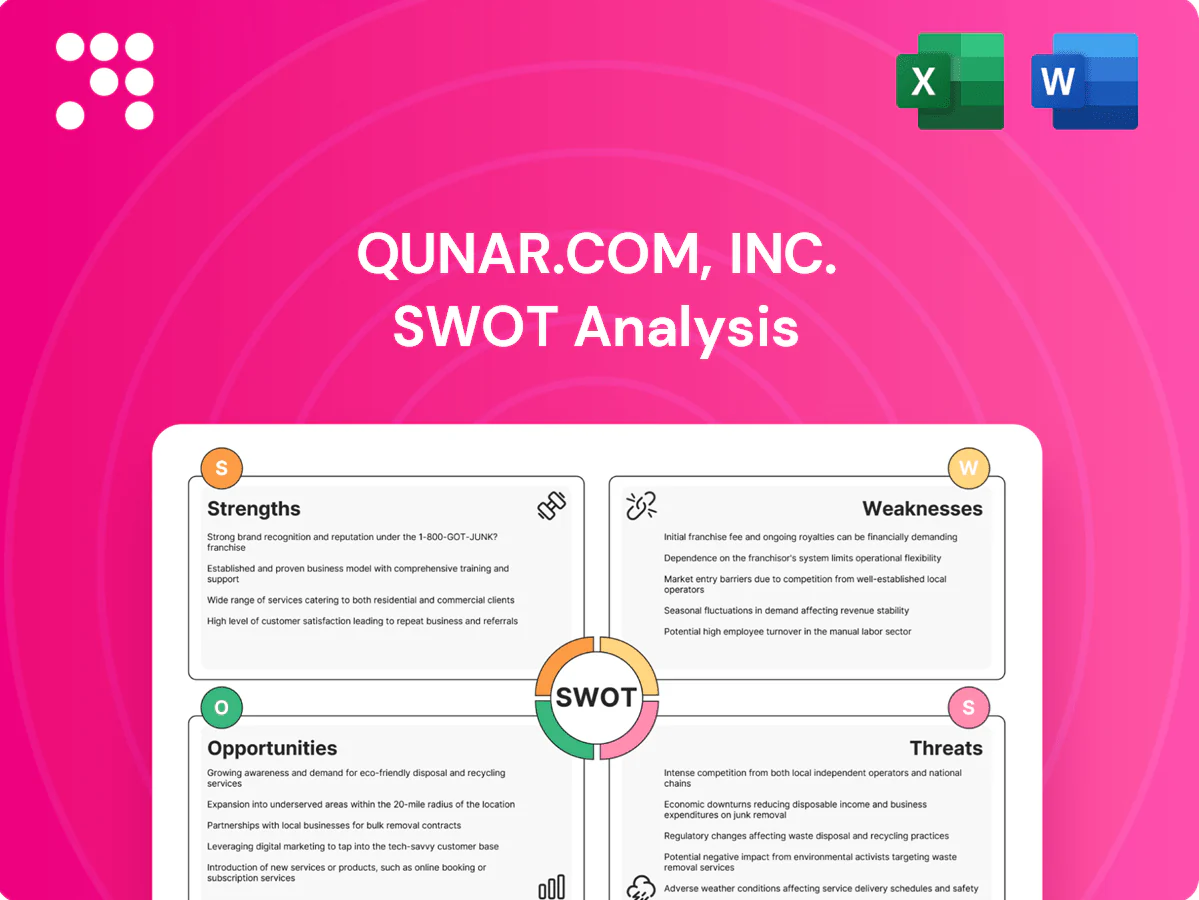
This is the actual SWOT analysis document for Qunar.Com, Inc. you’ll receive upon purchase—no surprises, just professional quality. The preview below is taken directly from the full SWOT report and reflects the complete structure and findings. Buy now to unlock the full, editable version immediately after payment.

Description
Your Strategic Toolkit Starts Here
Qunar.com’s SWOT highlights a strong brand and travel-tech platform with solid user reach, offset by thin margins, regulatory sensitivity, and intense competition from OTA giants; emerging international opportunities and data-driven personalization are clear growth levers. What you’ve seen is just the beginning—gain the full investor-ready SWOT in Word and Excel to strategize, present, and act with confidence.
Strengths
Leading travel meta-search and booking platform in China
As Qunar, majority-owned by Trip.com Group since 2015, strong brand recognition and high organic traffic drive lower-cost user acquisition and repeated visits. Its meta-search breadth lets users compare airlines, hotels and agencies in real time, positioning Qunar as a first-stop travel discovery gateway. Scale advantages from group ownership enable deeper inventory and stronger partner negotiation leverage, serving millions of users across China.
Comprehensive product breadth across flights, hotels, and ground transport
Coverage spans flights, hotels, trains, buses, car rentals and packages—Qunar, acquired by Trip.com Group in 2015, serves millions of users with end-to-end trip fulfilment.
Cross-sell across categories boosts average order value and monetization per user, while broad inventory raises match rates and conversion.
One-stop convenience improves retention and repeat purchase behavior for leisure and business travelers.
Dual monetization via commissions and advertising
Dual monetization via commissions and advertising diversifies Qunar.Com’s revenue, reducing dependence on a single line item. Commissions capture high-intent booking transactions while advertising monetizes large consideration-stage audiences and content traffic. This mix smooths yields across seasonality and demand cycles. It also enables revenue from non-booking content, reviews and user-generated travel guides.
Rich user-generated content and reviews
Rich user-generated reviews and travel guides on Qunar bolster trust and cut decision friction, supporting Trip.com Group ownership since 2015 and feeding higher conversion rates for suppliers beyond price alone. User content boosts organic SEO and repeat visits, while unique reviews and local tips differentiate listings and raise booking likelihood. Network effects strengthen as more users contribute, creating a deeper data moat over time.
- Trust: user reviews reduce purchase friction
- SEO: content drives organic traffic and repeat visits
- Conversion: differentiates suppliers beyond price
- Network effect: more contributors deepen data moat
Data and algorithmic pricing/aggregation capabilities
Qunar leverages real-time aggregation and pricing intelligence to surface competitive deals rapidly, improving deal discovery and user stickiness. Advanced ranking and recommendation models empirically raise conversion rates and ad ROI while large-scale behavioral data strengthens fraud detection and content quality. Continuous online learning loops compound accuracy and defensibility over time.
- Real-time aggregation
- Improved ranking & recommendation
- Data-driven fraud detection
- Continuous learning for defensibility
Meta-search travel platform: real-time aggregation, ML ranking, higher conversion and dual revenue
Qunar, majority-owned by Trip.com Group since 2015, is a high-traffic meta-search and full-service travel platform serving millions of users across flights, hotels, trains and packages. Strengths include strong brand/SEO, rich user reviews and content, group-scale inventory/negotiation leverage, cross-sell that boosts AOV, and dual revenue from commissions and advertising. Real-time aggregation plus ML-driven ranking improves conversion and ad ROI.
| Metric | Fact |
|---|---|
| Ownership | Trip.com Group (since 2015) |
| Scale | Serves millions of users (platform-wide) |
| Coverage | Flights, hotels, trains, buses, cars, packages |
| Monetization | Commissions & advertising |
What is included in the product
Detailed Word Document
Provides a concise SWOT analysis of Qunar.Com, Inc., highlighting internal strengths and weaknesses and external opportunities and threats shaping its competitive position in the online travel services market.
Customizable Excel Spreadsheet
Provides a concise SWOT matrix to quickly pinpoint Qunar.com's vulnerabilities and strengths, enabling rapid prioritization of fixes for customer acquisition, platform reliability, and competitive positioning.
Weaknesses
Dependence on third-party suppliers and OTAs
Qunar’s heavy reliance on airlines, hotels and travel agencies exposes it to supply restrictions and conflicts that can reduce available inventory and price competitiveness. Inventory pullbacks or exclusivity deals by partners have in the past degraded user experience and conversion rates. Partner disputes can cascade into service disruptions and cancellations, while Qunar’s bargaining power is constrained versus dominant hotel chains and carrier alliances.
Intense price competition and thin take rates
Chinese online travel is highly promotional, compressing margins as platforms chase share; meta-search models typically earn lower take rates of about 1–3% versus 8–15% for direct OTA bookings. Price wars force higher subsidies and raise customer acquisition costs, eroding unit economics. Profitability is volatile across peak and off-peak seasons, amplifying the impact of thin take rates on cash flow.
Service quality and dispute resolution challenges
Fragmented supplier base at Qunar, acquired by Trip.com Group in 2015, increases risk of post-booking issues and complicates refunds, changes and overbooking resolution. Slow handling of these events erodes satisfaction and fuels negative social media attention, where isolated incidents can trend rapidly. Rising customer-support demands squeeze unit economics through higher per-booking support costs.
High exposure to China travel market cycles
Heavy concentration in the China travel market makes Qunar highly sensitive to local macro swings; 2023 domestic tourism revenue totaled RMB 5.8 trillion (Ministry of Culture and Tourism), so policy shifts or localized disruptions can sharply hit booking demand and revenue.
- Concentration: domestic exposure raises cyclicality
- Policy risk: local restrictions can cut demand
- Diversification: limited international mix amplifies volatility
- FX/outbound: currency and travel controls constrain growth
Trust risks from inaccurate listings or fake reviews
Trust risks from inaccurate listings or fake reviews undermine Qunar.com’s credibility: ensuring quality control across thousands of partners is complex, inaccurate availability or pricing leads to booking failures, and manipulated reviews can mislead users and trigger platform or regulator penalties, requiring continuous investment in verification and moderation.
- Complex partner QA
- Inaccurate pricing/availability
- Fake reviews risk
- Ongoing verification costs
Dependence on airlines, hotels and meta-search 1–3% take rates squeeze margins
Heavy reliance on airlines, hotels and agencies constrains inventory and bargaining power, risking cancellations and conversion drops. Meta-search take rates run about 1–3% versus 8–15% for direct OTA bookings, compressing margins and forcing promotional spend. Concentration in China ties performance to domestic tourism (RMB 5.8 trillion in 2023). Trust issues from inaccurate listings and fake reviews raise verification costs.
| Metric | Figure |
|---|---|
| Meta-search take rate | 1–3% |
| Direct OTA take rate | 8–15% |
| China domestic tourism (2023) | RMB 5.8 trillion |
| Acquisition by Trip.com Group | 2015 |
Same Document Delivered
Qunar.Com, Inc. SWOT Analysis
This is the actual SWOT analysis document for Qunar.Com, Inc. you’ll receive upon purchase—no surprises, just professional quality. The preview below is taken directly from the full SWOT report and reflects the complete structure and findings. Buy now to unlock the full, editable version immediately after payment.