The RMR Group Porter's Five Forces Analysis

Go Beyond the Preview—Access the Full Strategic Report
The RMR Group faces nuanced competitive pressures—from tenant bargaining power and asset-level concentration to barriers restricting new entrants—and our snapshot highlights key friction points and strategic levers. Unlock the full Porter's Five Forces Analysis to explore force-by-force ratings, visuals, and actionable insights to guide smarter investment and strategy decisions.
Suppliers Bargaining Power

Concentrated capital markets counterparties
Debt providers and investment banks that underwrite acquisitions, refinancings and dispositions are few and large—top U.S. banks hold about 45% of total U.S. banking assets—giving them leverage over pricing and covenants. In tight credit cycles lenders have imposed covenant constraints that can limit fee-generating services and delay capital deployment. Such covenant pressure compresses transaction fees and slows dispositions. RMR must diversify financing sources to reduce concentration risk.
Critical property-level vendors
Property managers, facility services, and construction contractors drive operating costs and asset quality for RMR-managed assets; shortages of qualified vendors in certain geographies and specialties raise switching costs and operational risk. Cost inflation and labor constraints can compress NOI and thus performance-linked management fees. Preferred vendor networks and long-term contracts help dampen volatility and preserve margins.

Data and technology platforms
RMR’s reliance on third‑party real estate data, ESG reporting tools and leasing/asset management software concentrates supplier power; with RMR advising roughly $18 billion AUM in 2024, vendor price hikes or integration frictions can materially raise overhead and constrain scalability. Loss of access slows underwriting and investor reporting cycles. Multi‑vendor setups and negotiated enterprise licenses help mitigate this exposure.

Talent and specialized expertise
Experienced asset managers, leasing professionals, and capital markets teams are scarce in certain REIT sub-sectors and regions, with specialized-role turnover often exceeding 20% and larger alternative managers paying 20–40% compensation premiums in 2024, elevating RMRs hiring costs and bargaining power of talent suppliers.
- Talent scarcity: high in niche sub-sectors
- Comp premium: 20–40% vs. smaller firms (2024)
- Turnover risk: >20% in specialized roles
- Mitigation: succession planning and incentive alignment
Insurance and compliance services
- 2024 premium increase: ~10–25%
- Rebid cadence: 2–3 years
- Impact: NOI and fee base compression
- Mitigation: bundling + competitive RFPs
High supplier power: banks 45%, insurers +10–25%
Debt providers, insurers, vendors and specialized talent exert moderate-to-high supplier power for RMR: top U.S. banks hold ~45% of assets, lending covenants tighten pricing; insurance premiums rose ~10–25% in 2024; talent premiums 20–40% with turnover >20%; third‑party tech/vendor concentration on ~$18bn AUM raises scalability risk.
| Supplier | 2024 metric |
|---|---|
| Banks | 45% market share |
| Insurance | +10–25% prem |
| Talent | 20–40% prem; >20% turnover |
| Tech vendors | $18bn AUM exposure |
What is included in the product
 Detailed Word Document
Tailored Porter's Five Forces analysis for The RMR Group, uncovering key competitive drivers, buyer and supplier power, barriers to entry, threat of substitutes, and emerging disruptors that shape pricing, profitability, and strategic positioning.

 Customizable Excel Spreadsheet
A concise one-sheet Porter’s Five Forces for The RMR Group that highlights competitive threats and bargaining pressures, ready to drop into decks; customize pressure levels, swap in your data, and model scenarios without macros—ideal for quick strategic decisions and boardroom-ready summaries.
Customers Bargaining Power

Affiliated REITs with governance oversight
RMR advises 19 publicly traded REITs whose independent boards have significant leverage to press for fee cuts, performance hurdles and higher service levels after underperformance. Long-dated management contracts (commonly 3–5 year terms) limit churn but concentrate bargaining power at renewal windows. Transparent KPIs—FFO, TSR and peer-median benchmarking—drive renegotiations and fee outcomes. Boards routinely use peer metrics to justify changes.
Fee sensitivity amid market cycles
Fee sensitivity amid market cycles forces clients in 2024 to push for lower base fees and higher variable/performance components, compressing margins and increasing RMRs earnings volatility. Strong relative performance can offset fee pressure, but weak leasing or distressed dispositions amplify buyer power and renegotiation risk. Packaging services and quantifying cost-to-value with client-level metrics helps defend pricing and stabilize revenue mix.

Potential to internalize management
Some REITs may internalize management to cut recurring fees and gain control; the credible threat is meaningful given rising activist activity in 2024.
Even without execution, the threat strengthens tenant/owner bargaining, particularly after scale-up or proxy fights when internalization risk spikes.
RMR counters with scope, systems and scale—advising 22 public REITs as of 2024—advantages costly for incumbents to replicate.

Client concentration risk
Revenue at RMR Group is concentrated in a limited number of affiliated entities, so any mandate reduction or termination can materially impact cash flows; this concentration magnifies buyer leverage in fee negotiations and renewal terms. Diversifying mandates and expanding adjacencies reduces dependence and mitigates downside risk.
- Client concentration: limited affiliated entities
- Impact: mandate loss materially affects cash flow
- Bargaining power: magnified buyer leverage
- Mitigation: diversify mandates and adjacencies
Access to competing managers
Large real estate managers and advisors court REITs with lower fees or broader platforms, and in 2024 the largest 10 global asset managers held over 100 trillion in AUM, increasing available alternatives. Availability of competitors raises switching options at contract events; comparative track records and cost structures (fee spreads often 10–50 bps) are closely scrutinized. Differentiated sector expertise and tenant/owner relationships can blunt this bargaining power.
- Competition: >100T AUM (top 10, 2024)
- Fee spread: 10–50 bps
- Switch points: contract renewals
- Defense: niche expertise & relationships
Boards use advisory rollovers to push fee cuts as activism compresses REIT manager fees
RMR advises 22 public REITs (2024), giving client boards leverage to demand fee cuts, performance hurdles and higher service levels at renewals; long-dated contracts concentrate bargaining power at rollovers. Transparent KPIs (FFO, TSR, peer benchmarks) and rising 2024 activism increase internalization threat, compressing base fees and raising variable pay. Top-10 managers hold >100T AUM (2024), widening alternatives and tightening fee spreads (10–50 bps), while RMR scale and niche expertise partially defend pricing.
| Metric | 2024 |
|---|---|
| Public REITs advised | 22 |
| Top-10 managers AUM | >100T |
| Typical fee spread | 10–50 bps |
What You See Is What You Get
The RMR Group Porter's Five Forces Analysis
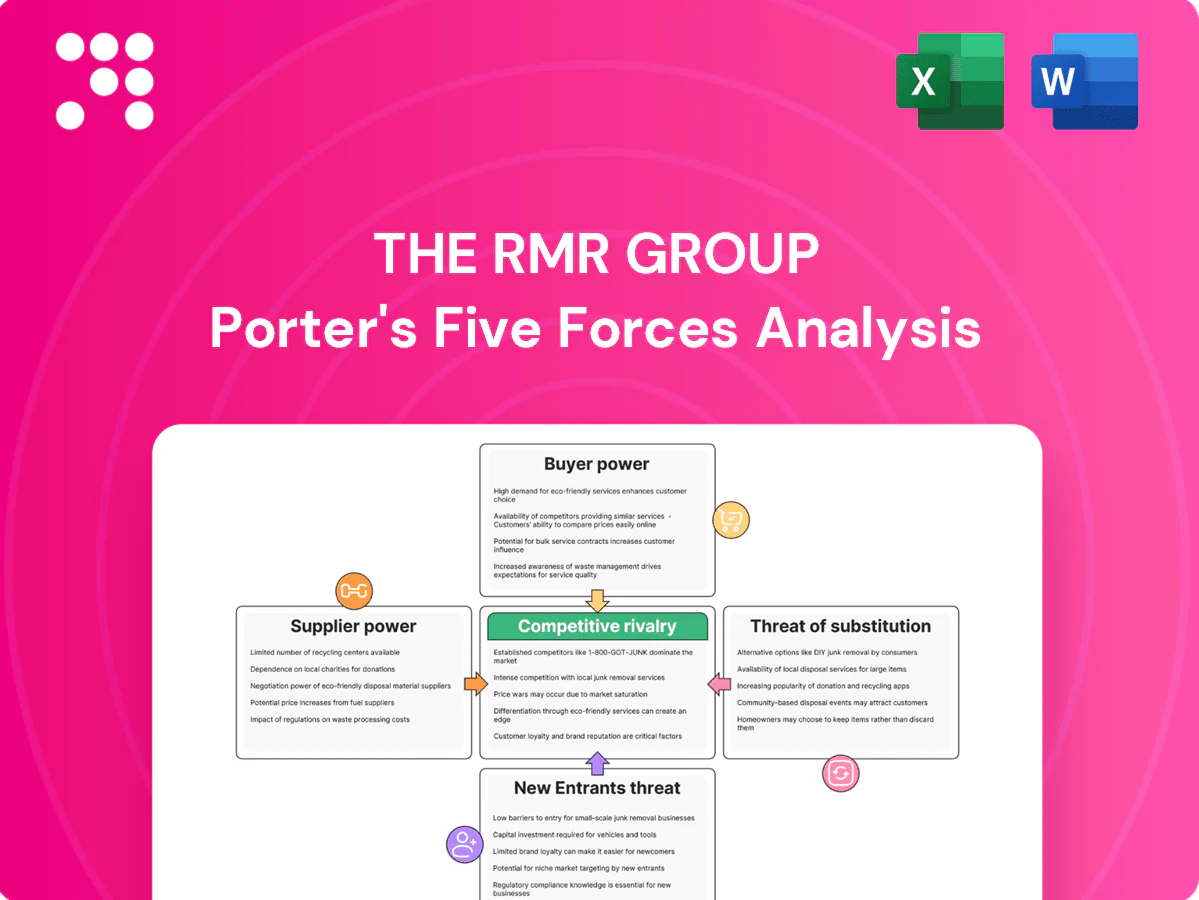
This preview shows the exact Porter’s Five Forces analysis of The RMR Group you'll receive immediately after purchase—no placeholders or mockups. The document is fully formatted, professionally written and ready for download and use the moment you buy. What you see here is the complete deliverable, available instantly upon payment.

Description
Go Beyond the Preview—Access the Full Strategic Report
The RMR Group faces nuanced competitive pressures—from tenant bargaining power and asset-level concentration to barriers restricting new entrants—and our snapshot highlights key friction points and strategic levers. Unlock the full Porter's Five Forces Analysis to explore force-by-force ratings, visuals, and actionable insights to guide smarter investment and strategy decisions.
Suppliers Bargaining Power
Concentrated capital markets counterparties
Debt providers and investment banks that underwrite acquisitions, refinancings and dispositions are few and large—top U.S. banks hold about 45% of total U.S. banking assets—giving them leverage over pricing and covenants. In tight credit cycles lenders have imposed covenant constraints that can limit fee-generating services and delay capital deployment. Such covenant pressure compresses transaction fees and slows dispositions. RMR must diversify financing sources to reduce concentration risk.
Critical property-level vendors
Property managers, facility services, and construction contractors drive operating costs and asset quality for RMR-managed assets; shortages of qualified vendors in certain geographies and specialties raise switching costs and operational risk. Cost inflation and labor constraints can compress NOI and thus performance-linked management fees. Preferred vendor networks and long-term contracts help dampen volatility and preserve margins.
Data and technology platforms
RMR’s reliance on third‑party real estate data, ESG reporting tools and leasing/asset management software concentrates supplier power; with RMR advising roughly $18 billion AUM in 2024, vendor price hikes or integration frictions can materially raise overhead and constrain scalability. Loss of access slows underwriting and investor reporting cycles. Multi‑vendor setups and negotiated enterprise licenses help mitigate this exposure.
Talent and specialized expertise
Experienced asset managers, leasing professionals, and capital markets teams are scarce in certain REIT sub-sectors and regions, with specialized-role turnover often exceeding 20% and larger alternative managers paying 20–40% compensation premiums in 2024, elevating RMRs hiring costs and bargaining power of talent suppliers.
- Talent scarcity: high in niche sub-sectors
- Comp premium: 20–40% vs. smaller firms (2024)
- Turnover risk: >20% in specialized roles
- Mitigation: succession planning and incentive alignment
Insurance and compliance services
- 2024 premium increase: ~10–25%
- Rebid cadence: 2–3 years
- Impact: NOI and fee base compression
- Mitigation: bundling + competitive RFPs
High supplier power: banks 45%, insurers +10–25%
Debt providers, insurers, vendors and specialized talent exert moderate-to-high supplier power for RMR: top U.S. banks hold ~45% of assets, lending covenants tighten pricing; insurance premiums rose ~10–25% in 2024; talent premiums 20–40% with turnover >20%; third‑party tech/vendor concentration on ~$18bn AUM raises scalability risk.
| Supplier | 2024 metric |
|---|---|
| Banks | 45% market share |
| Insurance | +10–25% prem |
| Talent | 20–40% prem; >20% turnover |
| Tech vendors | $18bn AUM exposure |
What is included in the product
Detailed Word Document
Tailored Porter's Five Forces analysis for The RMR Group, uncovering key competitive drivers, buyer and supplier power, barriers to entry, threat of substitutes, and emerging disruptors that shape pricing, profitability, and strategic positioning.
Customizable Excel Spreadsheet
A concise one-sheet Porter’s Five Forces for The RMR Group that highlights competitive threats and bargaining pressures, ready to drop into decks; customize pressure levels, swap in your data, and model scenarios without macros—ideal for quick strategic decisions and boardroom-ready summaries.
Customers Bargaining Power
Affiliated REITs with governance oversight
RMR advises 19 publicly traded REITs whose independent boards have significant leverage to press for fee cuts, performance hurdles and higher service levels after underperformance. Long-dated management contracts (commonly 3–5 year terms) limit churn but concentrate bargaining power at renewal windows. Transparent KPIs—FFO, TSR and peer-median benchmarking—drive renegotiations and fee outcomes. Boards routinely use peer metrics to justify changes.
Fee sensitivity amid market cycles
Fee sensitivity amid market cycles forces clients in 2024 to push for lower base fees and higher variable/performance components, compressing margins and increasing RMRs earnings volatility. Strong relative performance can offset fee pressure, but weak leasing or distressed dispositions amplify buyer power and renegotiation risk. Packaging services and quantifying cost-to-value with client-level metrics helps defend pricing and stabilize revenue mix.
Potential to internalize management
Some REITs may internalize management to cut recurring fees and gain control; the credible threat is meaningful given rising activist activity in 2024.
Even without execution, the threat strengthens tenant/owner bargaining, particularly after scale-up or proxy fights when internalization risk spikes.
RMR counters with scope, systems and scale—advising 22 public REITs as of 2024—advantages costly for incumbents to replicate.
Client concentration risk
Revenue at RMR Group is concentrated in a limited number of affiliated entities, so any mandate reduction or termination can materially impact cash flows; this concentration magnifies buyer leverage in fee negotiations and renewal terms. Diversifying mandates and expanding adjacencies reduces dependence and mitigates downside risk.
- Client concentration: limited affiliated entities
- Impact: mandate loss materially affects cash flow
- Bargaining power: magnified buyer leverage
- Mitigation: diversify mandates and adjacencies
Access to competing managers
Large real estate managers and advisors court REITs with lower fees or broader platforms, and in 2024 the largest 10 global asset managers held over 100 trillion in AUM, increasing available alternatives. Availability of competitors raises switching options at contract events; comparative track records and cost structures (fee spreads often 10–50 bps) are closely scrutinized. Differentiated sector expertise and tenant/owner relationships can blunt this bargaining power.
- Competition: >100T AUM (top 10, 2024)
- Fee spread: 10–50 bps
- Switch points: contract renewals
- Defense: niche expertise & relationships
Boards use advisory rollovers to push fee cuts as activism compresses REIT manager fees
RMR advises 22 public REITs (2024), giving client boards leverage to demand fee cuts, performance hurdles and higher service levels at renewals; long-dated contracts concentrate bargaining power at rollovers. Transparent KPIs (FFO, TSR, peer benchmarks) and rising 2024 activism increase internalization threat, compressing base fees and raising variable pay. Top-10 managers hold >100T AUM (2024), widening alternatives and tightening fee spreads (10–50 bps), while RMR scale and niche expertise partially defend pricing.
| Metric | 2024 |
|---|---|
| Public REITs advised | 22 |
| Top-10 managers AUM | >100T |
| Typical fee spread | 10–50 bps |
What You See Is What You Get
The RMR Group Porter's Five Forces Analysis
This preview shows the exact Porter’s Five Forces analysis of The RMR Group you'll receive immediately after purchase—no placeholders or mockups. The document is fully formatted, professionally written and ready for download and use the moment you buy. What you see here is the complete deliverable, available instantly upon payment.