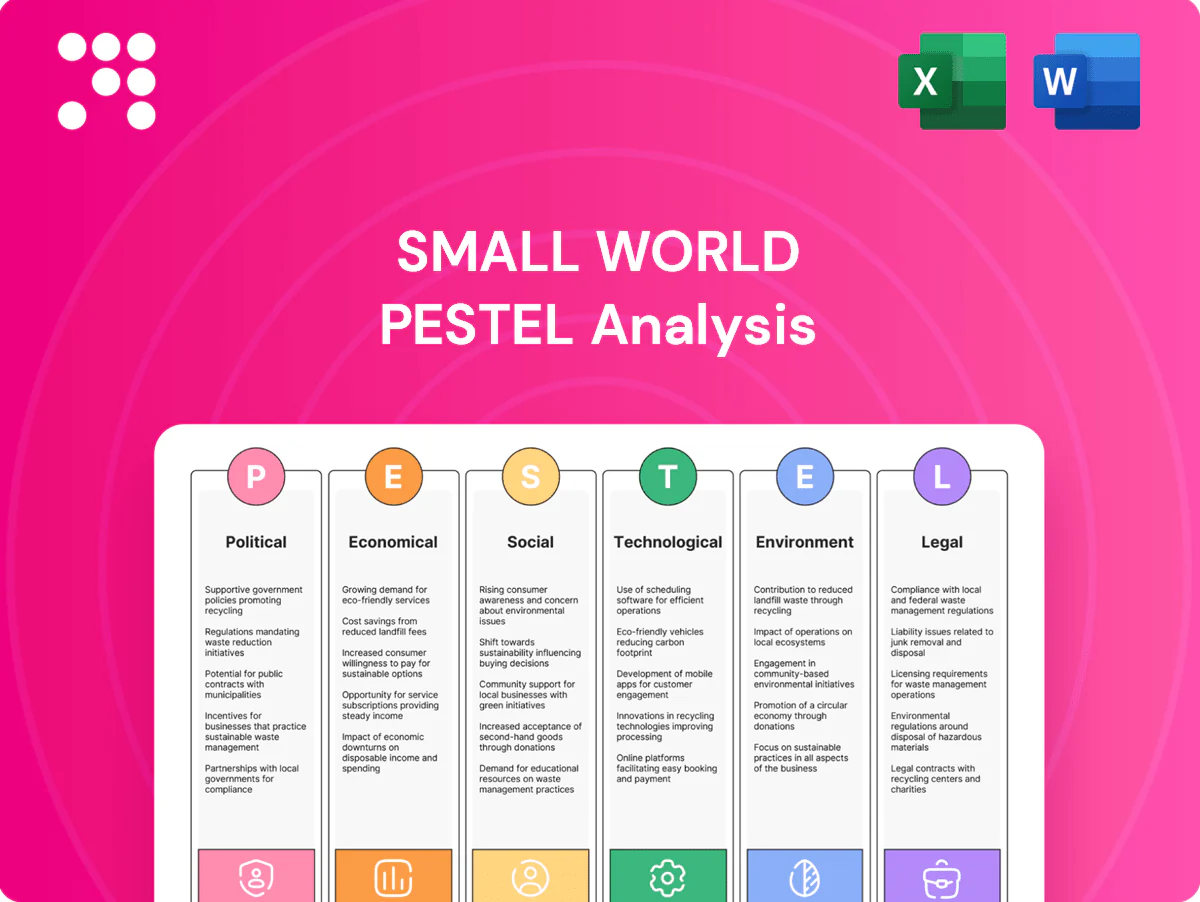
Qunar.Com, Inc. PESTLE Analysis

Skip the Research. Get the Strategy.
Our PESTLE analysis of Qunar.Com, Inc. reveals how regulatory shifts, economic cycles, social trends, and technology disruptions shape its travel marketplace. You’ll see actionable risks and growth levers tied to legal changes and environmental pressures. Ideal for investors and strategists seeking a competitive edge. Buy the full report to access the complete, ready-to-use analysis.
Political factors

Regulatory oversight of online platforms
China’s intensified scrutiny of platform firms since 2020 affects OTA pricing, display order and fair competition, forcing Qunar to reconsider ranking algorithms and commission models; regulators’ high-profile penalties, such as Alibaba’s 18.228 billion RMB antitrust fine in 2021, signal enforcement risk. Policy shifts can quickly reallocate traffic between suppliers and aggregators, making compliance investments a recurring operating cost for Qunar.
Data localization and cybersecurity enforcement
Strict Chinese data-security and localization rules force Qunar to store and process domestic user data and choose onshore cloud and vetted vendors, with cross-border transfers subject to CAC security assessments when datasets exceed 1 million users. Under PIPL, violations can draw fines up to RMB 50 million or 5% of annual revenue and risk app-store removal or service suspension. Ongoing mandatory audits and reviews add measurable compliance costs and operational complexity.

Tourism promotion and domestic travel policy
Government initiatives to boost domestic consumption and culture-tourism lifted demand on Qunar, with China reporting about 5.2 billion domestic trips and roughly 4.0 trillion RMB tourism revenue in 2023, driving higher bookings. Subsidies, targeted coupons and occasional holiday extensions have produced sharp booking spikes, which Qunar can amplify by tailoring campaigns to policy-backed destinations. Heavy reliance on such policy tailwinds creates volatility if government priorities shift.

Cross-border travel and visa diplomacy
Cross-border travel for Qunar hinges on bilateral visas, flight quotas and geopolitical stability; UNWTO reports 2023 international arrivals reached about 88% of 2019, so relaxations quickly spike bookings while restrictions compress volumes, forcing Qunar to rebalance inventory exposure and routing within days; currency controls and settlement rules constrain payment flows and repatriation timing.
- Visas/quotas: immediate demand swings
- Inventory: rapid rebalancing required
- Payments: currency controls affect cash flow
Content governance and information controls
User reviews, guides and forums on Qunar must meet Chinese content standards; platforms must implement moderation workflows to satisfy takedown obligations and real-name requirements under the Cybersecurity Law (2017), Data Security Law (2021) and 2022 Algorithm Measures.
- China internet users: 1.05 billion (CNNIC, Jun 2024)
- Non-compliance: fines, account limits, visibility penalties
- Policies drive moderation, product trust and community engagement
Regulatory crackdown and data law fines reshape OTA models amid volatile post-pandemic travel demand
Regulatory scrutiny since 2020 (eg Alibaba RMB 18.228bn fine) raises enforcement risk for Qunar, forcing algorithm, commission and compliance redesigns; data laws (PIPL/Data Security) require onshore storage and can levy up to RMB 50m or 5% revenue fines. Policy-driven tourism stimulus (≈5.2bn domestic trips; RMB 4.0tn revenue in 2023) and easing cross-border travel (2023 arrivals ≈88% of 2019) create volatile demand spikes.
| Metric | Value | Relevance |
|---|---|---|
| China internet users | 1.05bn (Jun 2024) | Addressable market |
| Domestic trips | 5.2bn (2023) | Booking volume driver |
| Antitrust fine | RMB 18.228bn (Alibaba, 2021) | Enforcement precedent |
What is included in the product
 Detailed Word Document
Explores how Political, Economic, Social, Technological, Environmental and Legal forces uniquely shape Qunar.com, Inc., combining data-driven trend analysis with industry-specific examples to identify risks and opportunities for executives, investors and strategists.

 Customizable Excel Spreadsheet
A concise, visually segmented Qunar.com, Inc. PESTLE summary that’s easy to drop into presentations, share across teams, and customize with notes—ideal for quick alignment on external risks, regulatory shifts, and market positioning.
Economic factors

Consumer spending cycles
Travel demand closely tracks income growth and consumer confidence; UNWTO reports 1.4 billion international arrivals in 2023, reflecting broad recovery. Economic slowdowns typically shift bookings toward budget options and shorter stays, compressing average order value that Qunar’s commission-driven model depends on. Dynamic promotions and targeted discounts can help defend volumes during weak cycles by preserving transaction counts even as AOV falls.
Airfare and fuel price pass-through
Airline fuel costs, which represent roughly 20–30% of carriers’ operating expenses (IATA), flow quickly into ticket prices and compress OTA conversion rates — short‑run price elasticity of demand for air travel is about −0.7. Higher fares drive shoppers to rail and bus alternatives (China HSR carried ~2.9 billion passengers in 2024), shifting Qunar’s product mix. Qunar’s broad inventory across transport modes hedges category swings, but margin per booking can swing with supplier pricing power and fare pass‑through.

Seasonality and holiday peaks
Golden Week, Lunar New Year and summer holidays trigger sharp demand spikes—May Day Golden Week 2023 saw about 309 million domestic trips, reflecting the scale Qunar must serve. Robust capacity planning and dynamic pricing algorithms are critical to capture peaks without degrading UX. Off-peak periods need targeted discounts and curated content to sustain bookings, while supply bottlenecks can divert users to alternative transport modes and destinations.

Competitive intensity and take rates
Rival OTAs and direct supplier channels squeeze Qunar.Com take rates by pressuring commissions and ad yields, while exclusive inventory, loyalty programs and fintech bundles from Trip.com Group act as partial defenses; bid costs for performance marketing further compress margins and require tighter ROI management, making metasearch differentiation essential to sustain traffic share.
- Competitive pressure: OTA/direct channels reduce commission yields
- Defensive levers: exclusive inventory, loyalty, fintech bundles
- Cost headwind: rising performance marketing bids
- Strategic priority: metasearch differentiation to retain traffic
FX and outbound travel affordability
RMB exchange-rate swings directly affect outbound trip affordability and supplier settlements; USD/CNY hovered around 7.3 in mid-2025, amplifying costs for many travelers. A weaker RMB shifts demand toward domestic and nearby markets, which Qunar can monetize by promoting currency-favorable destinations. Hedging programs and multicurrency payment options help Qunar and suppliers reduce FX volatility and margin risk.
- FX tag: USD/CNY ~7.3 (mid-2025)
- Demand shift: domestic/nearby markets
- Qunar levers: destination steering, hedging, multicurrency payments
Regulatory crackdown and data law fines reshape OTA models amid volatile post-pandemic travel demand
Travel recovery (1.4B int'l arrivals, 2023) boosts volume but economic slumps compress AOV; Qunar must protect transactions via discounts. Airline fuel = 20–30% of costs (IATA) with air elasticity ~−0.7, shifting demand to HSR (2.9B passengers, 2024). Holiday spikes (309M May Day 2023) and USD/CNY ~7.3 (mid‑2025) drive product mix and FX hedging needs.
| Metric | Value |
|---|---|
| Intl arrivals (2023) | 1.4B |
| China HSR (2024) | 2.9B |
| May Day trips (2023) | 309M |
| USD/CNY (mid‑2025) | ~7.3 |
| Airline fuel share | 20–30% |
Same Document Delivered
Qunar.Com, Inc. PESTLE Analysis
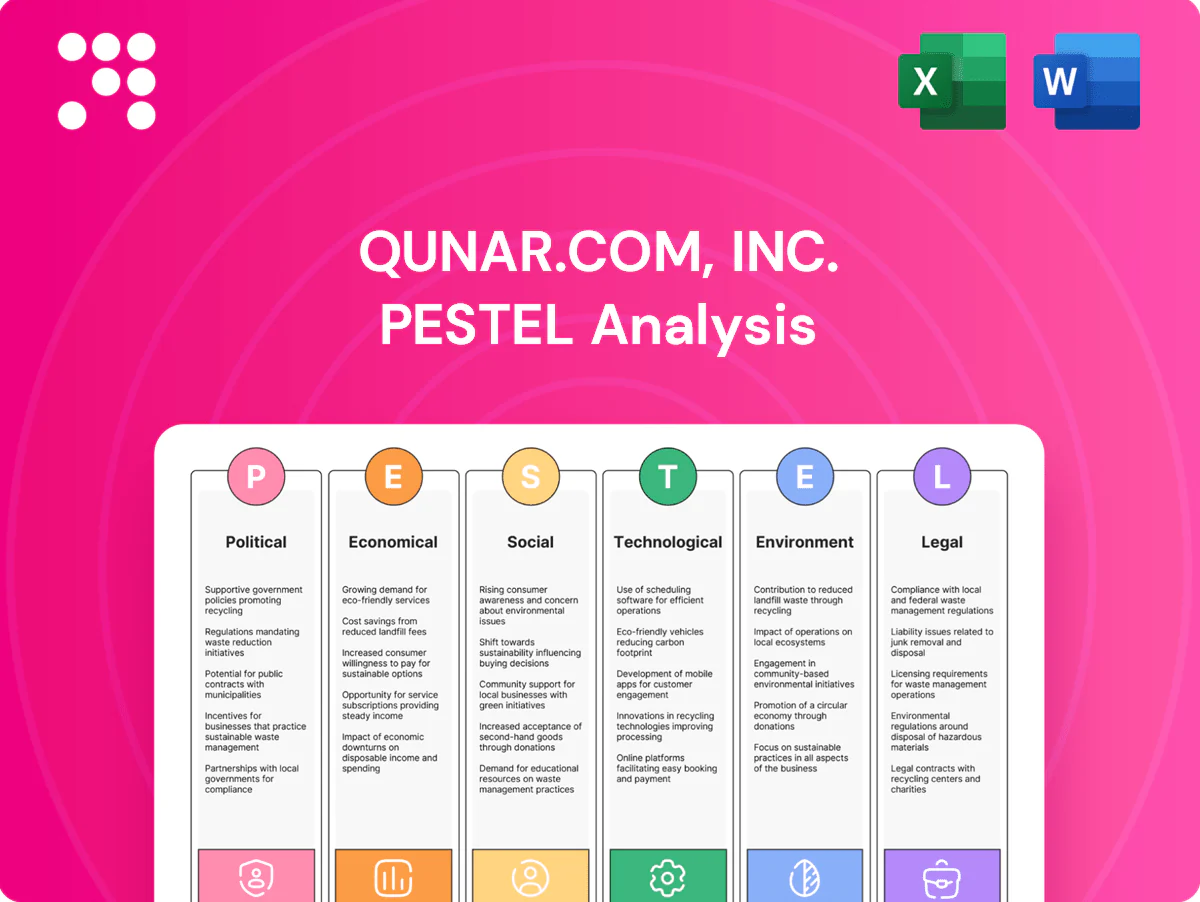
This PESTLE analysis of Qunar.Com, Inc. examines political, economic, social, technological, legal, and environmental factors shaping its travel-platform strategy. The preview shown here is the exact document you’ll receive after purchase—fully formatted and ready to use. No placeholders or teasers; the content and structure visible are the final, ready-to-download file.

Description
Skip the Research. Get the Strategy.
Our PESTLE analysis of Qunar.Com, Inc. reveals how regulatory shifts, economic cycles, social trends, and technology disruptions shape its travel marketplace. You’ll see actionable risks and growth levers tied to legal changes and environmental pressures. Ideal for investors and strategists seeking a competitive edge. Buy the full report to access the complete, ready-to-use analysis.
Political factors
Regulatory oversight of online platforms
China’s intensified scrutiny of platform firms since 2020 affects OTA pricing, display order and fair competition, forcing Qunar to reconsider ranking algorithms and commission models; regulators’ high-profile penalties, such as Alibaba’s 18.228 billion RMB antitrust fine in 2021, signal enforcement risk. Policy shifts can quickly reallocate traffic between suppliers and aggregators, making compliance investments a recurring operating cost for Qunar.
Data localization and cybersecurity enforcement
Strict Chinese data-security and localization rules force Qunar to store and process domestic user data and choose onshore cloud and vetted vendors, with cross-border transfers subject to CAC security assessments when datasets exceed 1 million users. Under PIPL, violations can draw fines up to RMB 50 million or 5% of annual revenue and risk app-store removal or service suspension. Ongoing mandatory audits and reviews add measurable compliance costs and operational complexity.
Tourism promotion and domestic travel policy
Government initiatives to boost domestic consumption and culture-tourism lifted demand on Qunar, with China reporting about 5.2 billion domestic trips and roughly 4.0 trillion RMB tourism revenue in 2023, driving higher bookings. Subsidies, targeted coupons and occasional holiday extensions have produced sharp booking spikes, which Qunar can amplify by tailoring campaigns to policy-backed destinations. Heavy reliance on such policy tailwinds creates volatility if government priorities shift.
Cross-border travel and visa diplomacy
Cross-border travel for Qunar hinges on bilateral visas, flight quotas and geopolitical stability; UNWTO reports 2023 international arrivals reached about 88% of 2019, so relaxations quickly spike bookings while restrictions compress volumes, forcing Qunar to rebalance inventory exposure and routing within days; currency controls and settlement rules constrain payment flows and repatriation timing.
- Visas/quotas: immediate demand swings
- Inventory: rapid rebalancing required
- Payments: currency controls affect cash flow
Content governance and information controls
User reviews, guides and forums on Qunar must meet Chinese content standards; platforms must implement moderation workflows to satisfy takedown obligations and real-name requirements under the Cybersecurity Law (2017), Data Security Law (2021) and 2022 Algorithm Measures.
- China internet users: 1.05 billion (CNNIC, Jun 2024)
- Non-compliance: fines, account limits, visibility penalties
- Policies drive moderation, product trust and community engagement
Regulatory crackdown and data law fines reshape OTA models amid volatile post-pandemic travel demand
Regulatory scrutiny since 2020 (eg Alibaba RMB 18.228bn fine) raises enforcement risk for Qunar, forcing algorithm, commission and compliance redesigns; data laws (PIPL/Data Security) require onshore storage and can levy up to RMB 50m or 5% revenue fines. Policy-driven tourism stimulus (≈5.2bn domestic trips; RMB 4.0tn revenue in 2023) and easing cross-border travel (2023 arrivals ≈88% of 2019) create volatile demand spikes.
| Metric | Value | Relevance |
|---|---|---|
| China internet users | 1.05bn (Jun 2024) | Addressable market |
| Domestic trips | 5.2bn (2023) | Booking volume driver |
| Antitrust fine | RMB 18.228bn (Alibaba, 2021) | Enforcement precedent |
What is included in the product
Detailed Word Document
Explores how Political, Economic, Social, Technological, Environmental and Legal forces uniquely shape Qunar.com, Inc., combining data-driven trend analysis with industry-specific examples to identify risks and opportunities for executives, investors and strategists.
Customizable Excel Spreadsheet
A concise, visually segmented Qunar.com, Inc. PESTLE summary that’s easy to drop into presentations, share across teams, and customize with notes—ideal for quick alignment on external risks, regulatory shifts, and market positioning.
Economic factors
Consumer spending cycles
Travel demand closely tracks income growth and consumer confidence; UNWTO reports 1.4 billion international arrivals in 2023, reflecting broad recovery. Economic slowdowns typically shift bookings toward budget options and shorter stays, compressing average order value that Qunar’s commission-driven model depends on. Dynamic promotions and targeted discounts can help defend volumes during weak cycles by preserving transaction counts even as AOV falls.
Airfare and fuel price pass-through
Airline fuel costs, which represent roughly 20–30% of carriers’ operating expenses (IATA), flow quickly into ticket prices and compress OTA conversion rates — short‑run price elasticity of demand for air travel is about −0.7. Higher fares drive shoppers to rail and bus alternatives (China HSR carried ~2.9 billion passengers in 2024), shifting Qunar’s product mix. Qunar’s broad inventory across transport modes hedges category swings, but margin per booking can swing with supplier pricing power and fare pass‑through.
Seasonality and holiday peaks
Golden Week, Lunar New Year and summer holidays trigger sharp demand spikes—May Day Golden Week 2023 saw about 309 million domestic trips, reflecting the scale Qunar must serve. Robust capacity planning and dynamic pricing algorithms are critical to capture peaks without degrading UX. Off-peak periods need targeted discounts and curated content to sustain bookings, while supply bottlenecks can divert users to alternative transport modes and destinations.
Competitive intensity and take rates
Rival OTAs and direct supplier channels squeeze Qunar.Com take rates by pressuring commissions and ad yields, while exclusive inventory, loyalty programs and fintech bundles from Trip.com Group act as partial defenses; bid costs for performance marketing further compress margins and require tighter ROI management, making metasearch differentiation essential to sustain traffic share.
- Competitive pressure: OTA/direct channels reduce commission yields
- Defensive levers: exclusive inventory, loyalty, fintech bundles
- Cost headwind: rising performance marketing bids
- Strategic priority: metasearch differentiation to retain traffic
FX and outbound travel affordability
RMB exchange-rate swings directly affect outbound trip affordability and supplier settlements; USD/CNY hovered around 7.3 in mid-2025, amplifying costs for many travelers. A weaker RMB shifts demand toward domestic and nearby markets, which Qunar can monetize by promoting currency-favorable destinations. Hedging programs and multicurrency payment options help Qunar and suppliers reduce FX volatility and margin risk.
- FX tag: USD/CNY ~7.3 (mid-2025)
- Demand shift: domestic/nearby markets
- Qunar levers: destination steering, hedging, multicurrency payments
Regulatory crackdown and data law fines reshape OTA models amid volatile post-pandemic travel demand
Travel recovery (1.4B int'l arrivals, 2023) boosts volume but economic slumps compress AOV; Qunar must protect transactions via discounts. Airline fuel = 20–30% of costs (IATA) with air elasticity ~−0.7, shifting demand to HSR (2.9B passengers, 2024). Holiday spikes (309M May Day 2023) and USD/CNY ~7.3 (mid‑2025) drive product mix and FX hedging needs.
| Metric | Value |
|---|---|
| Intl arrivals (2023) | 1.4B |
| China HSR (2024) | 2.9B |
| May Day trips (2023) | 309M |
| USD/CNY (mid‑2025) | ~7.3 |
| Airline fuel share | 20–30% |
Same Document Delivered
Qunar.Com, Inc. PESTLE Analysis
This PESTLE analysis of Qunar.Com, Inc. examines political, economic, social, technological, legal, and environmental factors shaping its travel-platform strategy. The preview shown here is the exact document you’ll receive after purchase—fully formatted and ready to use. No placeholders or teasers; the content and structure visible are the final, ready-to-download file.