Samsung SDI Co PESTLE Analysis

Your Competitive Advantage Starts with This Report
Navigate the complex external forces shaping Samsung SDI Co's future with our comprehensive PESTLE analysis. Understand how political shifts, economic volatility, and technological advancements are impacting battery innovation and the electric vehicle market. Gain a strategic advantage by leveraging these crucial insights to refine your own market approach. Download the full version now for actionable intelligence.
Political factors

Government Subsidies and Incentives
Government policies, particularly in major markets like the US and Europe, offer significant subsidies and incentives for electric vehicles and renewable energy, directly boosting demand for Samsung SDI's battery and energy storage solutions. For instance, the US Inflation Reduction Act (IRA) provides substantial tax credits for EV purchases and domestic battery manufacturing, aiming to onshore critical supply chains.
These initiatives, such as the IRA and similar European programs, directly influence manufacturing location decisions and supply chain strategies for companies like Samsung SDI, encouraging local production and fostering strategic partnerships. These policies can also include direct grants and tax rebates for establishing battery production facilities, impacting Samsung SDI's capital expenditure plans and overall operational costs.
Trade Policies and Geopolitical Tensions
Global trade policies, including tariffs and import/export restrictions, directly impact Samsung SDI's international supply chains and market access. For instance, ongoing trade disputes between the US and China can influence the cost of components and finished batteries.
Geopolitical tensions, particularly between major economic blocs, can disrupt raw material sourcing and manufacturing operations. This necessitates diversified supply chains and regional production hubs for companies like Samsung SDI to maintain operational stability.
Samsung SDI is actively navigating these complexities. A prime example is its joint venture with General Motors in the U.S., establishing Ultium Cells, which helps mitigate supply chain risks and capitalizes on local market opportunities for electric vehicle battery production.

Energy and Environmental Regulations
Government regulations concerning carbon emissions and renewable energy are increasingly stringent. For instance, the European Union's Carbon Border Adjustment Mechanism (CBAM), implemented in October 2023, impacts the cost of imported goods based on their carbon footprint, potentially affecting Samsung SDI's supply chain and manufacturing costs. These mandates push companies like Samsung SDI to invest heavily in cleaner production methods and develop batteries with lower environmental impact, directly influencing their research and development priorities.
Mandates for battery recycling and the circular economy are also becoming critical. By 2027, the EU Battery Regulation aims for specific collection rates and recycling efficiencies for batteries, requiring Samsung SDI to enhance its battery design for easier disassembly and recycling. This regulatory push not only ensures compliance but also opens up new business opportunities in battery material recovery and reuse, a strategic area for sustainable growth.
Furthermore, policies supporting energy storage systems (ESS) for grid stability and renewable energy integration are a significant tailwind. Governments worldwide are setting ambitious renewable energy targets, such as the US Inflation Reduction Act's incentives for clean energy and battery manufacturing, which directly benefit Samsung SDI's ESS business. This creates a robust market demand for advanced battery solutions that can support the transition to a greener energy landscape.

Local Content Requirements and Protectionism
Many nations are increasingly adopting local content requirements and protectionist policies to bolster their domestic industries. This global trend directly impacts Samsung SDI's operational strategies, particularly its manufacturing presence and collaborative ventures. For instance, the company's significant investments in new production facilities in the United States, such as its joint venture with Stellantis in Indiana, and its ongoing expansions in Hungary, are partly driven by the need to align with these local manufacturing mandates and cater to regional demand.
These regulatory landscapes compel Samsung SDI to re-evaluate its supply chain architecture, actively seeking to integrate localized sourcing of raw materials and components. This shift aims to ensure compliance and potentially mitigate risks associated with international trade barriers. The push for domestic content can influence the cost structure and availability of essential inputs, requiring agile adjustments in procurement and partnership strategies to maintain competitive advantage.
- US Inflation Reduction Act (IRA): Provisions within the IRA, effective from 2023, incentivize battery production and sourcing of critical minerals within North America, influencing Samsung SDI's investment decisions in the region.
- European Union Battery Regulations: The EU is progressively introducing mandates for battery passports and increased recycled content, pushing for localized supply chains and manufacturing processes within member states.
- South Korean Government Support: While South Korea is Samsung SDI's home market, its government also offers incentives for domestic battery production and R&D, encouraging a balance between global expansion and national industry strengthening.
- Trade Agreements and Tariffs: Evolving trade agreements and the imposition of tariffs between major economic blocs can create complex compliance challenges and necessitate strategic adjustments in where components are sourced and finished products are manufactured.
Political Stability in Manufacturing Regions
Political stability in key manufacturing hubs like South Korea and Hungary is crucial for Samsung SDI's production continuity and investment security. For instance, South Korea, a major base for Samsung SDI, has a history of stable governance, though geopolitical tensions with North Korea remain a background consideration. Hungary, where Samsung SDI has invested significantly in battery production facilities, has experienced shifts in its political landscape, necessitating ongoing risk assessment by the company.
Unforeseen political changes can directly impact operations, affecting labor relations and potentially leading to new regulations that influence profitability. Samsung SDI's €1.2 billion investment in its Hungarian battery plant, announced in 2018 and expanded since, is highly sensitive to such shifts. The company actively monitors these factors to safeguard its global manufacturing network.
- South Korea's political stability underpins Samsung SDI's domestic operations.
- Hungary's political environment requires continuous monitoring for Samsung SDI's battery plant investments.
- Policy changes stemming from political shifts can affect manufacturing costs and market access.
- Geopolitical risks, though not a daily operational factor, are a constant backdrop for Korean-based companies like Samsung SDI.
Policy Fuels Battery Expansion and Localization
Government incentives, such as the US Inflation Reduction Act, are driving significant investment in EV battery manufacturing, directly benefiting Samsung SDI's expansion plans. The EU's Battery Regulation, with its focus on recycled content and battery passports, is also shaping Samsung SDI's approach to supply chain localization and circular economy initiatives, aiming for increased recycled content in batteries by 2030.
Trade policies and tariffs, particularly those impacting critical minerals and battery components, necessitate diversified sourcing strategies for Samsung SDI. For instance, the ongoing trade dynamics between the US and China can influence the cost of materials like lithium and cobalt, impacting Samsung SDI's profitability and necessitating regional production hubs.
Political stability in key operational regions, like South Korea and Hungary, is paramount. Samsung SDI's substantial investment in its Hungarian facility, a key European production base, highlights the importance of stable regulatory environments for long-term operational security and capital expenditure planning.
The push for domestic content requirements in major markets, exemplified by the US and EU, is compelling Samsung SDI to increase local production and partnerships, such as its joint venture with Stellantis in Indiana, to ensure market access and compliance with evolving regulations.
What is included in the product
 Detailed Word Document
This PESTLE analysis examines the external macro-environmental factors impacting Samsung SDI Co across Political, Economic, Social, Technological, Environmental, and Legal dimensions, providing a comprehensive overview of its operating landscape.

 Customizable Excel Spreadsheet
This PESTLE analysis for Samsung SDI acts as a pain point reliever by providing a clear, summarized version of external factors, enabling quick referencing during meetings and simplifying complex market dynamics for easier strategic decision-making.
Economic factors

Global EV Market Slowdown and Recovery
The global electric vehicle (EV) market saw a noticeable slowdown towards the end of 2024. This dip in demand directly affected battery manufacturers like Samsung SDI, impacting their revenue streams and operating profits. For instance, a significant slowdown in EV sales in key markets could lead to reduced orders for battery components.
However, the outlook is brighter, with projections indicating a market recovery starting in the latter half of 2024. The EV market is anticipated to expand by roughly 21% in 2025. This growth is expected to be particularly strong in regions like the US and Europe, fueled by the introduction of new EV models and increasingly stringent emission standards.
This market volatility necessitates strategic adjustments for Samsung SDI. The company must remain agile, adapting its production schedules and sales strategies to navigate these fluctuations. A key focus will be on leveraging the projected recovery and maintaining a long-term growth trajectory amidst evolving market conditions.
Raw Material Price Volatility
Fluctuations in the prices of critical raw materials like lithium and cobalt directly affect Samsung SDI's manufacturing expenses and profit margins. For instance, lithium prices saw considerable swings in 2023 and early 2024, driven by supply-demand imbalances and geopolitical factors, impacting battery production costs globally.
Samsung SDI navigates the challenge of managing these costs amidst ongoing global supply chain disruptions and the escalating demand for electric vehicle batteries. The company's ability to secure stable and cost-effective raw material supplies is paramount for maintaining its competitive edge.
To counter the financial risks tied to raw material price volatility, Samsung SDI increasingly relies on strategic sourcing initiatives and the establishment of long-term supply agreements. These measures are vital for ensuring predictable input costs and mitigating the impact of market uncertainties on its bottom line.

Increased Competition and Market Share
Samsung SDI is navigating a highly competitive landscape, with significant pressure from Chinese rivals like CATL and BYD who are steadily gaining ground in the global battery market. This intensified competition directly impacts pricing strategies and profit margins, a critical challenge in the rapidly growing electric vehicle (EV) battery segment.
In 2024, Samsung SDI held an estimated 4.9% of the global EV battery market share, a figure that underscores the need to adapt to market dynamics. To counter this, the company is strategically investing in the development of more cost-effective battery chemistries, such as lithium iron phosphate (LFP) batteries, and aggressively expanding its production capabilities to meet escalating demand.

Currency Exchange Rate Fluctuations
Samsung SDI, as a global player, faces significant currency exchange rate risks. For instance, a strengthening South Korean Won (KRW) against the US Dollar (USD) can make its exports more expensive for American buyers, potentially impacting sales volume. Conversely, a weaker Won can increase the cost of imported components vital for battery production.
These fluctuations directly influence Samsung SDI's financial performance. In 2023, the company reported that significant swings in major currencies like the USD and Euro could materially affect its revenues and profits from international operations. For example, a 10% depreciation of the KRW against the USD could positively impact operating profit by billions of KRW, while an appreciation would have the opposite effect.
Managing these currency exposures is crucial for Samsung SDI’s financial health. The company employs hedging strategies, such as forward contracts and options, to mitigate the impact of volatile exchange rates on its cost of goods sold and the repatriation of overseas earnings. This proactive approach aims to stabilize earnings and protect the value of international investments.
- Impact on Exports: A stronger KRW makes Samsung SDI's battery products more expensive in foreign markets, potentially dampening demand.
- Cost of Imports: Fluctuations affect the cost of raw materials and components sourced internationally, impacting production expenses.
- Overseas Investments: Exchange rate changes can alter the value of profits and assets held by Samsung SDI's foreign subsidiaries and joint ventures.
- Hedging Strategies: Samsung SDI utilizes financial instruments to manage currency risks, aiming for more predictable financial outcomes.
Interest Rates and Investment Climate
Elevated interest rates, a persistent theme in the 2024-2025 economic landscape, directly influence consumer purchasing power for big-ticket items like electric vehicles, a key market for Samsung SDI. Furthermore, these higher rates increase the cost of capital, posing a challenge for Samsung SDI's ambitious expansion plans.
Despite this, Samsung SDI is demonstrating resilience and a forward-looking strategy. The company successfully raised approximately 1.1 trillion South Korean won (around $800 million USD) through a rights offering in late 2023, specifically earmarked for bolstering its global production capabilities. This capital infusion is critical for expanding operations in key regions such as the United States, Hungary, and South Korea, underscoring a firm commitment to long-term growth even amidst a more expensive financing environment.
- Increased Cost of Capital: Higher interest rates (e.g., US Federal Reserve rates remaining elevated in 2024-2025) directly increase the cost of borrowing for Samsung SDI's substantial capital expenditures.
- Impact on EV Demand: Elevated rates can dampen consumer demand for high-value goods like electric vehicles due to increased financing costs for buyers.
- Strategic Funding: Samsung SDI's successful rights issue of approximately 1.1 trillion KRW in late 2023 demonstrates proactive capital raising to support expansion despite interest rate pressures.
- Global Expansion: Funds from the rights issue are allocated to critical manufacturing sites in the U.S., Hungary, and South Korea, signaling a strategic bet on future market growth.
Strategic Growth Amidst EV Surge and Economic Pressures
The global economic environment in 2024-2025 presents a mixed bag for Samsung SDI. While a projected 21% growth in the EV market for 2025 offers significant opportunity, persistent inflation and elevated interest rates continue to impact raw material costs and consumer spending. Samsung SDI's strategic capital raising, including a 1.1 trillion KRW rights offering in late 2023, highlights its commitment to expansion despite these economic headwinds.
Navigating currency fluctuations remains a critical factor, with the South Korean Won's strength impacting export competitiveness and the cost of imported components. The company's proactive hedging strategies are essential for stabilizing financial performance amidst these volatile exchange rates.
Samsung SDI's market share, estimated at 4.9% in 2024, faces pressure from aggressive competitors. However, the company's investment in cost-effective battery chemistries and production capacity expansion positions it to capitalize on the anticipated recovery and growth in the EV sector.
Full Version Awaits
Samsung SDI Co PESTLE Analysis
The preview shown here is the exact document you’ll receive after purchase—fully formatted and ready to use, providing a comprehensive PESTLE analysis of Samsung SDI Co. This includes detailed insights into the Political, Economic, Social, Technological, Legal, and Environmental factors impacting the company.

Original: $10.00
-70%$10.00
$3.00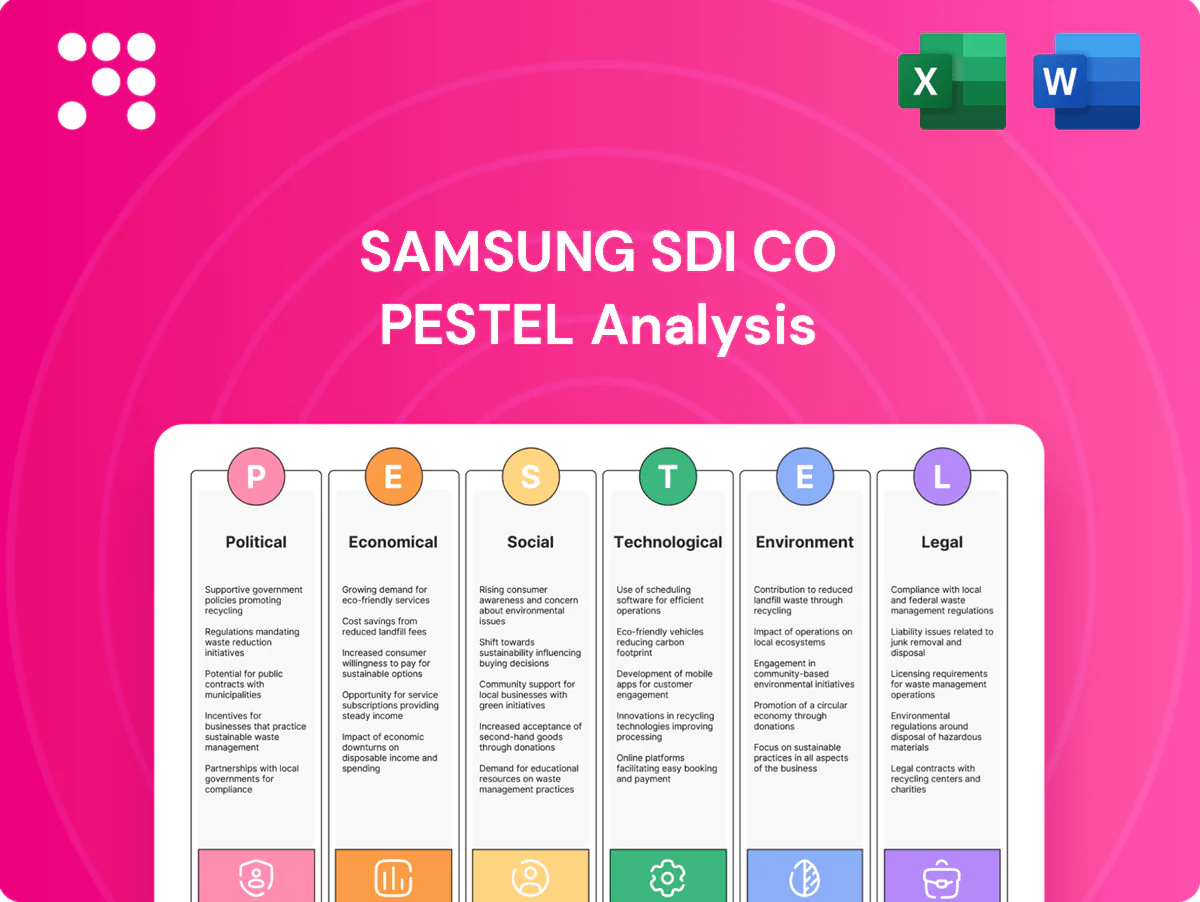
Description
Your Competitive Advantage Starts with This Report
Navigate the complex external forces shaping Samsung SDI Co's future with our comprehensive PESTLE analysis. Understand how political shifts, economic volatility, and technological advancements are impacting battery innovation and the electric vehicle market. Gain a strategic advantage by leveraging these crucial insights to refine your own market approach. Download the full version now for actionable intelligence.
Political factors
Government Subsidies and Incentives
Government policies, particularly in major markets like the US and Europe, offer significant subsidies and incentives for electric vehicles and renewable energy, directly boosting demand for Samsung SDI's battery and energy storage solutions. For instance, the US Inflation Reduction Act (IRA) provides substantial tax credits for EV purchases and domestic battery manufacturing, aiming to onshore critical supply chains.
These initiatives, such as the IRA and similar European programs, directly influence manufacturing location decisions and supply chain strategies for companies like Samsung SDI, encouraging local production and fostering strategic partnerships. These policies can also include direct grants and tax rebates for establishing battery production facilities, impacting Samsung SDI's capital expenditure plans and overall operational costs.
Trade Policies and Geopolitical Tensions
Global trade policies, including tariffs and import/export restrictions, directly impact Samsung SDI's international supply chains and market access. For instance, ongoing trade disputes between the US and China can influence the cost of components and finished batteries.
Geopolitical tensions, particularly between major economic blocs, can disrupt raw material sourcing and manufacturing operations. This necessitates diversified supply chains and regional production hubs for companies like Samsung SDI to maintain operational stability.
Samsung SDI is actively navigating these complexities. A prime example is its joint venture with General Motors in the U.S., establishing Ultium Cells, which helps mitigate supply chain risks and capitalizes on local market opportunities for electric vehicle battery production.
Energy and Environmental Regulations
Government regulations concerning carbon emissions and renewable energy are increasingly stringent. For instance, the European Union's Carbon Border Adjustment Mechanism (CBAM), implemented in October 2023, impacts the cost of imported goods based on their carbon footprint, potentially affecting Samsung SDI's supply chain and manufacturing costs. These mandates push companies like Samsung SDI to invest heavily in cleaner production methods and develop batteries with lower environmental impact, directly influencing their research and development priorities.
Mandates for battery recycling and the circular economy are also becoming critical. By 2027, the EU Battery Regulation aims for specific collection rates and recycling efficiencies for batteries, requiring Samsung SDI to enhance its battery design for easier disassembly and recycling. This regulatory push not only ensures compliance but also opens up new business opportunities in battery material recovery and reuse, a strategic area for sustainable growth.
Furthermore, policies supporting energy storage systems (ESS) for grid stability and renewable energy integration are a significant tailwind. Governments worldwide are setting ambitious renewable energy targets, such as the US Inflation Reduction Act's incentives for clean energy and battery manufacturing, which directly benefit Samsung SDI's ESS business. This creates a robust market demand for advanced battery solutions that can support the transition to a greener energy landscape.
Local Content Requirements and Protectionism
Many nations are increasingly adopting local content requirements and protectionist policies to bolster their domestic industries. This global trend directly impacts Samsung SDI's operational strategies, particularly its manufacturing presence and collaborative ventures. For instance, the company's significant investments in new production facilities in the United States, such as its joint venture with Stellantis in Indiana, and its ongoing expansions in Hungary, are partly driven by the need to align with these local manufacturing mandates and cater to regional demand.
These regulatory landscapes compel Samsung SDI to re-evaluate its supply chain architecture, actively seeking to integrate localized sourcing of raw materials and components. This shift aims to ensure compliance and potentially mitigate risks associated with international trade barriers. The push for domestic content can influence the cost structure and availability of essential inputs, requiring agile adjustments in procurement and partnership strategies to maintain competitive advantage.
- US Inflation Reduction Act (IRA): Provisions within the IRA, effective from 2023, incentivize battery production and sourcing of critical minerals within North America, influencing Samsung SDI's investment decisions in the region.
- European Union Battery Regulations: The EU is progressively introducing mandates for battery passports and increased recycled content, pushing for localized supply chains and manufacturing processes within member states.
- South Korean Government Support: While South Korea is Samsung SDI's home market, its government also offers incentives for domestic battery production and R&D, encouraging a balance between global expansion and national industry strengthening.
- Trade Agreements and Tariffs: Evolving trade agreements and the imposition of tariffs between major economic blocs can create complex compliance challenges and necessitate strategic adjustments in where components are sourced and finished products are manufactured.
Political Stability in Manufacturing Regions
Political stability in key manufacturing hubs like South Korea and Hungary is crucial for Samsung SDI's production continuity and investment security. For instance, South Korea, a major base for Samsung SDI, has a history of stable governance, though geopolitical tensions with North Korea remain a background consideration. Hungary, where Samsung SDI has invested significantly in battery production facilities, has experienced shifts in its political landscape, necessitating ongoing risk assessment by the company.
Unforeseen political changes can directly impact operations, affecting labor relations and potentially leading to new regulations that influence profitability. Samsung SDI's €1.2 billion investment in its Hungarian battery plant, announced in 2018 and expanded since, is highly sensitive to such shifts. The company actively monitors these factors to safeguard its global manufacturing network.
- South Korea's political stability underpins Samsung SDI's domestic operations.
- Hungary's political environment requires continuous monitoring for Samsung SDI's battery plant investments.
- Policy changes stemming from political shifts can affect manufacturing costs and market access.
- Geopolitical risks, though not a daily operational factor, are a constant backdrop for Korean-based companies like Samsung SDI.
Policy Fuels Battery Expansion and Localization
Government incentives, such as the US Inflation Reduction Act, are driving significant investment in EV battery manufacturing, directly benefiting Samsung SDI's expansion plans. The EU's Battery Regulation, with its focus on recycled content and battery passports, is also shaping Samsung SDI's approach to supply chain localization and circular economy initiatives, aiming for increased recycled content in batteries by 2030.
Trade policies and tariffs, particularly those impacting critical minerals and battery components, necessitate diversified sourcing strategies for Samsung SDI. For instance, the ongoing trade dynamics between the US and China can influence the cost of materials like lithium and cobalt, impacting Samsung SDI's profitability and necessitating regional production hubs.
Political stability in key operational regions, like South Korea and Hungary, is paramount. Samsung SDI's substantial investment in its Hungarian facility, a key European production base, highlights the importance of stable regulatory environments for long-term operational security and capital expenditure planning.
The push for domestic content requirements in major markets, exemplified by the US and EU, is compelling Samsung SDI to increase local production and partnerships, such as its joint venture with Stellantis in Indiana, to ensure market access and compliance with evolving regulations.
What is included in the product
Detailed Word Document
This PESTLE analysis examines the external macro-environmental factors impacting Samsung SDI Co across Political, Economic, Social, Technological, Environmental, and Legal dimensions, providing a comprehensive overview of its operating landscape.
Customizable Excel Spreadsheet
This PESTLE analysis for Samsung SDI acts as a pain point reliever by providing a clear, summarized version of external factors, enabling quick referencing during meetings and simplifying complex market dynamics for easier strategic decision-making.
Economic factors
Global EV Market Slowdown and Recovery
The global electric vehicle (EV) market saw a noticeable slowdown towards the end of 2024. This dip in demand directly affected battery manufacturers like Samsung SDI, impacting their revenue streams and operating profits. For instance, a significant slowdown in EV sales in key markets could lead to reduced orders for battery components.
However, the outlook is brighter, with projections indicating a market recovery starting in the latter half of 2024. The EV market is anticipated to expand by roughly 21% in 2025. This growth is expected to be particularly strong in regions like the US and Europe, fueled by the introduction of new EV models and increasingly stringent emission standards.
This market volatility necessitates strategic adjustments for Samsung SDI. The company must remain agile, adapting its production schedules and sales strategies to navigate these fluctuations. A key focus will be on leveraging the projected recovery and maintaining a long-term growth trajectory amidst evolving market conditions.
Raw Material Price Volatility
Fluctuations in the prices of critical raw materials like lithium and cobalt directly affect Samsung SDI's manufacturing expenses and profit margins. For instance, lithium prices saw considerable swings in 2023 and early 2024, driven by supply-demand imbalances and geopolitical factors, impacting battery production costs globally.
Samsung SDI navigates the challenge of managing these costs amidst ongoing global supply chain disruptions and the escalating demand for electric vehicle batteries. The company's ability to secure stable and cost-effective raw material supplies is paramount for maintaining its competitive edge.
To counter the financial risks tied to raw material price volatility, Samsung SDI increasingly relies on strategic sourcing initiatives and the establishment of long-term supply agreements. These measures are vital for ensuring predictable input costs and mitigating the impact of market uncertainties on its bottom line.
Increased Competition and Market Share
Samsung SDI is navigating a highly competitive landscape, with significant pressure from Chinese rivals like CATL and BYD who are steadily gaining ground in the global battery market. This intensified competition directly impacts pricing strategies and profit margins, a critical challenge in the rapidly growing electric vehicle (EV) battery segment.
In 2024, Samsung SDI held an estimated 4.9% of the global EV battery market share, a figure that underscores the need to adapt to market dynamics. To counter this, the company is strategically investing in the development of more cost-effective battery chemistries, such as lithium iron phosphate (LFP) batteries, and aggressively expanding its production capabilities to meet escalating demand.
Currency Exchange Rate Fluctuations
Samsung SDI, as a global player, faces significant currency exchange rate risks. For instance, a strengthening South Korean Won (KRW) against the US Dollar (USD) can make its exports more expensive for American buyers, potentially impacting sales volume. Conversely, a weaker Won can increase the cost of imported components vital for battery production.
These fluctuations directly influence Samsung SDI's financial performance. In 2023, the company reported that significant swings in major currencies like the USD and Euro could materially affect its revenues and profits from international operations. For example, a 10% depreciation of the KRW against the USD could positively impact operating profit by billions of KRW, while an appreciation would have the opposite effect.
Managing these currency exposures is crucial for Samsung SDI’s financial health. The company employs hedging strategies, such as forward contracts and options, to mitigate the impact of volatile exchange rates on its cost of goods sold and the repatriation of overseas earnings. This proactive approach aims to stabilize earnings and protect the value of international investments.
- Impact on Exports: A stronger KRW makes Samsung SDI's battery products more expensive in foreign markets, potentially dampening demand.
- Cost of Imports: Fluctuations affect the cost of raw materials and components sourced internationally, impacting production expenses.
- Overseas Investments: Exchange rate changes can alter the value of profits and assets held by Samsung SDI's foreign subsidiaries and joint ventures.
- Hedging Strategies: Samsung SDI utilizes financial instruments to manage currency risks, aiming for more predictable financial outcomes.
Interest Rates and Investment Climate
Elevated interest rates, a persistent theme in the 2024-2025 economic landscape, directly influence consumer purchasing power for big-ticket items like electric vehicles, a key market for Samsung SDI. Furthermore, these higher rates increase the cost of capital, posing a challenge for Samsung SDI's ambitious expansion plans.
Despite this, Samsung SDI is demonstrating resilience and a forward-looking strategy. The company successfully raised approximately 1.1 trillion South Korean won (around $800 million USD) through a rights offering in late 2023, specifically earmarked for bolstering its global production capabilities. This capital infusion is critical for expanding operations in key regions such as the United States, Hungary, and South Korea, underscoring a firm commitment to long-term growth even amidst a more expensive financing environment.
- Increased Cost of Capital: Higher interest rates (e.g., US Federal Reserve rates remaining elevated in 2024-2025) directly increase the cost of borrowing for Samsung SDI's substantial capital expenditures.
- Impact on EV Demand: Elevated rates can dampen consumer demand for high-value goods like electric vehicles due to increased financing costs for buyers.
- Strategic Funding: Samsung SDI's successful rights issue of approximately 1.1 trillion KRW in late 2023 demonstrates proactive capital raising to support expansion despite interest rate pressures.
- Global Expansion: Funds from the rights issue are allocated to critical manufacturing sites in the U.S., Hungary, and South Korea, signaling a strategic bet on future market growth.
Strategic Growth Amidst EV Surge and Economic Pressures
The global economic environment in 2024-2025 presents a mixed bag for Samsung SDI. While a projected 21% growth in the EV market for 2025 offers significant opportunity, persistent inflation and elevated interest rates continue to impact raw material costs and consumer spending. Samsung SDI's strategic capital raising, including a 1.1 trillion KRW rights offering in late 2023, highlights its commitment to expansion despite these economic headwinds.
Navigating currency fluctuations remains a critical factor, with the South Korean Won's strength impacting export competitiveness and the cost of imported components. The company's proactive hedging strategies are essential for stabilizing financial performance amidst these volatile exchange rates.
Samsung SDI's market share, estimated at 4.9% in 2024, faces pressure from aggressive competitors. However, the company's investment in cost-effective battery chemistries and production capacity expansion positions it to capitalize on the anticipated recovery and growth in the EV sector.
Full Version Awaits
Samsung SDI Co PESTLE Analysis
The preview shown here is the exact document you’ll receive after purchase—fully formatted and ready to use, providing a comprehensive PESTLE analysis of Samsung SDI Co. This includes detailed insights into the Political, Economic, Social, Technological, Legal, and Environmental factors impacting the company.