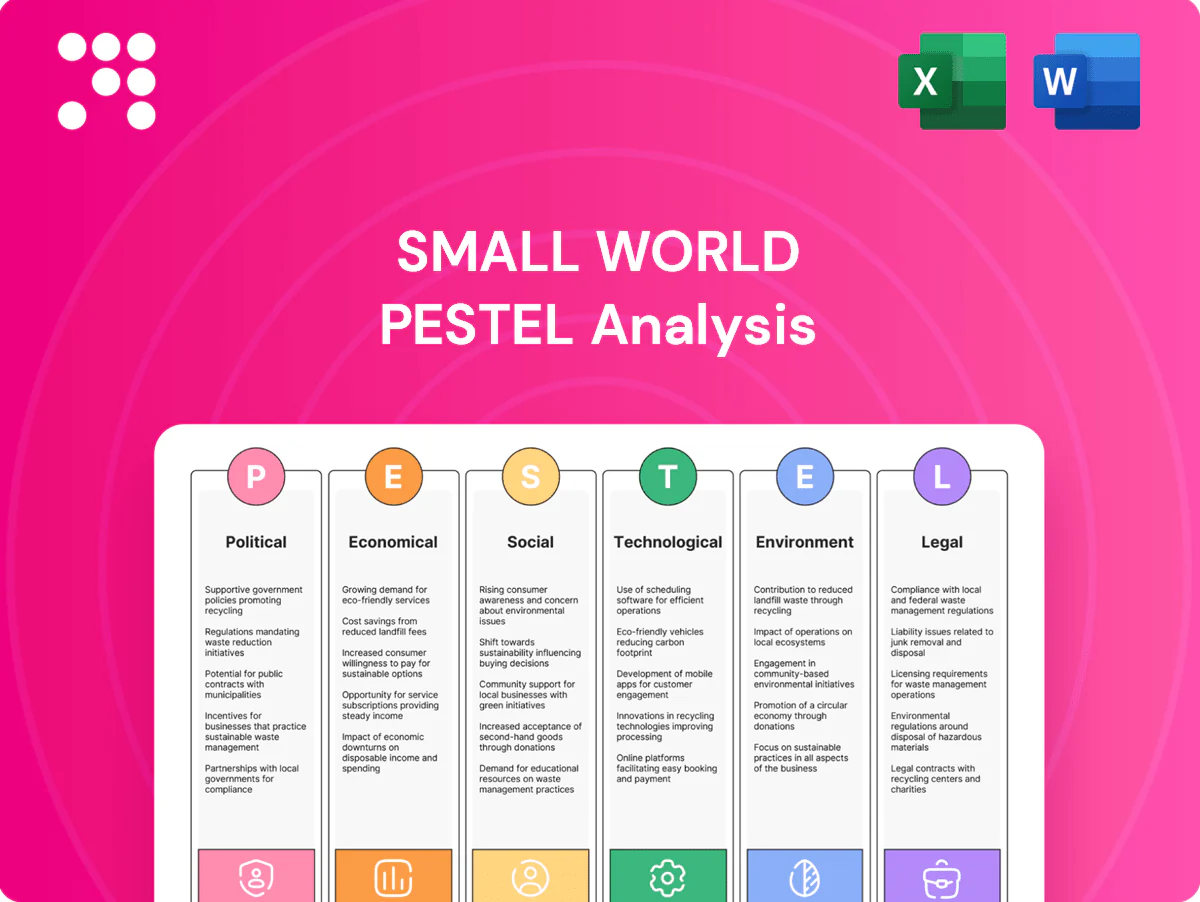
Ruby Tuesday PESTLE Analysis

Skip the Research. Get the Strategy.
Unlock the secrets to Ruby Tuesday's market position with our comprehensive PESTLE analysis. Understand the political, economic, social, technological, legal, and environmental forces shaping their strategy, from shifting consumer tastes to evolving regulations. Gain the foresight needed to navigate challenges and capitalize on opportunities in the dynamic restaurant industry. Download the full PESTLE analysis now and equip yourself with actionable intelligence for smarter business decisions.
Political factors

Government Health Regulations
Government health regulations, such as those seen during the COVID-19 pandemic, significantly influenced restaurant operations. For instance, during 2020-2021, many states implemented capacity limits, with some reaching as low as 25%, directly impacting Ruby Tuesday's ability to serve customers and generate revenue. These mandates, alongside potential vaccination or mask requirements, demanded operational flexibility and adherence to evolving public health directives to ensure business continuity and maintain customer confidence.
Minimum Wage Policies
Fluctuations in federal, state, and local minimum wage laws directly impact Ruby Tuesday's labor expenses, a significant portion of their operational costs. For instance, as of January 1, 2024, 22 states and numerous cities implemented minimum wage increases, with some states like California reaching $16.00 per hour. These policy shifts can compel the company to adjust menu prices or seek greater operational efficiencies to safeguard profit margins, potentially influencing customer spending habits.
Proactive monitoring and forecasting of these evolving wage regulations are crucial for Ruby Tuesday's financial planning and the development of competitive pricing strategies. Understanding these upcoming changes allows for better budgeting and strategic decision-making to navigate the impact on overall profitability.

Food Safety Standards
Regulatory bodies like the FDA continually update food safety standards, impacting restaurant operations. For instance, in 2024, the FDA's Food Code, a model for state and local regulations, emphasizes enhanced traceability and allergen control, requiring businesses like Ruby Tuesday to invest in updated training and potentially new equipment to ensure compliance. Failure to meet these evolving standards can lead to fines and operational disruptions.

Trade Policies and Tariffs
International trade policies and tariffs directly impact Ruby Tuesday's operational costs. For instance, tariffs imposed on imported food ingredients, such as certain spices or specialty produce, can inflate the cost of goods sold. In 2024, global supply chain disruptions, exacerbated by geopolitical tensions, led to increased volatility in commodity prices, potentially affecting the cost of key ingredients for restaurants like Ruby Tuesday.
Changes in trade agreements or the introduction of new tariffs can necessitate menu adjustments or force the company to seek alternative, potentially more expensive, domestic suppliers. A predictable trade environment is crucial for Ruby Tuesday to manage its procurement expenses effectively and ensure the consistent availability of its menu items to customers.
- Tariff Impact: Potential for increased ingredient costs due to tariffs on imported food supplies.
- Supply Chain Stability: Trade policies influence the reliability and cost of sourcing raw materials.
- Menu Adaptability: Policy shifts may require changes to menu offerings to manage ingredient availability and cost.
Taxation Policies
Changes in corporate income tax rates directly affect Ruby Tuesday's bottom line. For instance, the Tax Cuts and Jobs Act of 2017 lowered the U.S. federal corporate tax rate from 35% to 21%, a significant benefit for companies like Ruby Tuesday. Future adjustments to this rate, or shifts in state and local sales taxes, will continue to influence their pricing and profitability.
Favorable tax incentives, such as those for restaurant revitalization or job creation, can encourage investment and expansion. Conversely, increased tax burdens could necessitate adjustments to operational costs or menu pricing. For example, in 2024, some states are considering or have implemented changes to sales tax on prepared foods, which could impact restaurant sales volumes.
Ruby Tuesday's fiscal strategy must account for the evolving tax landscape.
- Federal Corporate Tax Rate: Currently 21% in the U.S., subject to potential future legislative changes.
- State and Local Sales Taxes: Vary significantly by location, impacting consumer spending on dining out.
- Tax Incentives: Potential benefits for job creation or capital investment in the restaurant sector.
- Impact on Profitability: Tax policies directly influence net income and the ability to reinvest in the business.
Navigating Regulatory Shifts: Impact on Restaurant Operations
Government health mandates, such as those experienced during the COVID-19 pandemic with capacity limits as low as 25% in 2020-2021, directly affected Ruby Tuesday's revenue generation and operational capacity. Evolving public health directives require ongoing adaptability to ensure business continuity and customer trust.
Changes in minimum wage laws, with 22 states and numerous cities increasing wages in 2024, such as California reaching $16.00 per hour, directly impact Ruby Tuesday's labor costs. These shifts necessitate careful pricing strategies and operational efficiency improvements to maintain profitability.
Food safety regulations, like the FDA's 2024 Food Code emphasizing traceability and allergen control, require investment in training and technology for compliance. Non-compliance can lead to fines and operational disruptions for restaurants like Ruby Tuesday.
What is included in the product
 Detailed Word Document
This PESTLE analysis examines the external macro-environmental factors influencing Ruby Tuesday, covering Political, Economic, Social, Technological, Environmental, and Legal aspects.

 Customizable Excel Spreadsheet
This Ruby Tuesday PESTLE analysis provides a clear, summarized version of external factors, acting as a pain point reliever by offering easy referencing during crucial meetings and strategic planning sessions.
Economic factors

Consumer Disposable Income
Consumer disposable income is a key driver for restaurants like Ruby Tuesday. When people have more money left after essential expenses, they tend to spend more on dining out. For example, in the U.S., real disposable income saw a notable increase in 2023, reaching approximately $50,000 per capita, which can translate to more frequent visits and higher spending at casual dining spots.
Conversely, economic slowdowns can put a damper on discretionary spending. If consumers feel financial pressure, dining out often becomes one of the first expenses to be cut back. This directly impacts sales volumes for establishments such as Ruby Tuesday, which rely on consumers having the extra cash to enjoy a meal away from home.
Ruby Tuesday's strategy often involves offering value propositions to attract a broad customer base, regardless of minor fluctuations in disposable income. However, significant shifts in the economic landscape, impacting the average consumer's ability to spend on non-essential items, will inevitably influence Ruby Tuesday's performance and revenue streams.
Inflationary Pressures
Rising inflation, especially for food and labor, is a major concern for Ruby Tuesday. For instance, the U.S. Consumer Price Index for food away from home saw a notable increase in early 2024, impacting restaurant operating costs. This puts pressure on their profit margins.
The company faces a tough decision: absorb these higher costs or raise menu prices. Finding the right balance is key to keeping customers happy and maintaining market share. Passing on too much of the cost could alienate diners, while absorbing it all eats into profitability.

Interest Rates and Credit Availability
Fluctuations in interest rates directly impact Ruby Tuesday's operational costs and expansion capabilities. For instance, if the Federal Reserve raises its benchmark interest rate, the cost of borrowing for new ventures or renovations, like upgrading kitchen equipment or remodeling dining areas, will likely increase. This could mean higher interest payments on loans for capital expenditures, potentially squeezing profit margins.
The availability and cost of credit are crucial for Ruby Tuesday's financial health and strategic execution. In late 2024 and early 2025, credit markets may tighten if economic uncertainty rises, making it harder and more expensive for the company to secure the necessary funds for ongoing operations or ambitious growth plans. Maintaining access to affordable credit ensures Ruby Tuesday can manage its working capital effectively and invest in initiatives that drive long-term value, such as new menu development or technology upgrades.

Unemployment Rates
Unemployment rates significantly influence the casual dining industry, directly affecting consumer spending power. High unemployment can dampen consumer confidence, leading to reduced discretionary spending on dining out, which would likely impact Ruby Tuesday's customer traffic and overall sales volume. For instance, in May 2024, the US unemployment rate stood at 4.0%, a slight increase from previous months, indicating potential headwinds for sectors reliant on consumer discretionary income.
Conversely, low unemployment rates, while signaling economic strength, can present their own challenges. A robust job market often leads to increased consumer spending, which is generally positive for restaurants like Ruby Tuesday. However, it also intensifies competition for labor, potentially driving up wage costs for the company as it seeks to attract and retain qualified staff. The average hourly earnings for all employees in the US private sector saw a 4.1% increase year-over-year as of May 2024, reflecting this wage pressure.
The health of the job market serves as a critical economic barometer for the casual dining sector. Ruby Tuesday's performance is closely tied to how many people are employed and have disposable income to spend on dining experiences.
- US Unemployment Rate: 4.0% as of May 2024.
- Impact of High Unemployment: Reduced consumer confidence and discretionary spending.
- Impact of Low Unemployment: Increased consumer spending but also higher labor costs due to competition.
- Wage Growth Indicator: Average hourly earnings increased by 4.1% year-over-year in May 2024.
Economic Growth and Recession Cycles
The health of the broader economy directly impacts the casual dining sector, and by extension, Ruby Tuesday. When the economy is growing, consumers generally have more disposable income, making them more inclined to spend on dining out. This increased consumer confidence and spending power translates to higher sales for restaurants like Ruby Tuesday.
Conversely, economic downturns, or recessions, tend to curb discretionary spending. During these periods, consumers often cut back on non-essential expenses, and dining out is frequently one of the first areas to see reduced activity. This forces restaurants to adapt by offering value-oriented promotions or focusing on more affordable menu items to retain customers.
For instance, the U.S. economy experienced a significant slowdown during the COVID-19 pandemic, impacting the restaurant industry severely. While recovery has been underway, factors like inflation and interest rate hikes in 2024 continue to shape consumer spending habits. In Q1 2024, the U.S. GDP grew at an annualized rate of 1.3%, indicating a moderating growth trend that requires careful navigation by businesses.
- Economic Expansion: Increased consumer confidence and disposable income lead to higher dining-out frequency.
- Economic Contraction: Reduced discretionary spending forces consumers to opt for budget-friendly meals or dine at home more often.
- Inflationary Pressures: Rising costs for ingredients and labor can impact restaurant pricing and profitability, potentially affecting consumer affordability.
- Interest Rate Environment: Higher interest rates can increase borrowing costs for businesses and reduce consumer spending power on non-essential items.
Economic Factors Impact Casual Dining Performance
Economic growth directly fuels consumer spending on dining out, benefiting restaurants like Ruby Tuesday. Conversely, economic slowdowns or recessions lead to reduced discretionary income, prompting consumers to cut back on non-essential expenses such as eating at restaurants. This dynamic significantly impacts sales volumes and revenue for casual dining establishments.
Inflationary pressures, particularly on food and labor, directly squeeze Ruby Tuesday's profit margins, forcing difficult decisions on pricing. Interest rate fluctuations affect borrowing costs for expansion and operational investments, while unemployment levels dictate overall consumer spending power and confidence in the casual dining sector.
The U.S. economy's GDP growth rate of 1.3% annualized in Q1 2024 signals a moderating trend, requiring businesses to adapt. Meanwhile, average hourly earnings in the U.S. private sector rose 4.1% year-over-year by May 2024, highlighting ongoing wage pressures that impact labor costs for restaurants.
| Economic Factor | Data Point (as of May 2024 or Q1 2024) | Impact on Ruby Tuesday |
| U.S. GDP Growth (Annualized) | 1.3% (Q1 2024) | Moderating growth may indicate cautious consumer spending. |
| U.S. Unemployment Rate | 4.0% (May 2024) | Low unemployment generally supports spending, but wage competition increases labor costs. |
| Average Hourly Earnings Growth (U.S. Private Sector) | 4.1% (Year-over-year, May 2024) | Indicates rising labor costs, impacting restaurant operational expenses. |
| U.S. CPI for Food Away From Home | Notable increase in early 2024 | Increases food costs, pressuring profit margins. |
Same Document Delivered
Ruby Tuesday PESTLE Analysis
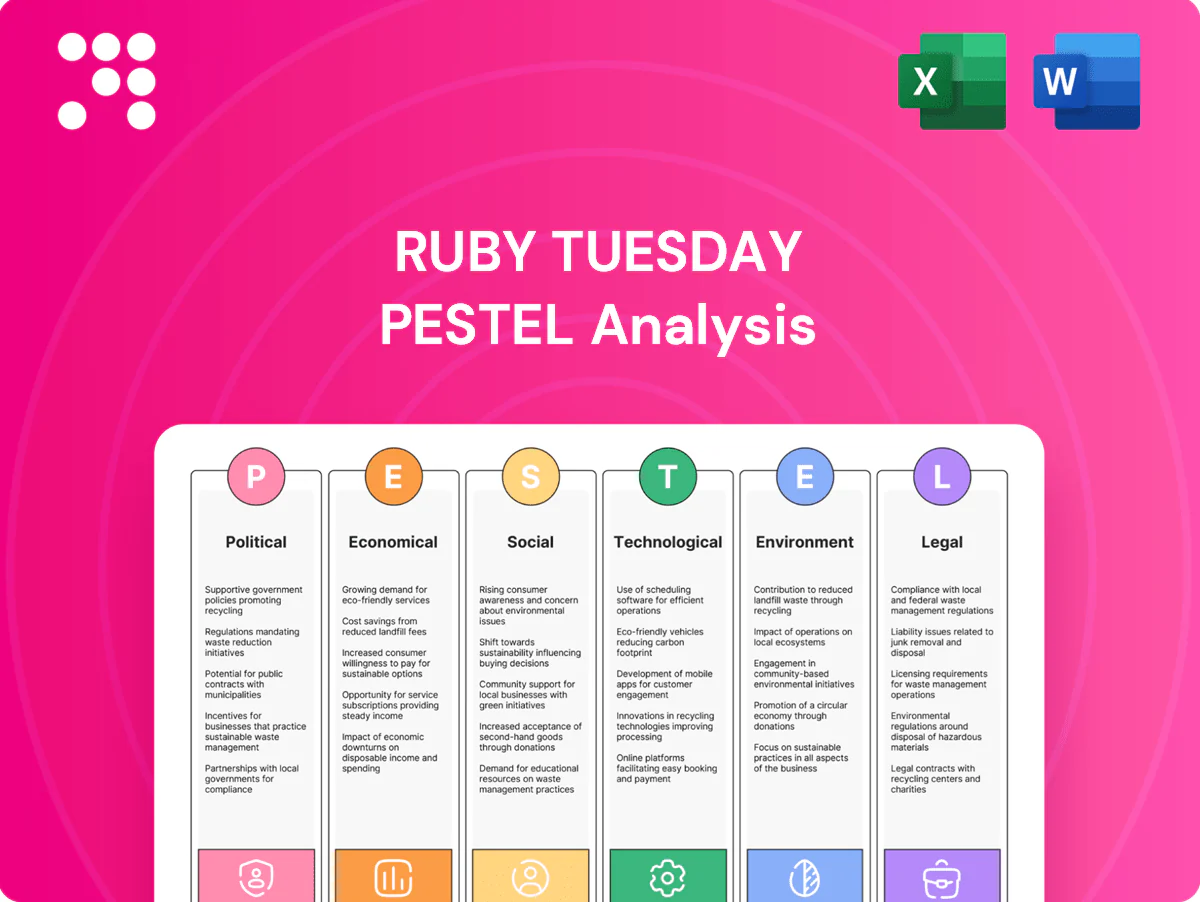
This preview of the Ruby Tuesday PESTLE Analysis showcases the comprehensive market insights you'll receive. The content and structure shown in the preview is the same document you’ll download after payment. You'll gain a deep understanding of the Political, Economic, Social, Technological, Legal, and Environmental factors impacting Ruby Tuesday.

Description
Skip the Research. Get the Strategy.
Unlock the secrets to Ruby Tuesday's market position with our comprehensive PESTLE analysis. Understand the political, economic, social, technological, legal, and environmental forces shaping their strategy, from shifting consumer tastes to evolving regulations. Gain the foresight needed to navigate challenges and capitalize on opportunities in the dynamic restaurant industry. Download the full PESTLE analysis now and equip yourself with actionable intelligence for smarter business decisions.
Political factors
Government Health Regulations
Government health regulations, such as those seen during the COVID-19 pandemic, significantly influenced restaurant operations. For instance, during 2020-2021, many states implemented capacity limits, with some reaching as low as 25%, directly impacting Ruby Tuesday's ability to serve customers and generate revenue. These mandates, alongside potential vaccination or mask requirements, demanded operational flexibility and adherence to evolving public health directives to ensure business continuity and maintain customer confidence.
Minimum Wage Policies
Fluctuations in federal, state, and local minimum wage laws directly impact Ruby Tuesday's labor expenses, a significant portion of their operational costs. For instance, as of January 1, 2024, 22 states and numerous cities implemented minimum wage increases, with some states like California reaching $16.00 per hour. These policy shifts can compel the company to adjust menu prices or seek greater operational efficiencies to safeguard profit margins, potentially influencing customer spending habits.
Proactive monitoring and forecasting of these evolving wage regulations are crucial for Ruby Tuesday's financial planning and the development of competitive pricing strategies. Understanding these upcoming changes allows for better budgeting and strategic decision-making to navigate the impact on overall profitability.
Food Safety Standards
Regulatory bodies like the FDA continually update food safety standards, impacting restaurant operations. For instance, in 2024, the FDA's Food Code, a model for state and local regulations, emphasizes enhanced traceability and allergen control, requiring businesses like Ruby Tuesday to invest in updated training and potentially new equipment to ensure compliance. Failure to meet these evolving standards can lead to fines and operational disruptions.
Trade Policies and Tariffs
International trade policies and tariffs directly impact Ruby Tuesday's operational costs. For instance, tariffs imposed on imported food ingredients, such as certain spices or specialty produce, can inflate the cost of goods sold. In 2024, global supply chain disruptions, exacerbated by geopolitical tensions, led to increased volatility in commodity prices, potentially affecting the cost of key ingredients for restaurants like Ruby Tuesday.
Changes in trade agreements or the introduction of new tariffs can necessitate menu adjustments or force the company to seek alternative, potentially more expensive, domestic suppliers. A predictable trade environment is crucial for Ruby Tuesday to manage its procurement expenses effectively and ensure the consistent availability of its menu items to customers.
- Tariff Impact: Potential for increased ingredient costs due to tariffs on imported food supplies.
- Supply Chain Stability: Trade policies influence the reliability and cost of sourcing raw materials.
- Menu Adaptability: Policy shifts may require changes to menu offerings to manage ingredient availability and cost.
Taxation Policies
Changes in corporate income tax rates directly affect Ruby Tuesday's bottom line. For instance, the Tax Cuts and Jobs Act of 2017 lowered the U.S. federal corporate tax rate from 35% to 21%, a significant benefit for companies like Ruby Tuesday. Future adjustments to this rate, or shifts in state and local sales taxes, will continue to influence their pricing and profitability.
Favorable tax incentives, such as those for restaurant revitalization or job creation, can encourage investment and expansion. Conversely, increased tax burdens could necessitate adjustments to operational costs or menu pricing. For example, in 2024, some states are considering or have implemented changes to sales tax on prepared foods, which could impact restaurant sales volumes.
Ruby Tuesday's fiscal strategy must account for the evolving tax landscape.
- Federal Corporate Tax Rate: Currently 21% in the U.S., subject to potential future legislative changes.
- State and Local Sales Taxes: Vary significantly by location, impacting consumer spending on dining out.
- Tax Incentives: Potential benefits for job creation or capital investment in the restaurant sector.
- Impact on Profitability: Tax policies directly influence net income and the ability to reinvest in the business.
Navigating Regulatory Shifts: Impact on Restaurant Operations
Government health mandates, such as those experienced during the COVID-19 pandemic with capacity limits as low as 25% in 2020-2021, directly affected Ruby Tuesday's revenue generation and operational capacity. Evolving public health directives require ongoing adaptability to ensure business continuity and customer trust.
Changes in minimum wage laws, with 22 states and numerous cities increasing wages in 2024, such as California reaching $16.00 per hour, directly impact Ruby Tuesday's labor costs. These shifts necessitate careful pricing strategies and operational efficiency improvements to maintain profitability.
Food safety regulations, like the FDA's 2024 Food Code emphasizing traceability and allergen control, require investment in training and technology for compliance. Non-compliance can lead to fines and operational disruptions for restaurants like Ruby Tuesday.
What is included in the product
Detailed Word Document
This PESTLE analysis examines the external macro-environmental factors influencing Ruby Tuesday, covering Political, Economic, Social, Technological, Environmental, and Legal aspects.
Customizable Excel Spreadsheet
This Ruby Tuesday PESTLE analysis provides a clear, summarized version of external factors, acting as a pain point reliever by offering easy referencing during crucial meetings and strategic planning sessions.
Economic factors
Consumer Disposable Income
Consumer disposable income is a key driver for restaurants like Ruby Tuesday. When people have more money left after essential expenses, they tend to spend more on dining out. For example, in the U.S., real disposable income saw a notable increase in 2023, reaching approximately $50,000 per capita, which can translate to more frequent visits and higher spending at casual dining spots.
Conversely, economic slowdowns can put a damper on discretionary spending. If consumers feel financial pressure, dining out often becomes one of the first expenses to be cut back. This directly impacts sales volumes for establishments such as Ruby Tuesday, which rely on consumers having the extra cash to enjoy a meal away from home.
Ruby Tuesday's strategy often involves offering value propositions to attract a broad customer base, regardless of minor fluctuations in disposable income. However, significant shifts in the economic landscape, impacting the average consumer's ability to spend on non-essential items, will inevitably influence Ruby Tuesday's performance and revenue streams.
Inflationary Pressures
Rising inflation, especially for food and labor, is a major concern for Ruby Tuesday. For instance, the U.S. Consumer Price Index for food away from home saw a notable increase in early 2024, impacting restaurant operating costs. This puts pressure on their profit margins.
The company faces a tough decision: absorb these higher costs or raise menu prices. Finding the right balance is key to keeping customers happy and maintaining market share. Passing on too much of the cost could alienate diners, while absorbing it all eats into profitability.
Interest Rates and Credit Availability
Fluctuations in interest rates directly impact Ruby Tuesday's operational costs and expansion capabilities. For instance, if the Federal Reserve raises its benchmark interest rate, the cost of borrowing for new ventures or renovations, like upgrading kitchen equipment or remodeling dining areas, will likely increase. This could mean higher interest payments on loans for capital expenditures, potentially squeezing profit margins.
The availability and cost of credit are crucial for Ruby Tuesday's financial health and strategic execution. In late 2024 and early 2025, credit markets may tighten if economic uncertainty rises, making it harder and more expensive for the company to secure the necessary funds for ongoing operations or ambitious growth plans. Maintaining access to affordable credit ensures Ruby Tuesday can manage its working capital effectively and invest in initiatives that drive long-term value, such as new menu development or technology upgrades.
Unemployment Rates
Unemployment rates significantly influence the casual dining industry, directly affecting consumer spending power. High unemployment can dampen consumer confidence, leading to reduced discretionary spending on dining out, which would likely impact Ruby Tuesday's customer traffic and overall sales volume. For instance, in May 2024, the US unemployment rate stood at 4.0%, a slight increase from previous months, indicating potential headwinds for sectors reliant on consumer discretionary income.
Conversely, low unemployment rates, while signaling economic strength, can present their own challenges. A robust job market often leads to increased consumer spending, which is generally positive for restaurants like Ruby Tuesday. However, it also intensifies competition for labor, potentially driving up wage costs for the company as it seeks to attract and retain qualified staff. The average hourly earnings for all employees in the US private sector saw a 4.1% increase year-over-year as of May 2024, reflecting this wage pressure.
The health of the job market serves as a critical economic barometer for the casual dining sector. Ruby Tuesday's performance is closely tied to how many people are employed and have disposable income to spend on dining experiences.
- US Unemployment Rate: 4.0% as of May 2024.
- Impact of High Unemployment: Reduced consumer confidence and discretionary spending.
- Impact of Low Unemployment: Increased consumer spending but also higher labor costs due to competition.
- Wage Growth Indicator: Average hourly earnings increased by 4.1% year-over-year in May 2024.
Economic Growth and Recession Cycles
The health of the broader economy directly impacts the casual dining sector, and by extension, Ruby Tuesday. When the economy is growing, consumers generally have more disposable income, making them more inclined to spend on dining out. This increased consumer confidence and spending power translates to higher sales for restaurants like Ruby Tuesday.
Conversely, economic downturns, or recessions, tend to curb discretionary spending. During these periods, consumers often cut back on non-essential expenses, and dining out is frequently one of the first areas to see reduced activity. This forces restaurants to adapt by offering value-oriented promotions or focusing on more affordable menu items to retain customers.
For instance, the U.S. economy experienced a significant slowdown during the COVID-19 pandemic, impacting the restaurant industry severely. While recovery has been underway, factors like inflation and interest rate hikes in 2024 continue to shape consumer spending habits. In Q1 2024, the U.S. GDP grew at an annualized rate of 1.3%, indicating a moderating growth trend that requires careful navigation by businesses.
- Economic Expansion: Increased consumer confidence and disposable income lead to higher dining-out frequency.
- Economic Contraction: Reduced discretionary spending forces consumers to opt for budget-friendly meals or dine at home more often.
- Inflationary Pressures: Rising costs for ingredients and labor can impact restaurant pricing and profitability, potentially affecting consumer affordability.
- Interest Rate Environment: Higher interest rates can increase borrowing costs for businesses and reduce consumer spending power on non-essential items.
Economic Factors Impact Casual Dining Performance
Economic growth directly fuels consumer spending on dining out, benefiting restaurants like Ruby Tuesday. Conversely, economic slowdowns or recessions lead to reduced discretionary income, prompting consumers to cut back on non-essential expenses such as eating at restaurants. This dynamic significantly impacts sales volumes and revenue for casual dining establishments.
Inflationary pressures, particularly on food and labor, directly squeeze Ruby Tuesday's profit margins, forcing difficult decisions on pricing. Interest rate fluctuations affect borrowing costs for expansion and operational investments, while unemployment levels dictate overall consumer spending power and confidence in the casual dining sector.
The U.S. economy's GDP growth rate of 1.3% annualized in Q1 2024 signals a moderating trend, requiring businesses to adapt. Meanwhile, average hourly earnings in the U.S. private sector rose 4.1% year-over-year by May 2024, highlighting ongoing wage pressures that impact labor costs for restaurants.
| Economic Factor | Data Point (as of May 2024 or Q1 2024) | Impact on Ruby Tuesday |
| U.S. GDP Growth (Annualized) | 1.3% (Q1 2024) | Moderating growth may indicate cautious consumer spending. |
| U.S. Unemployment Rate | 4.0% (May 2024) | Low unemployment generally supports spending, but wage competition increases labor costs. |
| Average Hourly Earnings Growth (U.S. Private Sector) | 4.1% (Year-over-year, May 2024) | Indicates rising labor costs, impacting restaurant operational expenses. |
| U.S. CPI for Food Away From Home | Notable increase in early 2024 | Increases food costs, pressuring profit margins. |
Same Document Delivered
Ruby Tuesday PESTLE Analysis
This preview of the Ruby Tuesday PESTLE Analysis showcases the comprehensive market insights you'll receive. The content and structure shown in the preview is the same document you’ll download after payment. You'll gain a deep understanding of the Political, Economic, Social, Technological, Legal, and Environmental factors impacting Ruby Tuesday.