RENK PESTLE Analysis

Make Smarter Strategic Decisions with a Complete PESTEL View
Gain a competitive edge with our PESTLE Analysis tailored to RENK. Uncover how political, economic, social, technological, legal and environmental forces shape its strategy and risk profile. Ideal for investors, consultants and managers seeking actionable insights. Buy the full report for instant, editable access.
Political factors

Defense budgets and procurement
Defense expenditure cycles, with NATO collective spending topping $1.1 trillion in 2023, drive order volumes for RENK’s military gear and suspension systems and create multi-year procurement pipelines that improve revenue visibility.
These programs remain election- and coalition-sensitive, so RENK must align capture plans with national defense roadmaps and offset policies while diversifying across jurisdictions to cut single-country political risk.
Export controls and sanctions
Export controls such as ITAR (civil/criminal penalties up to $1,000,000 and 20 years imprisonment per violation) and EU Dual-Use Regulation (EU 2021/821) plus country-specific embargoes constrain RENK sales, parts and services across borders. Sanctions tied to geopolitical conflicts can abruptly close markets or suppliers, as seen since 2022. Robust screening and compliance-by-design for products and data flows are essential, while alternative sourcing and regionalization mitigate disruption.

Industrial policy and localization
Government incentives increasingly mandate local content and tech transfer—many major procurements set local content thresholds in the 30–50% range—pushing RENK toward joint ventures in defense and energy to qualify for tenders. Local assembly can unlock contracts but raises quality control and IP protection risks, and offsets frequently increase total landed cost by a material premium. RENK must balance offsets against control of critical know-how; strategic partnerships can accelerate market entry while meeting policy thresholds.

Infrastructure and energy security agendas
State priorities on grid resilience, naval fleets and critical industries are raising demand for high-reliability drives; procurement cycles now favor ruggedized propulsion and turbine retrofits. EU mechanisms such as the Recovery and Resilience Facility (€723.8bn) and REPowerEU (~€300bn investment plan) can catalyze large projects. Political shifts to energy independence accelerate turbine and marine-propulsion modernization; RENK must map policy timelines to bid pipelines.
- Policy drivers: grid resilience, defense, industrial security
- Funding: RRF €723.8bn; REPowerEU ~€300bn
- Opportunity: turbine/marine propulsion modernization
- Action: align product roadmap to national/EU timelines
Trade policy and tariffs
Tariff changes such as the US 25% steel tariffs under Section 232 (since 2018) and variable electronics duties materially alter RENK BOM and pricing for steel, precision components and electronics. Regional agreements like USMCA (effective 2020) and the EU single market streamline logistics for heavy equipment. CE marking and ISO/IEC certifications act as non-tariff barriers shaping market access. Proactive customs planning preserves margin and delivery reliability.
- Tariff impact: 25% US steel tariff
- Agreements: USMCA 2020, EU single market
- NTBs: CE marking, ISO/IEC certifications
Defense cycles, local-content and export controls shape multi-year systems demand
Defense spend cycles (NATO $1.1T in 2023) and state priorities (grid, naval, critical industries) drive multi-year demand for RENK systems; align capture plans to national roadmaps and offsets. Export controls (ITAR penalties up to $1,000,000/20 yrs) and sanctions constrain markets—robust compliance and regional sourcing are essential. Local-content rules (commonly 30–50%) and EU funds (RRF €723.8bn; REPowerEU ~€300bn) shape JV and localization choices.
| Driver | Key figure |
|---|---|
| NATO spend (2023) | $1.1T |
| ITAR penalty | $1,000,000 / 20 yrs |
| Local content | 30–50% |
| EU funds | RRF €723.8bn; REPowerEU ~€300bn |
| US steel tariff | 25% |
What is included in the product
 Detailed Word Document
Explores how macro-environmental factors uniquely affect RENK across Political, Economic, Social, Technological, Environmental and Legal dimensions, with data-driven insights, region‑and‑industry specifics, forward‑looking scenario guidance and actionable findings to inform strategy, risk management and investor communications.

 Customizable Excel Spreadsheet
A clean, summarized RENK PESTLE analysis visually segmented by PESTLE categories for quick interpretation and sharing, enabling teams to drop concise insights into presentations or planning sessions and add notes specific to their region or business line.
Economic factors

Capex cycles in end-markets
Marine, energy and industrial capex follow GDP cycles (IMF world growth ~3.0% in 2024) and commodity/financing swings (ECB policy rates ~4% in 2024), while defense is relatively counter‑cyclical—global military spending was $2.24 trillion in 2023 (SIPRI), stabilizing revenues. RENK should balance cyclical industrial exposure with resilient defense programs; order intake visibility depends on customer backlog and public funding approvals.
Input costs and supply chain inflation
Steel production reached about 1.9 billion tonnes in 2024 and the global semiconductor market was near US$600 billion, making steel, alloys, precision castings and semiconductors key drivers of input-cost volatility for RENK. Long-lead components force hedging and dual-sourcing to protect margins. Price-escalation clauses indexed to metals can offset inflationary spikes. Lean inventories boost cash efficiency but must be balanced against supply risk for strategic parts.

Currency and financing conditions
EUR/USD hovered near 1.09 and EUR/GBP around 0.86 in mid‑2025, creating translation risk that can swing reported revenues and export competitiveness for RENK by several percentage points. Higher global rates (ECB ~4.0%, Fed ~5.25%) push customer WACC up 100–200 bps, delaying capex for large gear and turret orders. RENK can deploy natural hedges and forward contracts to stabilize cash flows, while vendor financing or pay‑per‑use service models can unlock hesitant buyers.

Aftermarket and services resilience
Aftermarket sales—spare parts, refurbishments and long-term service agreements—generate steady recurring revenue for RENK and dampen cycle volatility as maintenance spend is counter-cyclical; data-driven service contracts improve uptime and expand share-of-wallet while OEM-specific parts grant clear pricing power with a growing installed base.
- Spare parts
- Refurbishments
- LT service agreements
- Data-driven uptime
- OEM pricing power
Emerging market growth
Industrialization and naval modernization across Asia, the Middle East and LATAM are expanding RENKs addressable market; IMF projected emerging market and developing economies growth at about 4.3% in 2024, supporting higher defense and maritime capex.
Country risk and extended payment terms mean deals often require export credit, sovereign guarantees or project finance; World Bank/IFC estimates trade and working capital gaps in EMs remain in the hundreds of billions, raising financing complexity.
Localization and local content programs—over 30 countries maintain defense offset or local procurement rules—can raise win rates and lower operating costs; portfolio decisions should align with regional sector priorities (shipyards, land systems, powertrain).
- Market growth: IMF EMDE growth ~4.3% (2024)
- Financing pressure: trade/working capital gaps remain large (World Bank/IFC)
- Policy: 30+ countries enforce offsets/local content
- Strategy: match portfolio to regional shipbuilding and land-systems demand
Defense cycles, local-content and export controls shape multi-year systems demand
RENK faces cyclical industrial demand (IMF global GDP ~3.0% in 2024) and counter‑cyclical defense (global military spend $2.24tn in 2023), input cost volatility (steel ~1.9bn t, semiconductors ~$600bn) and FX/WACC pressures (EUR/USD ~1.09 mid‑2025; ECB ~4.0%, Fed ~5.25%), while aftermarket and localization provide resilient revenue and win-rate advantages.
| Metric | Value |
|---|---|
| Global GDP 2024 | ~3.0% |
| Military spend 2023 | $2.24tn |
| Steel 2024 | ~1.9bn t |
| Semiconductors | ~$600bn |
| EUR/USD mid‑2025 | ~1.09 |
Preview Before You Purchase
RENK PESTLE Analysis
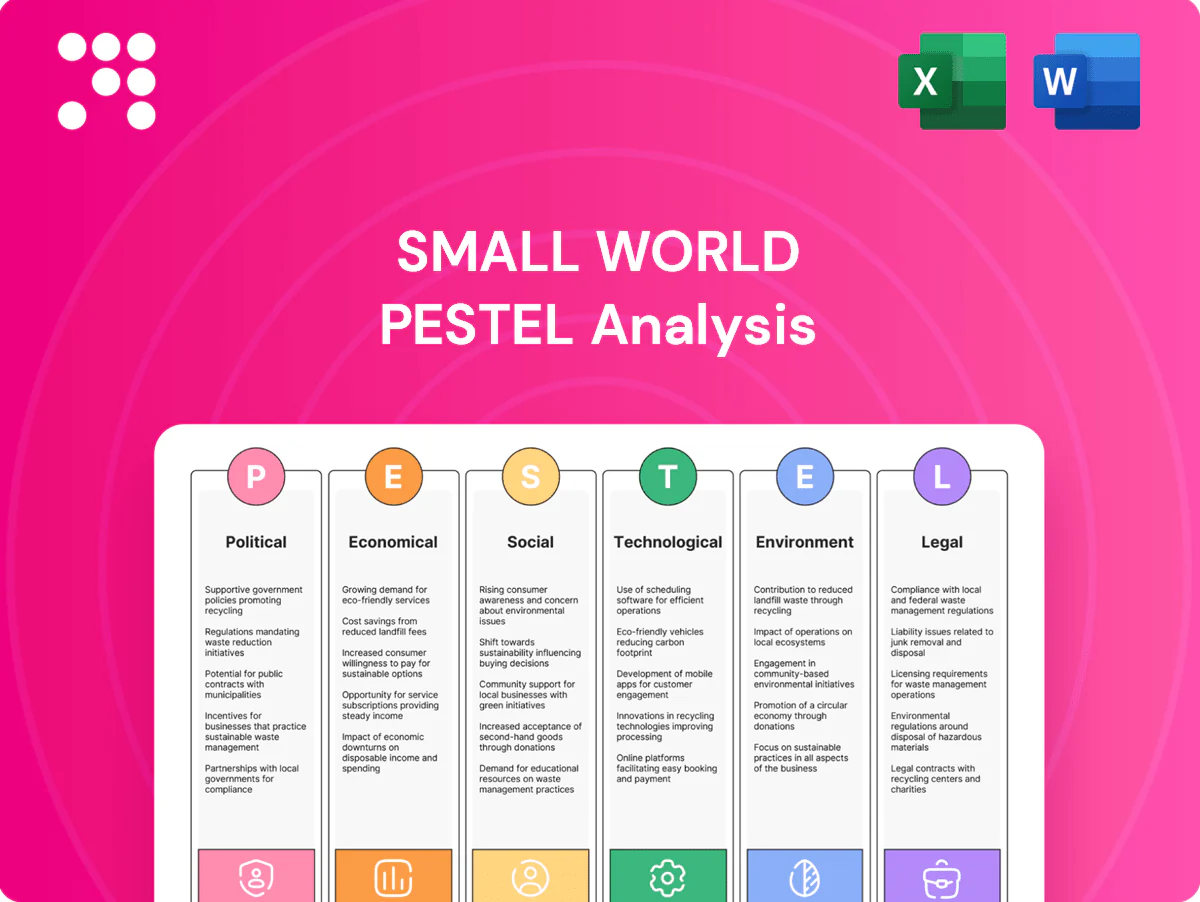
The preview shown here is the exact RENK PESTLE Analysis document you’ll receive after purchase—fully formatted and ready to use. It presents political, economic, social, technological, legal and environmental insights specific to RENK. No placeholders or teasers—this is the final, downloadable file you’ll get immediately after checkout.

Original: $10.00
-70%$10.00
$3.00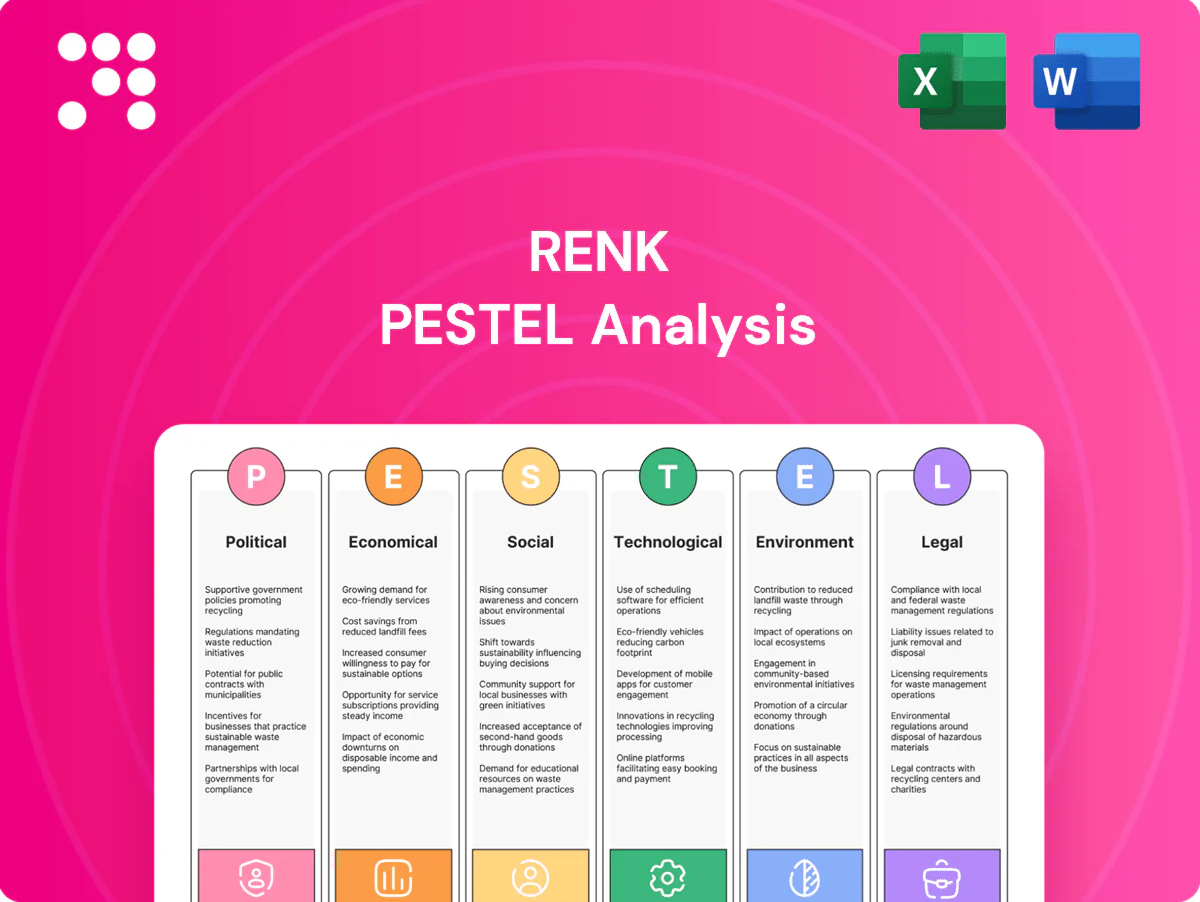
Description
Make Smarter Strategic Decisions with a Complete PESTEL View
Gain a competitive edge with our PESTLE Analysis tailored to RENK. Uncover how political, economic, social, technological, legal and environmental forces shape its strategy and risk profile. Ideal for investors, consultants and managers seeking actionable insights. Buy the full report for instant, editable access.
Political factors
Defense budgets and procurement
Defense expenditure cycles, with NATO collective spending topping $1.1 trillion in 2023, drive order volumes for RENK’s military gear and suspension systems and create multi-year procurement pipelines that improve revenue visibility.
These programs remain election- and coalition-sensitive, so RENK must align capture plans with national defense roadmaps and offset policies while diversifying across jurisdictions to cut single-country political risk.
Export controls and sanctions
Export controls such as ITAR (civil/criminal penalties up to $1,000,000 and 20 years imprisonment per violation) and EU Dual-Use Regulation (EU 2021/821) plus country-specific embargoes constrain RENK sales, parts and services across borders. Sanctions tied to geopolitical conflicts can abruptly close markets or suppliers, as seen since 2022. Robust screening and compliance-by-design for products and data flows are essential, while alternative sourcing and regionalization mitigate disruption.
Industrial policy and localization
Government incentives increasingly mandate local content and tech transfer—many major procurements set local content thresholds in the 30–50% range—pushing RENK toward joint ventures in defense and energy to qualify for tenders. Local assembly can unlock contracts but raises quality control and IP protection risks, and offsets frequently increase total landed cost by a material premium. RENK must balance offsets against control of critical know-how; strategic partnerships can accelerate market entry while meeting policy thresholds.
Infrastructure and energy security agendas
State priorities on grid resilience, naval fleets and critical industries are raising demand for high-reliability drives; procurement cycles now favor ruggedized propulsion and turbine retrofits. EU mechanisms such as the Recovery and Resilience Facility (€723.8bn) and REPowerEU (~€300bn investment plan) can catalyze large projects. Political shifts to energy independence accelerate turbine and marine-propulsion modernization; RENK must map policy timelines to bid pipelines.
- Policy drivers: grid resilience, defense, industrial security
- Funding: RRF €723.8bn; REPowerEU ~€300bn
- Opportunity: turbine/marine propulsion modernization
- Action: align product roadmap to national/EU timelines
Trade policy and tariffs
Tariff changes such as the US 25% steel tariffs under Section 232 (since 2018) and variable electronics duties materially alter RENK BOM and pricing for steel, precision components and electronics. Regional agreements like USMCA (effective 2020) and the EU single market streamline logistics for heavy equipment. CE marking and ISO/IEC certifications act as non-tariff barriers shaping market access. Proactive customs planning preserves margin and delivery reliability.
- Tariff impact: 25% US steel tariff
- Agreements: USMCA 2020, EU single market
- NTBs: CE marking, ISO/IEC certifications
Defense cycles, local-content and export controls shape multi-year systems demand
Defense spend cycles (NATO $1.1T in 2023) and state priorities (grid, naval, critical industries) drive multi-year demand for RENK systems; align capture plans to national roadmaps and offsets. Export controls (ITAR penalties up to $1,000,000/20 yrs) and sanctions constrain markets—robust compliance and regional sourcing are essential. Local-content rules (commonly 30–50%) and EU funds (RRF €723.8bn; REPowerEU ~€300bn) shape JV and localization choices.
| Driver | Key figure |
|---|---|
| NATO spend (2023) | $1.1T |
| ITAR penalty | $1,000,000 / 20 yrs |
| Local content | 30–50% |
| EU funds | RRF €723.8bn; REPowerEU ~€300bn |
| US steel tariff | 25% |
What is included in the product
Detailed Word Document
Explores how macro-environmental factors uniquely affect RENK across Political, Economic, Social, Technological, Environmental and Legal dimensions, with data-driven insights, region‑and‑industry specifics, forward‑looking scenario guidance and actionable findings to inform strategy, risk management and investor communications.
Customizable Excel Spreadsheet
A clean, summarized RENK PESTLE analysis visually segmented by PESTLE categories for quick interpretation and sharing, enabling teams to drop concise insights into presentations or planning sessions and add notes specific to their region or business line.
Economic factors
Capex cycles in end-markets
Marine, energy and industrial capex follow GDP cycles (IMF world growth ~3.0% in 2024) and commodity/financing swings (ECB policy rates ~4% in 2024), while defense is relatively counter‑cyclical—global military spending was $2.24 trillion in 2023 (SIPRI), stabilizing revenues. RENK should balance cyclical industrial exposure with resilient defense programs; order intake visibility depends on customer backlog and public funding approvals.
Input costs and supply chain inflation
Steel production reached about 1.9 billion tonnes in 2024 and the global semiconductor market was near US$600 billion, making steel, alloys, precision castings and semiconductors key drivers of input-cost volatility for RENK. Long-lead components force hedging and dual-sourcing to protect margins. Price-escalation clauses indexed to metals can offset inflationary spikes. Lean inventories boost cash efficiency but must be balanced against supply risk for strategic parts.
Currency and financing conditions
EUR/USD hovered near 1.09 and EUR/GBP around 0.86 in mid‑2025, creating translation risk that can swing reported revenues and export competitiveness for RENK by several percentage points. Higher global rates (ECB ~4.0%, Fed ~5.25%) push customer WACC up 100–200 bps, delaying capex for large gear and turret orders. RENK can deploy natural hedges and forward contracts to stabilize cash flows, while vendor financing or pay‑per‑use service models can unlock hesitant buyers.
Aftermarket and services resilience
Aftermarket sales—spare parts, refurbishments and long-term service agreements—generate steady recurring revenue for RENK and dampen cycle volatility as maintenance spend is counter-cyclical; data-driven service contracts improve uptime and expand share-of-wallet while OEM-specific parts grant clear pricing power with a growing installed base.
- Spare parts
- Refurbishments
- LT service agreements
- Data-driven uptime
- OEM pricing power
Emerging market growth
Industrialization and naval modernization across Asia, the Middle East and LATAM are expanding RENKs addressable market; IMF projected emerging market and developing economies growth at about 4.3% in 2024, supporting higher defense and maritime capex.
Country risk and extended payment terms mean deals often require export credit, sovereign guarantees or project finance; World Bank/IFC estimates trade and working capital gaps in EMs remain in the hundreds of billions, raising financing complexity.
Localization and local content programs—over 30 countries maintain defense offset or local procurement rules—can raise win rates and lower operating costs; portfolio decisions should align with regional sector priorities (shipyards, land systems, powertrain).
- Market growth: IMF EMDE growth ~4.3% (2024)
- Financing pressure: trade/working capital gaps remain large (World Bank/IFC)
- Policy: 30+ countries enforce offsets/local content
- Strategy: match portfolio to regional shipbuilding and land-systems demand
Defense cycles, local-content and export controls shape multi-year systems demand
RENK faces cyclical industrial demand (IMF global GDP ~3.0% in 2024) and counter‑cyclical defense (global military spend $2.24tn in 2023), input cost volatility (steel ~1.9bn t, semiconductors ~$600bn) and FX/WACC pressures (EUR/USD ~1.09 mid‑2025; ECB ~4.0%, Fed ~5.25%), while aftermarket and localization provide resilient revenue and win-rate advantages.
| Metric | Value |
|---|---|
| Global GDP 2024 | ~3.0% |
| Military spend 2023 | $2.24tn |
| Steel 2024 | ~1.9bn t |
| Semiconductors | ~$600bn |
| EUR/USD mid‑2025 | ~1.09 |
Preview Before You Purchase
RENK PESTLE Analysis
The preview shown here is the exact RENK PESTLE Analysis document you’ll receive after purchase—fully formatted and ready to use. It presents political, economic, social, technological, legal and environmental insights specific to RENK. No placeholders or teasers—this is the final, downloadable file you’ll get immediately after checkout.