Small World PESTLE Analysis

Skip the Research. Get the Strategy.
Uncover the critical external factors shaping Small World's trajectory with our comprehensive PESTLE analysis. Understand the political, economic, social, technological, legal, and environmental forces at play, empowering you to anticipate challenges and seize opportunities. Download the full report now to gain actionable intelligence and refine your strategic approach.
Political factors

Government Policies on Remittances
Government policies in both sending and receiving nations profoundly shape Small World Financial Services' operational landscape. Regulations can dictate the cost, speed, and legitimacy of money transfers, as governments often aim to manage capital flows or promote formal remittance channels. For instance, the World Bank reported that in 2023, global remittance flows reached an estimated $831 billion, highlighting the significant economic impact of these transactions and the potential for government intervention.
Shifts in these policies, such as the introduction of new remittance taxes or incentives for digital transfers, directly influence the company's business model and profitability. Countries like the Philippines, a major recipient of remittances, have implemented policies to encourage digital platforms, potentially benefiting companies like Small World. Conversely, stricter anti-money laundering (AML) regulations in sending countries can increase compliance costs and operational complexity.
International Relations and Sanctions
Geopolitical stability is a major concern for Small World, as international relations directly impact cross-border money transfers. Political tensions and trade disputes can disrupt remittance flows, and international sanctions against specific countries or entities can outright prohibit transactions. For example, sanctions imposed by the US and EU on Russia following the 2022 invasion of Ukraine significantly curtailed the operations of many financial service providers, including remittance companies, impacting their ability to serve customers in those regions.

Anti-Money Laundering (AML) and Counter-Terrorist Financing (CTF) Regulations
Global and national Anti-Money Laundering (AML) and Counter-Terrorist Financing (CTF) regulations are critical political considerations for Small World. These stringent rules necessitate substantial investment in compliance infrastructure and ongoing process enhancements. For instance, the FATF's updated recommendations, implemented throughout 2024, place increased scrutiny on beneficial ownership transparency and digital asset regulations, impacting remittance services directly.
Failure to adhere to these evolving standards, such as the upcoming EU AML Package 7 slated for late 2024, can lead to severe financial penalties, significant reputational harm, and even the revocation of operating licenses. Small World must remain agile, continuously updating its systems and employee training to align with directives from bodies like the FATF and regional regulators to avoid such repercussions.

Data Privacy Regulations
The intensifying global focus on data privacy, underscored by regulations like the EU's General Data Protection Regulation (GDPR) and a growing patchwork of US state laws such as California's CCPA/CPRA, directly impacts how Small World manages customer data. This necessitates stringent adherence to varying legal frameworks, particularly concerning secure cross-border data transfers and comprehensive data protection protocols.
Failure to comply with these evolving data privacy mandates carries significant risks. For instance, GDPR penalties can reach up to 4% of global annual revenue or €20 million, whichever is higher. Beyond financial penalties, breaches of data privacy can severely damage customer trust and brand reputation, making robust data governance a paramount political and legal consideration for Small World's operations.
Key compliance considerations for Small World include:
- Data Minimization: Collecting only necessary customer information.
- Consent Management: Ensuring clear and informed consent for data usage.
- Cross-Border Data Transfer Mechanisms: Implementing approved methods for international data movement.
- Data Breach Notification: Establishing protocols for timely reporting of security incidents.
Financial Services Liberalization and Cross-Border Agreements
Political drives toward financial liberalization and cross-border payment accords present significant opportunities for Small World. These initiatives can simplify international transactions, reduce regulatory hurdles, and boost interoperability across payment systems. For instance, the European Union's Payment Services Directive 2 (PSD2) has already fostered greater competition and innovation in financial services, potentially benefiting companies like Small World by opening up new avenues for partnerships and service integration.
Such agreements can lead to lower transaction costs and broader market access, crucial for a company like Small World aiming for global reach. By streamlining regulations, governments can encourage the flow of capital and services, making it easier for fintech companies to operate across different jurisdictions. The trend towards open banking, a key component of liberalization, encourages data sharing and collaboration, which can be leveraged by Small World to enhance its offerings.
- Increased Market Access: Liberalization policies can reduce barriers to entry in new international markets, allowing Small World to expand its customer base.
- Reduced Operational Costs: Streamlined regulations and cross-border agreements can lower compliance costs and transaction fees.
- Enhanced Interoperability: Agreements promoting interoperability between payment systems can simplify international money transfers for Small World's users.
- Potential for Protectionism: Conversely, protectionist policies could create obstacles, increasing operational complexity and limiting growth opportunities for Small World.
Government Policies Shape Global Payment Operations
Government policies directly influence Small World's operations, impacting everything from transaction costs to market access. Stricter Anti-Money Laundering (AML) and Counter-Terrorist Financing (CTF) regulations, like those updated by the FATF in 2024, increase compliance burdens. Conversely, financial liberalization and cross-border payment accords, such as the EU's PSD2, can simplify operations and expand market reach.
What is included in the product
 Detailed Word Document
The Small World PESTLE Analysis meticulously examines the Political, Economic, Social, Technological, Environmental, and Legal forces impacting the business, offering a comprehensive understanding of the external landscape.
This analysis provides actionable insights and data-driven recommendations to help navigate challenges and capitalize on emerging opportunities within the Small World's operating environment.

 Customizable Excel Spreadsheet
The Small World PESTLE Analysis offers a clean, summarized version of the full analysis for easy referencing during meetings or presentations, saving valuable time and reducing the stress of data overload.
Economic factors

Global Economic Growth and Recession
Global economic growth significantly impacts remittance flows. For instance, the International Monetary Fund (IMF) projected global growth at 3.2% for 2024, a slight slowdown from 2023's 3.1%. Stronger economies in host countries typically mean more job opportunities and higher incomes for migrant workers, thereby increasing the volume of remittances processed by services like Small World.
Conversely, economic downturns can dampen remittance activity. A recession in a major remittance-sending country can lead to job losses or wage cuts for migrant workers, directly reducing the amount of money they can send home. This was evident in 2020 when the COVID-19 pandemic caused a global economic shock, leading to a temporary dip in remittance flows before they began to recover.
Exchange Rate Fluctuations
Exchange rate fluctuations present a dual-edged sword for Small World. For instance, a strengthening US dollar against the Philippine peso in early 2024 could make remittances to the Philippines more attractive for senders in the US, potentially boosting transaction volumes. However, if the dollar weakens significantly, the same amount sent might buy less in the Philippines, impacting the recipient's purchasing power and potentially discouraging future remittances.
Managing these currency shifts is crucial. In 2023, many remittance providers faced challenges due to volatility in emerging market currencies, impacting their margins. Small World needs to offer competitive exchange rates, perhaps through dynamic pricing or hedging strategies, to maintain customer loyalty and market share amidst these unpredictable economic winds.

Inflation Rates and Purchasing Power
High inflation rates in receiving countries directly impact the effectiveness of remittances. For instance, if inflation in a recipient country like the Philippines reaches 5.5% in early 2024, the purchasing power of a $100 remittance is effectively reduced, requiring senders to transfer more money to maintain the same living standard for their families.
Conversely, inflation in sending countries, such as the UK where inflation was 3.4% in April 2024, can decrease the real value of earnings for migrants. This erosion of purchasing power might limit their capacity to send remittances, potentially affecting the total volume of funds transferred by companies like Small World.
Small World's fee structure needs to be agile, accounting for these fluctuating inflation rates across different corridors to remain competitive and ensure value for both senders and receivers. Adapting pricing in response to a 4.9% inflation rate in the US or 3.7% in the Eurozone during mid-2024 is crucial for sustained business operations.

Unemployment Rates in Sending and Receiving Countries
Unemployment rates significantly influence remittance flows, acting as a crucial economic indicator for businesses like Small World. When unemployment is high in a migrant's host country, their ability to earn and send money home can be directly impacted, potentially reducing remittance volumes. Conversely, elevated unemployment in a migrant's home country often heightens the need for financial support from family members working abroad, potentially increasing remittance demand.
For instance, as of early 2024, the unemployment rate in the United States hovered around 3.9%, while the Eurozone's rate was approximately 6.0%. In contrast, many countries that are major recipients of remittances, such as the Philippines, have seen their unemployment rates significantly lower, around 4.0% in late 2023. This dynamic highlights how labor market conditions in both sending and receiving nations shape remittance patterns.
- Host Country Impact: Higher unemployment in countries where migrants work directly curtails their earning potential, thus limiting the amount they can remit.
- Origin Country Impact: Increased unemployment in remittance-receiving countries often boosts the reliance on funds sent from abroad, thereby increasing the demand for remittance services.
- 2024/2025 Outlook: Projections for 2024 and 2025 suggest continued labor market resilience in many developed economies, though geopolitical factors could introduce volatility.
- Small World's Reliance: The stability of employment for Small World's customer base is paramount, making unemployment data a critical factor in business planning and risk assessment.
Cost of Living and Income Disparities
Significant differences in the cost of living and income levels globally are major forces behind migration patterns and the subsequent flow of remittances. For instance, in 2024, the average monthly disposable income in countries like Switzerland, a major remittance-sending nation, can be over $4,000 USD, starkly contrasting with many developing nations where it might be under $500 USD.
Migrants frequently send funds back to support family members who are dealing with lower incomes and elevated living expenses in their home countries. This economic reality makes services like Small World essential, acting as a crucial conduit for financial assistance that bridges these international economic divides.
- Global Income Gap: In 2024, the World Bank reported that the average income in high-income countries was approximately 30 times higher than in low-income countries, driving migration for economic betterment.
- Remittance Importance: Remittances accounted for over 10% of GDP in several developing economies in 2023, highlighting their critical role in household income and economic stability.
- Cost of Living Variance: The cost of essential goods and services can vary by hundreds of percentage points between countries, making cross-border financial support a necessity for many families.
Economic Stability and Volatility: Key to Remittance Flows
Economic stability in both sending and receiving countries is paramount for remittance flows. For example, the IMF's projection of 3.2% global growth for 2024 suggests a generally supportive environment for migrant workers' earnings and their ability to send money home. However, localized economic downturns or high inflation, like the 5.5% inflation seen in the Philippines in early 2024, can significantly diminish the real value of remittances, impacting recipients' purchasing power.
Exchange rate volatility, such as a strengthening USD against emerging market currencies in 2023, can create opportunities but also risks for remittance providers like Small World, necessitating agile pricing strategies. Similarly, unemployment rates, hovering around 3.9% in the US and 6.0% in the Eurozone in early 2024, directly influence the disposable income available for remittances, while lower unemployment in recipient nations, like the Philippines' 4.0% in late 2023, can increase the need for such support.
| Economic Factor | 2024/2025 Data Point | Impact on Remittances |
|---|---|---|
| Global Growth Projection | IMF: 3.2% (2024) | Supports higher earning potential for migrants. |
| Inflation Rate (Recipient Country Example) | Philippines: ~5.5% (early 2024) | Reduces purchasing power of received funds. |
| Unemployment Rate (Sending Country Example) | US: ~3.9% (early 2024) | Influences disposable income for sending. |
| Unemployment Rate (Receiving Country Example) | Philippines: ~4.0% (late 2023) | Can increase demand for remittances. |
| Income Disparity | High-income countries avg. income 30x low-income countries (World Bank, 2024) | Drives migration and sustained remittance flows. |
Preview Before You Purchase
Small World PESTLE Analysis
The preview you see here is the exact Small World PESTLE Analysis document you’ll receive after purchase—fully formatted and ready to use.
This is a real screenshot of the product you’re buying—delivered exactly as shown, no surprises, providing a comprehensive overview of the Political, Economic, Social, Technological, Legal, and Environmental factors impacting Small World.
The content and structure shown in the preview is the same document you’ll download after payment, offering actionable insights for strategic planning.

Original: $10.00
-70%$10.00
$3.00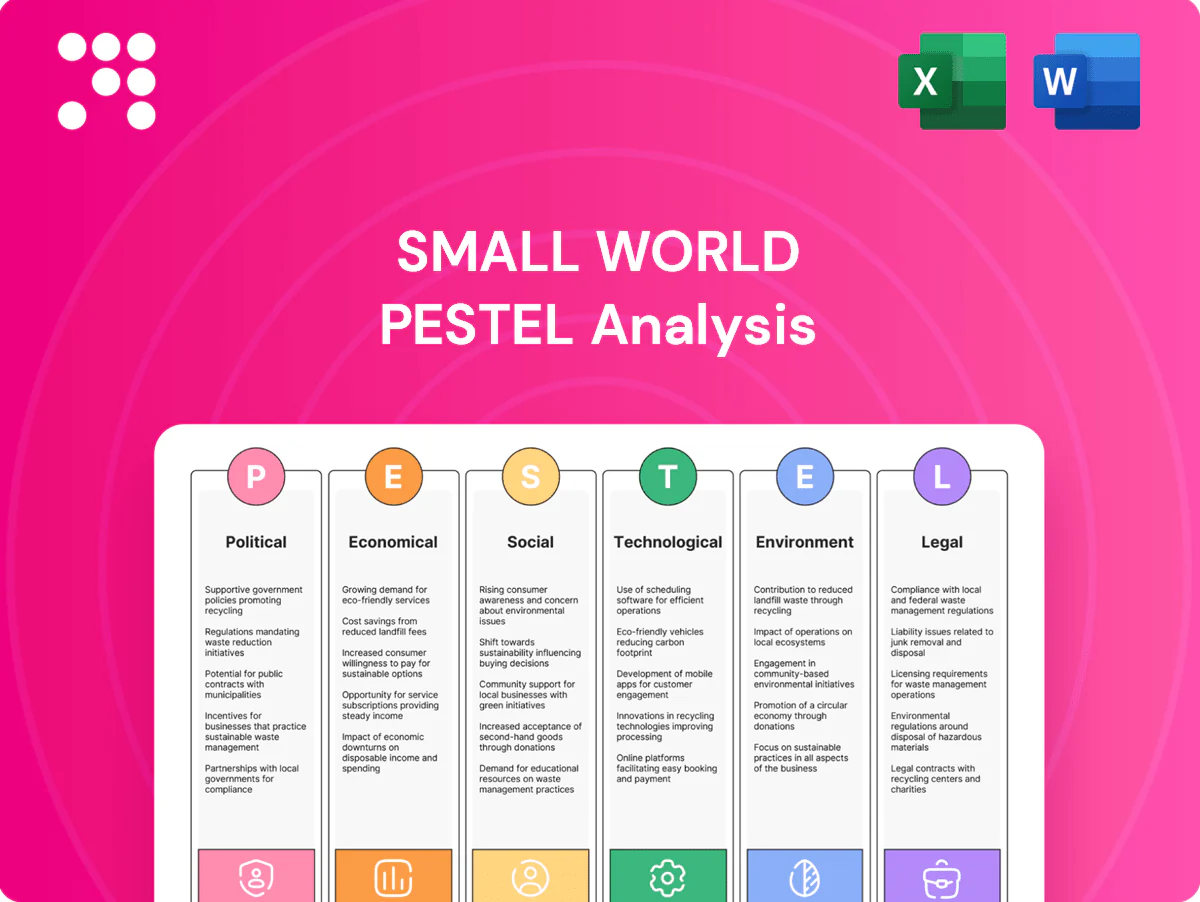
Description
Skip the Research. Get the Strategy.
Uncover the critical external factors shaping Small World's trajectory with our comprehensive PESTLE analysis. Understand the political, economic, social, technological, legal, and environmental forces at play, empowering you to anticipate challenges and seize opportunities. Download the full report now to gain actionable intelligence and refine your strategic approach.
Political factors
Government Policies on Remittances
Government policies in both sending and receiving nations profoundly shape Small World Financial Services' operational landscape. Regulations can dictate the cost, speed, and legitimacy of money transfers, as governments often aim to manage capital flows or promote formal remittance channels. For instance, the World Bank reported that in 2023, global remittance flows reached an estimated $831 billion, highlighting the significant economic impact of these transactions and the potential for government intervention.
Shifts in these policies, such as the introduction of new remittance taxes or incentives for digital transfers, directly influence the company's business model and profitability. Countries like the Philippines, a major recipient of remittances, have implemented policies to encourage digital platforms, potentially benefiting companies like Small World. Conversely, stricter anti-money laundering (AML) regulations in sending countries can increase compliance costs and operational complexity.
International Relations and Sanctions
Geopolitical stability is a major concern for Small World, as international relations directly impact cross-border money transfers. Political tensions and trade disputes can disrupt remittance flows, and international sanctions against specific countries or entities can outright prohibit transactions. For example, sanctions imposed by the US and EU on Russia following the 2022 invasion of Ukraine significantly curtailed the operations of many financial service providers, including remittance companies, impacting their ability to serve customers in those regions.
Anti-Money Laundering (AML) and Counter-Terrorist Financing (CTF) Regulations
Global and national Anti-Money Laundering (AML) and Counter-Terrorist Financing (CTF) regulations are critical political considerations for Small World. These stringent rules necessitate substantial investment in compliance infrastructure and ongoing process enhancements. For instance, the FATF's updated recommendations, implemented throughout 2024, place increased scrutiny on beneficial ownership transparency and digital asset regulations, impacting remittance services directly.
Failure to adhere to these evolving standards, such as the upcoming EU AML Package 7 slated for late 2024, can lead to severe financial penalties, significant reputational harm, and even the revocation of operating licenses. Small World must remain agile, continuously updating its systems and employee training to align with directives from bodies like the FATF and regional regulators to avoid such repercussions.
Data Privacy Regulations
The intensifying global focus on data privacy, underscored by regulations like the EU's General Data Protection Regulation (GDPR) and a growing patchwork of US state laws such as California's CCPA/CPRA, directly impacts how Small World manages customer data. This necessitates stringent adherence to varying legal frameworks, particularly concerning secure cross-border data transfers and comprehensive data protection protocols.
Failure to comply with these evolving data privacy mandates carries significant risks. For instance, GDPR penalties can reach up to 4% of global annual revenue or €20 million, whichever is higher. Beyond financial penalties, breaches of data privacy can severely damage customer trust and brand reputation, making robust data governance a paramount political and legal consideration for Small World's operations.
Key compliance considerations for Small World include:
- Data Minimization: Collecting only necessary customer information.
- Consent Management: Ensuring clear and informed consent for data usage.
- Cross-Border Data Transfer Mechanisms: Implementing approved methods for international data movement.
- Data Breach Notification: Establishing protocols for timely reporting of security incidents.
Financial Services Liberalization and Cross-Border Agreements
Political drives toward financial liberalization and cross-border payment accords present significant opportunities for Small World. These initiatives can simplify international transactions, reduce regulatory hurdles, and boost interoperability across payment systems. For instance, the European Union's Payment Services Directive 2 (PSD2) has already fostered greater competition and innovation in financial services, potentially benefiting companies like Small World by opening up new avenues for partnerships and service integration.
Such agreements can lead to lower transaction costs and broader market access, crucial for a company like Small World aiming for global reach. By streamlining regulations, governments can encourage the flow of capital and services, making it easier for fintech companies to operate across different jurisdictions. The trend towards open banking, a key component of liberalization, encourages data sharing and collaboration, which can be leveraged by Small World to enhance its offerings.
- Increased Market Access: Liberalization policies can reduce barriers to entry in new international markets, allowing Small World to expand its customer base.
- Reduced Operational Costs: Streamlined regulations and cross-border agreements can lower compliance costs and transaction fees.
- Enhanced Interoperability: Agreements promoting interoperability between payment systems can simplify international money transfers for Small World's users.
- Potential for Protectionism: Conversely, protectionist policies could create obstacles, increasing operational complexity and limiting growth opportunities for Small World.
Government Policies Shape Global Payment Operations
Government policies directly influence Small World's operations, impacting everything from transaction costs to market access. Stricter Anti-Money Laundering (AML) and Counter-Terrorist Financing (CTF) regulations, like those updated by the FATF in 2024, increase compliance burdens. Conversely, financial liberalization and cross-border payment accords, such as the EU's PSD2, can simplify operations and expand market reach.
What is included in the product
Detailed Word Document
The Small World PESTLE Analysis meticulously examines the Political, Economic, Social, Technological, Environmental, and Legal forces impacting the business, offering a comprehensive understanding of the external landscape.
This analysis provides actionable insights and data-driven recommendations to help navigate challenges and capitalize on emerging opportunities within the Small World's operating environment.
Customizable Excel Spreadsheet
The Small World PESTLE Analysis offers a clean, summarized version of the full analysis for easy referencing during meetings or presentations, saving valuable time and reducing the stress of data overload.
Economic factors
Global Economic Growth and Recession
Global economic growth significantly impacts remittance flows. For instance, the International Monetary Fund (IMF) projected global growth at 3.2% for 2024, a slight slowdown from 2023's 3.1%. Stronger economies in host countries typically mean more job opportunities and higher incomes for migrant workers, thereby increasing the volume of remittances processed by services like Small World.
Conversely, economic downturns can dampen remittance activity. A recession in a major remittance-sending country can lead to job losses or wage cuts for migrant workers, directly reducing the amount of money they can send home. This was evident in 2020 when the COVID-19 pandemic caused a global economic shock, leading to a temporary dip in remittance flows before they began to recover.
Exchange Rate Fluctuations
Exchange rate fluctuations present a dual-edged sword for Small World. For instance, a strengthening US dollar against the Philippine peso in early 2024 could make remittances to the Philippines more attractive for senders in the US, potentially boosting transaction volumes. However, if the dollar weakens significantly, the same amount sent might buy less in the Philippines, impacting the recipient's purchasing power and potentially discouraging future remittances.
Managing these currency shifts is crucial. In 2023, many remittance providers faced challenges due to volatility in emerging market currencies, impacting their margins. Small World needs to offer competitive exchange rates, perhaps through dynamic pricing or hedging strategies, to maintain customer loyalty and market share amidst these unpredictable economic winds.
Inflation Rates and Purchasing Power
High inflation rates in receiving countries directly impact the effectiveness of remittances. For instance, if inflation in a recipient country like the Philippines reaches 5.5% in early 2024, the purchasing power of a $100 remittance is effectively reduced, requiring senders to transfer more money to maintain the same living standard for their families.
Conversely, inflation in sending countries, such as the UK where inflation was 3.4% in April 2024, can decrease the real value of earnings for migrants. This erosion of purchasing power might limit their capacity to send remittances, potentially affecting the total volume of funds transferred by companies like Small World.
Small World's fee structure needs to be agile, accounting for these fluctuating inflation rates across different corridors to remain competitive and ensure value for both senders and receivers. Adapting pricing in response to a 4.9% inflation rate in the US or 3.7% in the Eurozone during mid-2024 is crucial for sustained business operations.
Unemployment Rates in Sending and Receiving Countries
Unemployment rates significantly influence remittance flows, acting as a crucial economic indicator for businesses like Small World. When unemployment is high in a migrant's host country, their ability to earn and send money home can be directly impacted, potentially reducing remittance volumes. Conversely, elevated unemployment in a migrant's home country often heightens the need for financial support from family members working abroad, potentially increasing remittance demand.
For instance, as of early 2024, the unemployment rate in the United States hovered around 3.9%, while the Eurozone's rate was approximately 6.0%. In contrast, many countries that are major recipients of remittances, such as the Philippines, have seen their unemployment rates significantly lower, around 4.0% in late 2023. This dynamic highlights how labor market conditions in both sending and receiving nations shape remittance patterns.
- Host Country Impact: Higher unemployment in countries where migrants work directly curtails their earning potential, thus limiting the amount they can remit.
- Origin Country Impact: Increased unemployment in remittance-receiving countries often boosts the reliance on funds sent from abroad, thereby increasing the demand for remittance services.
- 2024/2025 Outlook: Projections for 2024 and 2025 suggest continued labor market resilience in many developed economies, though geopolitical factors could introduce volatility.
- Small World's Reliance: The stability of employment for Small World's customer base is paramount, making unemployment data a critical factor in business planning and risk assessment.
Cost of Living and Income Disparities
Significant differences in the cost of living and income levels globally are major forces behind migration patterns and the subsequent flow of remittances. For instance, in 2024, the average monthly disposable income in countries like Switzerland, a major remittance-sending nation, can be over $4,000 USD, starkly contrasting with many developing nations where it might be under $500 USD.
Migrants frequently send funds back to support family members who are dealing with lower incomes and elevated living expenses in their home countries. This economic reality makes services like Small World essential, acting as a crucial conduit for financial assistance that bridges these international economic divides.
- Global Income Gap: In 2024, the World Bank reported that the average income in high-income countries was approximately 30 times higher than in low-income countries, driving migration for economic betterment.
- Remittance Importance: Remittances accounted for over 10% of GDP in several developing economies in 2023, highlighting their critical role in household income and economic stability.
- Cost of Living Variance: The cost of essential goods and services can vary by hundreds of percentage points between countries, making cross-border financial support a necessity for many families.
Economic Stability and Volatility: Key to Remittance Flows
Economic stability in both sending and receiving countries is paramount for remittance flows. For example, the IMF's projection of 3.2% global growth for 2024 suggests a generally supportive environment for migrant workers' earnings and their ability to send money home. However, localized economic downturns or high inflation, like the 5.5% inflation seen in the Philippines in early 2024, can significantly diminish the real value of remittances, impacting recipients' purchasing power.
Exchange rate volatility, such as a strengthening USD against emerging market currencies in 2023, can create opportunities but also risks for remittance providers like Small World, necessitating agile pricing strategies. Similarly, unemployment rates, hovering around 3.9% in the US and 6.0% in the Eurozone in early 2024, directly influence the disposable income available for remittances, while lower unemployment in recipient nations, like the Philippines' 4.0% in late 2023, can increase the need for such support.
| Economic Factor | 2024/2025 Data Point | Impact on Remittances |
|---|---|---|
| Global Growth Projection | IMF: 3.2% (2024) | Supports higher earning potential for migrants. |
| Inflation Rate (Recipient Country Example) | Philippines: ~5.5% (early 2024) | Reduces purchasing power of received funds. |
| Unemployment Rate (Sending Country Example) | US: ~3.9% (early 2024) | Influences disposable income for sending. |
| Unemployment Rate (Receiving Country Example) | Philippines: ~4.0% (late 2023) | Can increase demand for remittances. |
| Income Disparity | High-income countries avg. income 30x low-income countries (World Bank, 2024) | Drives migration and sustained remittance flows. |
Preview Before You Purchase
Small World PESTLE Analysis
The preview you see here is the exact Small World PESTLE Analysis document you’ll receive after purchase—fully formatted and ready to use.
This is a real screenshot of the product you’re buying—delivered exactly as shown, no surprises, providing a comprehensive overview of the Political, Economic, Social, Technological, Legal, and Environmental factors impacting Small World.
The content and structure shown in the preview is the same document you’ll download after payment, offering actionable insights for strategic planning.